Poison dart frogDendrobatidae — habitat, diet and reproduction
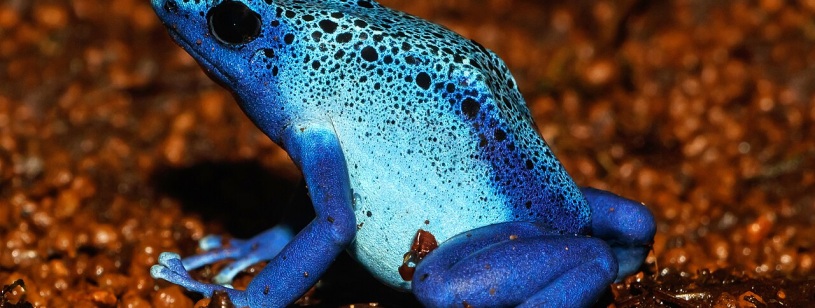
Blue poison dart frog (Dendrobates tinctorius). · H. Zell / CC BY-SA 3.0 (https://creativecommons.org/licenses/by-sa/3.0). Cropped and resized.
Poison dart frogs are small frogs from the tropical forests of Central and South America. Their bright blue, yellow, red or green colours warn predators. Some species carry very powerful poisons in their skin, once used by some indigenous peoples to tip darts.
Quick facts
| Common name | Poison dart frog |
| Scientific name | Dendrobatidae (family) |
| Lifespan | About 1–3 years in the wild; longer in captivity |
| Length | About 1.5–6 cm, depending on species |
| Diet | Carnivore: ants, termites, mites, small insects |
| Predators | Few; some snakes resist their poison |
| Conservation status | Varies: many species are Least Concern, others endangered |
| Distribution | Central America and northern South America |
| Habitat | Floor and understorey of humid tropical forests |
| Family | Dendrobatidae |
| Reproduction | Eggs on land; tadpoles carried to water |
Interesting facts
- The golden poison frog (Phyllobates terribilis) is considered one of the most toxic animals on Earth.
- The poison comes from food, especially ants and mites; frogs raised in terrariums are not toxic.
- Parents carry tadpoles on their backs to tiny pools in plants.
- Only three Phyllobates species were used to poison hunting darts.
Characteristics
Poison dart frogs are small, usually a few centimetres long, with smooth, shiny skin. Colours vary hugely, even within one species: deep blue, yellow, red, orange or green with black.
This warning colouration is called aposematism. A predator that tries a toxic frog once learns to avoid those colours.
Behaviour
Unlike many frogs, they are active by day and may sit openly on leaves because few predators dare attack them.
Males defend territories and call with trills or chirps. In some species males wrestle, while in others females compete for males.
Habitat and distribution
The family ranges from Nicaragua and Costa Rica to Brazil and Bolivia. Most species live in humid tropical forest, from lowlands to the slopes of the Andes.
They use the forest floor, shrub foliage and water-holding plants such as bromeliads.
Diet and feeding
Their food is ants, termites, mites, small beetles and other tiny invertebrates.
The frogs do not make their toxins from scratch. They come from alkaloids in these insects and mites, stored in skin glands. That is why frogs fed fruit flies or crickets in captivity lose their toxicity.
Reproduction and life cycle
Eggs are laid on land in damp leaf litter. One parent, often the male, guards and moistens them.
After hatching, tadpoles wriggle onto the parent’s back and are carried to small pools, for example in bromeliad leaves. In some species the female returns to lay unfertilised eggs that feed the tadpoles.
Name and history
The name “dart frog” comes from the Emberá and Noanamá peoples of Colombia, who rubbed blowgun dart tips on the skin of certain Phyllobates species.
The golden poison frog contains batrachotoxin, which blocks nerve and muscle function. A single frog carries enough poison to kill several people.
Conservation and threats
Conservation status varies by species. Many are still widespread, but others, such as the golden poison frog, are Endangered.
Main threats include deforestation, the fungal disease chytridiomycosis, which has killed amphibians worldwide, and collection for the pet trade. Many terrarium frogs are captive-bred, reducing pressure on wild populations.
Frequently asked questions
Why are poison dart frogs poisonous?
Their poison comes from the ants and mites they eat. The frog stores these substances in its skin as a defence.
Are terrarium dart frogs dangerous?
Usually not. Captive-bred frogs fed other food do not build up toxins.
Which is the most poisonous frog?
The golden poison frog (Phyllobates terribilis) of Colombia.
Why are they so brightly coloured?
The colours warn predators that the frog is toxic and not worth attacking.