PenguinInteresting facts and information
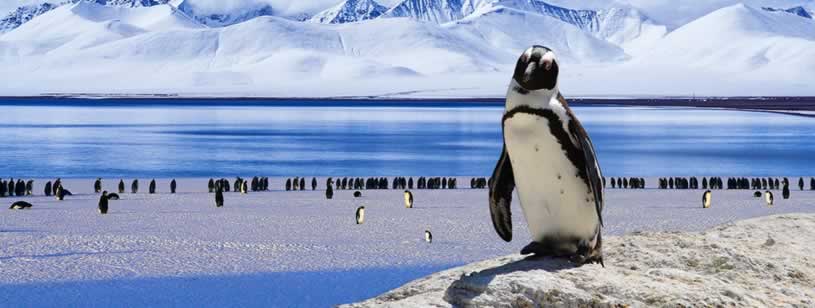
Penguins (Spheniscidae) are flightless birds adapted to swimming. Their wings work as flippers underwater. They live mainly in the Southern Hemisphere, with species living in climates from Antarctica to much warmer coasts.
With their streamlined bodies and wings turned into flippers, penguins are excellent swimmers and reach impressive speeds in the water. On land, by contrast, they waddle or slide on their bellies. Because of climate change and overfishing, several penguin species are now in danger, and conservation efforts are essential to protect them.
Quick facts
| Common name | Penguin |
| Scientific name | Spheniscidae |
| Typical lifespan | About 15-25 years, depending on species |
| Maximum swimming speed | About 25-35 km/h (the Gentoo penguin is the fastest) |
| Height | About 30 cm - 1.2 m (depending on species) |
| Weight | About 1-40 kg (depending on species) |
| Diet type | Carnivore (fish, crustaceans, squid) |
| Main predators | Leopard seals, orcas, sharks; gulls and skuas take eggs and chicks |
| Conservation status | Varies by species; some are Endangered |
| Distribution | Southern Hemisphere: Antarctica, South America, southern Africa, Australia, New Zealand, sub-Antarctic islands and the Galápagos |
| Living environment | Polar regions, cold coastal waters, remote islands |
- Primary category:Flightless birds
- Explore this animal's categories:
Interesting facts
- Their wings are built for swimming, not flying - Penguins have turned their wings into stiff, powerful flippers that "fly" them through the water.
- They can drink seawater - A special gland above the eyes removes extra salt from the blood, so penguins can drink seawater safely.
- Incredible resistance to cold - Emperor penguins survive temperatures of around -60°C, thanks to their dense feathers, a layer of fat and huddling together.
- Huge colonies - Zavodovski Island, in the South Atlantic, is home to one of the largest penguin colonies in the world, with around a million chinstrap penguins.
- Recognising voices - Penguins use calls to find their partners and chicks among thousands of other birds.
- The "no knees" idea is a myth - Penguins do have knees, but they are hidden under feathers and fat.
- Pebble gifts - In some species, such as Gentoo and Adélie penguins, males offer pebbles to females, which are used to build the nest.
- The fastest penguin - The Gentoo penguin is the fastest swimmer among penguins, reaching about 35 km/h.
Records and remarkable features
- Penguins (Spheniscidae) are flightless birds adapted to swimming. Their wings work as flippers underwater. They live mainly in the Southern Hemisphere, with species living in climates from Antarctica to much warmer coasts.
Physical characteristics and adaptations
Penguins have evolved to live in cold water, with special features that help them swim fast and survive extreme temperatures.
Key physical adaptations
- A streamlined body - Their torpedo shape reduces water resistance, so they swim efficiently.
- Wings turned into flippers - Stiff, flat wings and strong muscles act like paddles, driving penguins through the water.
- Waterproof feathers - Penguins have very dense, overlapping feathers that keep water out.
- A layer of fat - Helps keep them warm, especially in species that live in Antarctica.
- A salt gland - Penguins can drink seawater, because a gland above their eyes removes the extra salt.
- Short legs and strong claws - Give them grip on ice and help them climb rocky ground.
- Excellent underwater vision - Penguins' eyes are adapted to see clearly underwater, so they can spot prey easily.
Habits and behaviour
Penguins are extremely social birds that live in large colonies, which help protect them from predators and the cold.
How they move
- Fast, agile swimming - Penguins use their flippers to "fly" through the water.
- Waddling - On land, their short legs make them waddle.
- Tobogganing - On ice and snow, penguins often slide on their bellies to move faster.
Social behaviour
- Working together to survive - Emperor penguins huddle tightly together to keep warm during the Antarctic winter.
- Faithful partners - Many species form pairs, and some return to the same partner year after year.
- Voice recognition - Each penguin has a distinctive call that helps partners and chicks find each other in crowded colonies.
Defence strategies
- Safety in numbers - Penguins often enter and leave the water in groups to reduce the risk of being caught by predators such as leopard seals or orcas.
- Camouflage - Their black-and-white colouring helps them hide: seen from below, the white belly blends with the bright surface, and seen from above, the dark back blends with the deep water.
Habitat and geographic distribution
Penguins live almost exclusively in the Southern Hemisphere, in places ranging from frozen Antarctica to the tropical Galápagos Islands.
Species distribution
| Region | Example species |
|---|---|
| Antarctica | Emperor penguin, Adélie penguin |
| South America | Magellanic penguin, Humboldt penguin |
| Southern Africa | African penguin |
| Australia and New Zealand | Little penguin, yellow-eyed penguin, crested penguins |
| Galápagos Islands | Galápagos penguin |
Habitats
- Antarctic ice - Emperor and Adélie penguins are fully adapted to life in Antarctica. Related profile: Animals of Antarctica.
- Rocky islands and coasts - Most species live on remote islands or on the coasts of South America and Africa. Related profile: Animals of South America. Related profile: Animals of Africa.
- Cold, food-rich waters - Penguins depend on cold ocean currents that bring plenty of fish and krill to the places where they live.
Impact of climate change
- Melting sea ice - Threatens emperor penguin breeding sites and reduces their feeding areas.
- Less food - Overfishing and changes in ocean currents affect the fish and krill that penguins eat.
- Heatwaves - Penguins in warmer regions, such as the African penguin, suffer during very hot weather.
Diet and feeding
Penguins are marine predators that specialise in hunting underwater. Their diet depends on the species and where they live, but it mainly includes fish, crustaceans and squid.
What do penguins eat?
| Type of food | Examples |
|---|---|
| Small fish | Anchovies, sardines, herring, Antarctic silverfish |
| Crustaceans | Krill, shrimps, small crabs |
| Cephalopods | Squid |
How they feed
- Fast, precise dives - Depending on the species, penguins dive to depths of about 100-500 metres.
- Powerful swimming - Their flippers let them move quickly and catch moving prey.
- Excellent underwater vision - Their eyes are adapted to see clearly underwater, where they find their prey.
- Swallowing prey whole - Penguins swallow their food whole; backward-pointing spines on the tongue and palate stop slippery fish from escaping.
Reproduction and life cycle
Penguins have complex breeding strategies, and in most species both parents help raise the chicks.
Breeding season
- The breeding season varies with the species and the local climate.
- Most penguins are monogamous for at least one season, and many pairs reunite year after year.
Eggs and hatching
| Feature | Details |
|---|---|
| Eggs per season | 1-2 (depending on species) |
| Incubation | About 30-65 days |
| Parents' roles | In most species, both parents incubate the eggs and feed the chicks |
Raising chicks
- In most species, the parents take turns incubating the eggs while the other one goes to sea to feed.
- In emperor penguins, the male incubates the egg on his feet for about two months during the winter, while the female feeds at sea.
- Chicks are covered in thick down, which keeps them warm until they grow waterproof feathers.
- In many species, older chicks gather in groups called crèches, where they are safer while their parents fetch food.
Survival
- Many penguin chicks do not survive their first year, because of predators, bad weather or lack of food.
- Those that reach adulthood can live about 15-25 years in the wild.
Name and history
Origin of the name
- The origin of the word "penguin" is uncertain. One theory links it with the Welsh pen gwyn, "white head". The name was first used for the great auk (Pinguinus impennis), an extinct flightless bird of the North Atlantic that looked similar to today's penguins.
Taxonomic classification
| Classification | Name |
|---|---|
| Kingdom | Animalia |
| Phylum | Chordata |
| Class | Aves |
| Order | Sphenisciformes |
| Family | Spheniscidae |
Evolution and fossils
- The oldest penguin fossils are about 60 million years old, which suggests that penguins evolved soon after the dinosaurs died out.
- Their ancestors were birds that could fly, but gradually adapted to life at sea and lost the ability to fly.
- Some extinct penguins were giants; species such as Palaeeudyptes klekowskii may have stood about 1.6-2 metres tall.
Cultural significance and mythology
Penguins are symbols of courage, community and survival in extreme conditions. Although they appear in few ancient myths, they have become iconic birds in modern culture.
Penguins in traditional cultures
- New Zealand - Māori traditions have names for several local penguins, such as kororā for the little penguin and hoiho for the yellow-eyed penguin.
- South America and southern Africa - Coastal peoples have long known penguins, and their eggs and guano were collected for centuries.
Modern symbolism
- A symbol of loyalty - Because many penguins return to the same partner, they are seen as symbols of love and faithfulness.
- A symbol of endurance - Their ability to survive extreme cold makes them symbols of determination.
- A friendly mascot - Their charming appearance has made penguins popular mascots for companies, conservation groups and sports teams.
Conservation status and threats
Many penguin species are at risk because of climate change, overfishing and pollution.
Conservation status
| Species | IUCN status | Population estimate |
|---|---|---|
| Emperor penguin (Aptenodytes forsteri) | Near Threatened | About 250,000-300,000 breeding pairs |
| Adélie penguin (Pygoscelis adeliae) | Least Concern | Millions of birds |
| Magellanic penguin (Spheniscus magellanicus) | Least Concern | About 1.5 million breeding pairs |
| Galápagos penguin (Spheniscus mendiculus) | Endangered | About 1,200-2,000 birds |
Main threats
- Climate change - Melting sea ice affects the habitats of Antarctic penguins and their access to food.
- Overfishing - Fewer fish and less krill threaten penguins' main food supply.
- Pollution - Oil spills and plastic in the sea are major causes of death.
- Introduced predators - On some islands, cats, rats, stoats and dogs attack eggs, chicks and even adult penguins.
Protection measures
- Marine reserves - Many penguin breeding and feeding areas are now protected.
- Captive breeding and rescue - Rescue centres treat penguins affected by oil spills, and some threatened species, such as the African penguin, are bred in captivity.
- Fishing limits - Rules aim to limit fishing in areas that are critical for penguins' food.
In popular culture
Penguins are among the best-loved animals in modern culture and appear in films, cartoons, books and video games.
Films and cartoons
- March of the Penguins (2005) - A famous documentary about the life of emperor penguins.
- Happy Feet (2006) - An Oscar-winning animated film about a dancing penguin.
- Madagascar (2005-2012) - The film's four penguins became so popular that they got their own spin-off series and film.
- Penguins: Spy in the Huddle (BBC, 2013) - A documentary filmed with hidden "spy cameras" inside penguin colonies.
Books and comics
- Mr. Popper's Penguins (Richard and Florence Atwater, 1938) - A classic children's book about a house painter who ends up looking after a flock of penguins.
- The Penguin (Batman) - One of the best-known comic-book villains, named after the bird.
Mascots and brands
- Tux - The friendly penguin mascot of the Linux operating system.
- Club Penguin - A popular online game for children, in which players were penguins, with millions of users.