Woolly mammothMammuthus — habitat, diet and reproduction
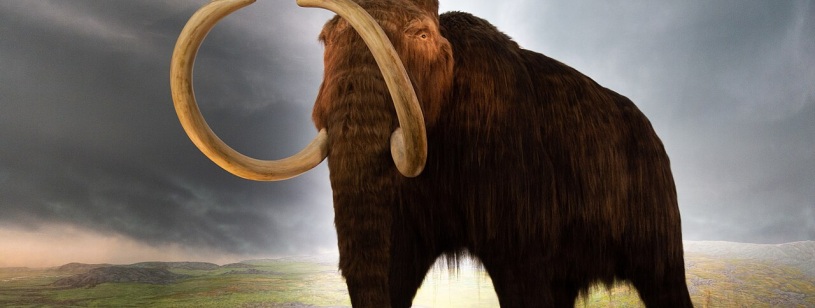
Woolly mammoth model (Mammuthus primigenius) at the Royal BC Museum. · Thomas Quine / CC BY 2.0 (https://creativecommons.org/licenses/by/2.0). Cropped and resized.
The woolly mammoth was a close relative of today’s elephants, adapted to the cold of the Ice Age. It had long, thick fur, small ears and huge curved tusks. It lived on the cold steppes of Europe, Asia and North America, including what is now Romania, and finally disappeared about 4,000 years ago.
Quick facts
| Common name | Woolly mammoth |
| Scientific name | Mammuthus primigenius (genus Mammuthus) |
| Lifespan | Probably about 60 years, like elephants |
| Height | About 2.7–3.4 m at the shoulder in males |
| Weight | Up to about 6 tonnes |
| Diet | Herbivore: grasses, sedges, small shrubs |
| Predators | Prehistoric humans; cave lions and wolves took calves |
| Conservation status | Extinct (EX) |
| Distribution | Europe, northern Asia and North America |
| Habitat | The cold Ice Age “mammoth steppe” |
| Family | Elephantidae |
| Period | Disappeared about 4,000 years ago |
- Primary category:Mammals
- Explore this animal's categories:
Interesting facts
- The last mammoths lived on Wrangel Island in the Arctic Ocean while the pyramids were being built in Egypt.
- Mammoth tusks could exceed 4 metres in length.
- Frozen mammoths with preserved fur and organs have been found in Siberia, such as the calf Lyuba.
- Prehistoric people painted mammoths on cave walls and built huts from their bones.
Characteristics
The woolly mammoth was about the size of a modern African elephant. Its coat had an outer layer of long hairs and a dense, woolly underlayer, with thick fat beneath the skin.
Small ears and tail reduced heat loss. It had a fatty hump on the shoulders and very long, spirally curved tusks used to clear snow and to fight.
Behaviour
Mammoths probably lived like today’s elephants: females and young in herds led by an old female, adult males alone or in small groups.
Their teeth show they ate a lot every day, and marks on tusks and bones suggest long seasonal migrations across the steppe.
Habitat and distribution
The woolly mammoth lived in northern Eurasia and North America, on the cold, dry steppe that covered these regions in the Ice Age.
Many mammoth fossils have been found in Romania: teeth, tusks and bones kept in museums. After the climate warmed, mammoths survived longest on isolated islands such as Wrangel and St. Paul.
Diet and feeding
The mammoth was a herbivore, eating grasses, sedges, flowers, mosses and shrub twigs, as plant remains in the stomachs of frozen mammoths show.
Its molars had broad ridges for grinding tough plants. An adult needed more than a hundred kilograms of plants a day.
Reproduction and life cycle
Like elephants, the female probably gave birth to a single calf after almost two years of pregnancy. The calf was nursed for a long time and protected by the herd.
The calf Lyuba, found in Siberia in 2007, was about a month old when it died. It was so well preserved that researchers found its mother’s milk in its stomach.
Name and history
The word “mammoth” probably comes from a Siberian language via Russian. The scientific name primigenius means “first-born”.
Researchers have decoded much of the mammoth genome. Some companies are trying to create elephants with mammoth traits, but that would not bring back the original species.
Conservation and threats
The woolly mammoth is extinct. The main causes were climate warming at the end of the Ice Age, which shrank the cold steppe, and hunting by people.
A small population on Wrangel Island survived a few thousand years longer but lost genetic diversity and vanished about 4,000 years ago. Its living relatives, the elephants, are now threatened.
Frequently asked questions
When did mammoths disappear?
Most vanished about 10,000 years ago, and the last ones, on Wrangel Island, about 4,000 years ago.
Did mammoths live in Romania?
Yes. Many woolly mammoth fossils have been found in Romania and are kept in museums.
How big was a mammoth?
Males stood about 2.7–3.4 m at the shoulder and could weigh up to about 6 tonnes.
Can the mammoth be brought back?
Not in its original form. Scientists can only genetically modify elephants to give them some mammoth traits.