Harbour porpoisePhocoena phocoena — habitat, diet and reproduction
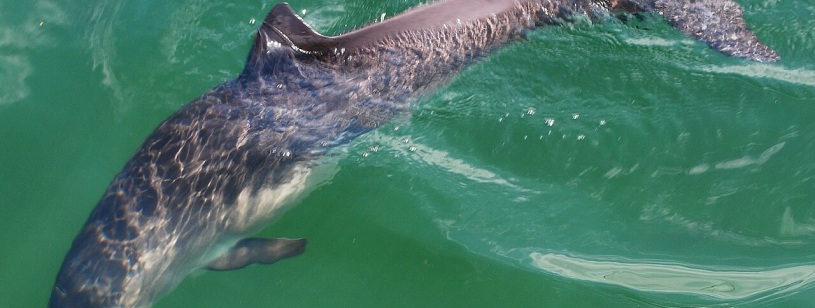
Harbour porpoise (Phocoena phocoena) swimming underwater. · Erik Christensen / CC BY-SA 3.0 (https://creativecommons.org/licenses/by-sa/3.0). Cropped and resized.
The harbour porpoise is a small cetacean related to dolphins but with a short, rounded snout and no “beak”. It is the smallest of the three cetaceans of the Black Sea, alongside the common and bottlenose dolphins. It is rarely seen because it surfaces only briefly, without dramatic leaps.
Quick facts
| Common name | Harbour porpoise |
| Scientific name | Phocoena phocoena |
| Lifespan | About 8–13 years; rarely over 20 |
| Length | About 1.4–1.9 m |
| Weight | About 45–70 kg |
| Diet | Carnivore: small fish such as anchovy, sprat and gobies |
| Predators | Orcas and large sharks in other seas |
| Conservation status | Least Concern (LC) globally; Black Sea subspecies Endangered (EN) |
| Distribution | Cool coastal waters of the Northern Hemisphere and the Black Sea |
| Habitat | Coastal waters, bays, estuaries |
| Family | Phocoenidae |
| Navigation | Echolocation |
- Primary category:Mammals
- Explore this animal's categories:Animals of AsiaAnimals of EuropeAnimals of North AmericaAnimals of RomaniaAnimals that live in groupsAnimals that use echolocationAquatic animalsCarnivoresCetaceansFish-eating animalsHLive-bearing animalsMammalsMarine animalsMarine mammalsOcean animalsProtected animals of RomaniaVertebratesWild animals
Interesting facts
- The porpoise must eat almost constantly because it loses heat quickly in water.
- Its teeth are flattened like little spades, unlike the conical teeth of dolphins.
- A distinct subspecies lives in the Black Sea, separated from Atlantic populations for thousands of years.
- Many porpoises die accidentally caught in turbot nets.
Characteristics
The harbour porpoise has a stocky body, dark grey above and pale below. The head is small without a long beak, and the dorsal fin is small and triangular.
It is much smaller than the bottlenose dolphin, and females are slightly larger than males.
Behaviour
Porpoises live alone or in small groups of 2–5 animals. They are shy and avoid boats.
When breathing, they roll at the surface with barely visible movement and a short puff. They use echolocation, sending very high-frequency clicks and listening to echoes to find prey and navigate.
Habitat and distribution
The species lives in cool coastal waters of the North Atlantic, North Pacific and Baltic Sea. An isolated population lives in the Black Sea, the Sea of Azov and sometimes the Sea of Marmara.
In Romanian waters it occurs along the coast, especially in spring when following fish shoals.
Diet and feeding
The porpoise eats small fish. In the Black Sea its main prey are anchovy, sprat, gobies and red mullet.
Being small, it loses heat quickly in cold water, so it must eat a lot, almost all the time, to keep warm.
Reproduction and life cycle
The female gives birth to one calf after about 10–11 months. The calf is born tail first underwater, and the mother helps it to the surface for its first breath.
It suckles rich milk for several months. Females can become pregnant while still nursing the previous calf.
Name and history
The name “marsuin” comes from the French “marsouin”, roughly “sea pig”. Older Romanian sources also call it “porc de mare”.
The Black Sea subspecies, Phocoena phocoena relicta, is a relic of populations that entered this sea long ago.
Conservation and threats
The species is assessed globally as Least Concern, but the Black Sea porpoise is Endangered. In the twentieth century, tens of thousands of cetaceans were killed in the Black Sea for oil until hunting was banned in 1983 in the former USSR, Romania and Bulgaria.
Today the main danger is set nets for turbot, in which porpoises become trapped and drown. Pollution and underwater noise also harm them. In Romania all cetaceans are strictly protected.
Frequently asked questions
What is a harbour porpoise?
A small cetacean related to dolphins, with a short, rounded snout. It is the smallest cetacean of the Black Sea.
How does a porpoise differ from a dolphin?
The porpoise is smaller, lacks a beak, has a triangular dorsal fin and spade-shaped teeth.
How many cetaceans live in the Black Sea?
Three: the common dolphin, the bottlenose dolphin and the harbour porpoise.
Why is the porpoise at risk in the Black Sea?
Mainly because of turbot nets, in which it becomes entangled and drowns.