Beluga whaleDelphinapterus leucas — habitat, diet and reproduction

A beluga whale, Delphinapterus leucas, photographed at Oceanogràfic in Valencia. · Carquinyol from Badalona, Catalunya / CC BY-SA 2.0 (https://creativecommons.org/licenses/by-sa/2.0). Cropped and resized.
The beluga is a toothed whale recognised by its white adult colour and rounded forehead. It lives in Arctic and subarctic waters, using sound to communicate and find food. This social mammal breathes air and nurses its young, while thick blubber helps insulate it in cold water.
Quick facts
| Common name | Beluga whale; white whale |
| Scientific name | Delphinapterus leucas |
| Longevity | Several decades; some individuals exceed 60 years |
| Diet | Carnivore: fish and aquatic invertebrates |
| Main predators | Orcas and polar bears |
| Conservation context | Varies by population; Cook Inlet belugas are endangered in the US |
| Distribution | Arctic and subarctic waters of the Northern Hemisphere |
| Habitat | Cold seas, bays, estuaries and ice-associated waters |
| Length | Adults commonly about 3.4–4.6 m; males are larger |
| Family | Monodontidae |
| Reproduction | Usually one calf; pregnancy around 14–15 months |
| Adaptation | No dorsal fin; thick insulating blubber |
- Primary category:Marine mammals
- Explore this animal's categories:
Interesting facts
- Calves are grey and become lighter as they grow.
- The neck is more flexible than in many other cetaceans.
- The rounded forehead contains a sound-focusing structure.
- Varied vocalisations inspired the nickname sea canary.
Characteristics
The robust body has relatively short pectoral flippers and a tail adapted for swimming. A low ridge replaces a tall dorsal fin.
The rounded forehead contains the melon, a fatty structure involved in projecting echolocation signals. Its shape can change during sound production. Neck vertebrae allow head movement, helping the whale manoeuvre in shallow water and around obstacles.
Behaviour
Belugas form groups that can change in size and membership. Animals gather to feed, travel and interact.
Their repertoire includes whistles, clicks and other calls. Communication and echolocation serve different roles: returning echoes provide information about objects and prey. Because sound is central to their lives, human-made underwater noise can interfere with important signals.
Habitat and distribution
The range covers the Arctic Ocean and nearby seas, including waters around Alaska, Canada, Greenland and Russia. Populations do not all follow the same routes.
Many use shallow bays and estuaries in summer, moving into deeper or ice-associated waters at other times. River mouths can provide feeding opportunities. Local conditions and prey availability influence seasonal movements.
Diet and feeding
Fish, crustaceans, molluscs and other invertebrates form a varied diet. The mix changes between populations and seasons.
Echolocation helps locate food when visibility is poor. Belugas possess teeth but do not chew in the same prolonged manner as many land mammals. Fish migrations create valuable feeding opportunities, making coastal habitats and healthy prey populations important to the whales.
Reproduction and life cycle
Pregnancy lasts roughly 14–15 months and usually produces one calf. Births often occur in summer in relatively warmer water.
The grey calf depends on its mother and may nurse for at least two years. Birth intervals are measured in years, so populations cannot recover rapidly after a decline even when a particular threat is removed. Maternal care is a substantial investment.
Name and history
The name beluga comes from a Russian word associated with white. Sea canary refers to the variety of calls, not a relationship with birds.
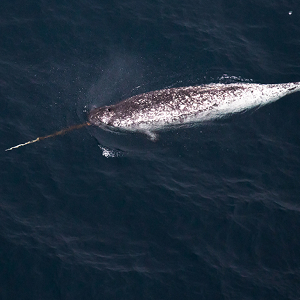
Belugas and narwhals belong to Monodontidae and share anatomical and northern-water adaptations. Despite their streamlined aquatic bodies, belugas remain mammals: they breathe through lungs and produce milk for their young.
Conservation and threats
Conservation conditions vary among populations. A local group can face serious problems even when the species occurs widely across northern waters. Cook Inlet belugas in Alaska receive particular protection.
Pollution, underwater noise, habitat change, climate change and limited prey can act together. Monitoring populations and preserving important feeding and calving areas are central to their conservation.
Frequently asked questions
Is a beluga a fish?
No. It is a toothed whale, a mammal that breathes air and nurses its calf.
Are beluga calves white?
No. They are grey and gradually become lighter.
Why is the forehead rounded?
It contains the melon, a fatty structure involved in focusing echolocation signals.
Does it have a dorsal fin?
It has a low dorsal ridge rather than a tall dorsal fin.