Arctic foxInteresting facts and information
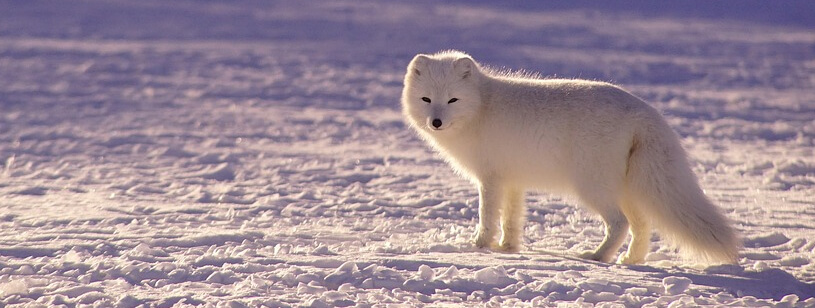
The Arctic fox (Vulpes lagopus) is a small fox built for life in the far north, with a compact body, short legs, small ears and one of the warmest fur coats of any mammal. Most Arctic foxes turn white in winter and brownish-grey in summer.
It is an opportunistic feeder, eating lemmings, birds, eggs, fish, berries and remains from polar bear kills.
Globally it is listed as Least Concern, but some local populations, especially in Scandinavia, are endangered. Climate change and competition with red foxes are growing threats.
Quick facts
| Common name | Arctic fox |
| Scientific name | Vulpes lagopus |
| Typical lifespan | Usually 3-4 years in the wild; up to about 14 years in captivity |
| Maximum speed | About 45 km/h in short bursts |
| Size | Head and body approximately 45–68 cm |
| Tail length | Around 30 cm |
| Weight | Usually about 3–5 kg (up to about 9 kg) |
| Diet type | Opportunistic, mainly animal food: lemmings, birds, eggs, fish and carrion, plus some berries |
| Main predators | Polar bears, wolves, wolverines, red foxes, golden eagles and snowy owls (for pups) |
| Conservation status | Least Concern globally; endangered in Scandinavia |
| Geographic distribution | Circumpolar Arctic regions, including North America, Greenland, Iceland, northern Europe and northern Asia |
| Habitat | Arctic tundra, coasts, northern mountains and sea ice |
| Social behaviour | Usually forages alone; lives in breeding pairs and families |
| Special adaptations | Very warm fur, compact body, furred feet and hearing that detects prey under snow |
Interesting facts
- Superb insulation: its thick winter fur is one of the warmest coats of any mammal; an Arctic fox can rest at about −40 °C without having to work harder to stay warm.
- Two colour forms: the white form is white in winter and brownish-grey in summer, while the "blue" form stays dark grey-brown all year.
- It hears prey under the snow: it listens for lemmings moving under the snow, then leaps high and dives in head-first.
- It does not hibernate: it stays active through the long Arctic winter.
- Furry feet: thick fur on the soles keeps its feet warm on snow and ice.
- Long-distance traveller: in 2018, a young female walked 3,506 km in 76 days, from Svalbard in Norway to Ellesmere Island in Canada, crossing sea ice.
Records and remarkable features
- A small Arctic fox: it is smaller than a red fox, usually weighing about 3–5 kg.
- Built for the cold: its thick fur, short legs, short muzzle and small ears help it survive temperatures far below −40 °C.
- A record journey: the 3,506 km trek of a young female in 2018 is one of the longest journeys ever recorded for an Arctic fox.
- Ancient dens: some Arctic fox dens have dozens of entrances and have been used by many generations, in some cases for hundreds of years.
- Huge litters: in years with plenty of lemmings, a female can have more than 15 pups, among the largest litters of any carnivore.
Characteristics
The Arctic fox has many features that help it cope with extreme cold, hunting under snow and seasonal camouflage.
Physical appearance
- Compact body: short legs, a short muzzle and small ears reduce heat loss.
- Seasonal fur: the coat becomes very thick in winter and thinner in summer. Only the white form turns white in winter.
- Furred soles: thick hair on the feet protects them from the cold ground.
- Small, rounded ears: they lose less heat than large ears.
- Bushy tail: the fox wraps it around its body and face like a blanket when it rests.
Special adaptations
- Saving energy: in winter, it can lower its activity and live partly on fat stored in autumn.
- Sensitive hearing: it can hear prey hidden under the snow.
- Digging: it digs dens in sandy hills and slopes, where the ground is not permanently frozen.
- Built for winter: instead of hibernating, it stays active and hunts all winter.
Habits and behaviour
Arctic foxes are adaptable, opportunistic animals. They often hunt alone, but breed in pairs and raise their pups as a family.
Social behaviour
- Alone or together: they usually search for food alone, but several foxes may gather at a large carcass.
- Pairs: a male and female usually pair up for the breeding season and often stay together for years, raising the pups together.
- Family dens: the same den may be used again and again by many generations.
Defence and survival
- Camouflage: white winter fur blends with snow, and the darker summer coat blends with rocks and tundra.
- Dens: foxes escape into their dens from predators such as wolves, polar bears, golden eagles and red foxes.
- Travelling for food: when food is scarce, some foxes travel hundreds or even thousands of kilometres, often across sea ice.
Habitat and geographic distribution
The Arctic fox lives all around the Arctic, in North America, Greenland, northern Europe and northern Asia. It lives on the tundra, along coasts and on sea ice.
| Region | Habitat examples | Population information |
|---|---|---|
| Greenland and the Canadian Arctic | Arctic tundra, islands and coasts | Widespread |
| Norway, Sweden and Finland | Mountain tundra | Endangered; a few hundred animals, recovering thanks to conservation programmes |
| Russia and northern Siberia | Arctic tundra and coasts | Widespread; numbers rise and fall with lemming cycles |
| Alaska, United States | Tundra and coastal landscapes | Widespread in the north and west |
| Iceland | The island’s only native land mammal | Common; it reached Iceland over the sea ice at the end of the last ice age |
Habitat types
- Arctic tundra: provides lemmings, birds and sandy hills for dens.
- Coasts: foxes find fish, seabirds and remains washed up by the sea.
- Mountains and sea ice: some populations live in northern mountains, and in winter some foxes travel far out on the sea ice.
Human pressures and threats
- Climate change: warmer winters change snow and ice and can disrupt lemming cycles.
- Fur hunting: heavy hunting for fur in the past reduced some populations; regulated hunting continues in some regions.
- Competition with red foxes: as the climate warms, larger red foxes move north, take over dens and sometimes kill Arctic foxes.
Diet and feeding
Arctic foxes eat live prey and carrion, and some berries too. Their diet changes with the season and region.
What do Arctic foxes eat?
| Food type | Dietary context | Role |
|---|---|---|
| Lemmings and other small mammals | The main food of many inland foxes | Provide protein, fat and energy |
| Birds, including migratory species | Important in summer, especially near bird colonies | Valuable seasonal food |
| Bird eggs | Plentiful in the bird breeding season | Eaten fresh or stored for later |
| Fish and marine invertebrates | Important for coastal foxes | Food when lemmings are scarce |
| Carrion, including seal remains from polar bear kills | Important in winter, especially on the sea ice | Food when hunting is difficult |
| Berries and other plant foods | Eaten in late summer and autumn | An extra source of energy |
Feeding methods
- Listening and pouncing: it listens for prey under the snow, then leaps and dives in to catch it.
- Caching: it hides extra food, such as eggs, to eat in winter; one fox may store hundreds or thousands of eggs.
- Scavenging: in winter, some foxes follow polar bears to eat the remains of their seal kills.
- Raiding nests: in summer, it takes eggs and chicks from bird colonies.
Reproduction and life cycle
Arctic foxes can have very large litters, but the number of pups depends strongly on how much food there is, especially lemmings.
| Characteristic | Details |
|---|---|
| Breeding maturity | About 10 months to 1 year |
| Mating season | Late winter and spring (about March–May) |
| Reproduction type | Live birth, followed by nursing |
| Gestation | About 52 days |
| Litter size | Usually about 5–8 pups; more than 15 in good lemming years |
| Birth weight | About 60–80 g |
| Nursing | About 6–8 weeks |
| Independence of young | Late summer or autumn of their first year |
| Lifespan | Usually 3–4 years in the wild; up to about 14 years in captivity |
Breeding and family care
- Breeding pairs: both parents raise the pups, and pairs often stay together for several years.
- Den choice: the pair usually uses an old den or digs a new one in a sandy hill.
- Food provisioning: the male brings food to the female and pups; sometimes young foxes from the year before help too.
Pup development
- Helpless newborns: pups are born with closed eyes and depend on their mother's milk.
- Coming out: at about 3–4 weeks, they come out of the den and start eating food brought by their parents.
- Learning to hunt: play and practice teach them to find and catch food.
- Leaving home: in late summer and autumn, the young foxes leave the den area; some travel very far.
Name and history
Origin and meaning of the name
- Vulpes lagopus combines the Latin vulpes, "fox", with the Greek lagopus, "hare-footed", a reference to its furry feet.
- It is also called the white fox, polar fox or snow fox. In Swedish it is called fjällräv, "mountain fox".
Scientific study
- The species was described by Carl Linnaeus in 1758.
- Arctic research has shown how it survives the cold, what it eats and how far it can travel.
- Satellite collars have revealed journeys of thousands of kilometres across the sea ice.
Cultural significance and mythology
The Arctic fox appears in the stories and traditions of many northern peoples.
- Fox fires: the Finnish word for the northern lights, revontulet, means "fox fires", from a folk tale in which a fox running across the snow sweeps sparks into the sky with its tail.
- The fox wife: a well-known Inuit story tells of a hunter whose wife is secretly a fox who takes off her fur to live as a woman.
- Fur trade: for centuries, Arctic fox furs were an important source of income for trappers in the Arctic.
Conservation status and threats
Globally, the Arctic fox is listed as Least Concern, but some local populations are threatened, especially in Scandinavia and on Russia's Commander Islands.
| Assessment scope | Population information | Regions |
|---|---|---|
| Global: Least Concern | Probably several hundred thousand animals; numbers change with lemming cycles | Circumpolar Arctic range |
| Local conservation concern | Small populations needing active protection | Norway, Sweden and Finland; Mednyi Island (Commander Islands) |
Main threats
- Climate change: changes in snow, sea ice and lemming cycles can reduce food.
- Red fox competition: red foxes take over dens and kill Arctic foxes where their ranges overlap.
- Fur hunting: hunting in the past almost wiped out the Scandinavian population, which has been protected since the 1920s–1940s.
- Disease: on Mednyi Island, mange brought by dogs killed most of the foxes in the 1970s.
Conservation work
- Captive breeding: since 2005, Norway has bred Arctic foxes and released them into the mountains.
- Extra food and red fox control: in Sweden and Norway, feeding stations and the removal of red foxes have helped numbers grow from about 40–60 adults around 2000 to several hundred.
- Monitoring: satellite collars, camera traps and den surveys follow how populations change.
In popular culture
With its snow-white coat, the Arctic fox has inspired films, games and brands.
Film and animation
- Arctic Dogs (2019): an animated adventure about Swifty, an Arctic fox who dreams of becoming a sled-delivery "top dog".
Video games
- Never Alone (2014): made with Alaska Native storytellers, this game follows an Iñupiaq girl and her Arctic fox companion.
- Minecraft: snowy areas of the game are home to a white "snow fox".
Commercial imagery
- Fjällräven: the Swedish outdoor brand's name means "Arctic fox", and its logo shows the animal.
- Conservation campaigns: the Arctic fox is often used as a symbol of the changing Arctic.