ManateeInteresting facts and information
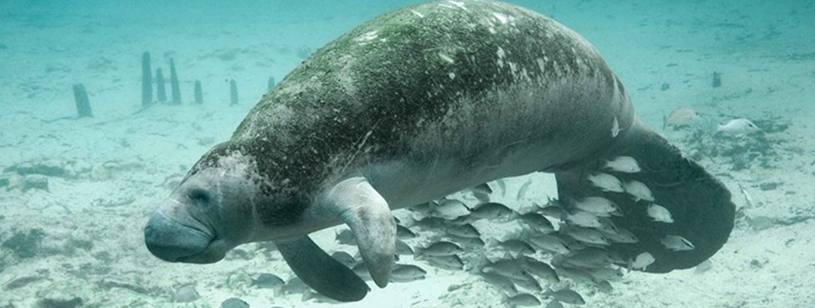
Manatees (Trichechus) are aquatic mammals that feed on plants. Different species use rivers, estuaries or coastal waters in warm regions. Their slow movements and need for suitable habitat can make them vulnerable to human activities.
Adult manatees have few natural predators, but they are threatened by boat strikes, habitat loss, pollution and, in some regions, hunting. All three species are protected by law in most of their range.
Manatees are gentle grazers of seagrass and freshwater plants. Their closest living relatives are the dugong and, more distantly, elephants.
Quick facts
| Common name | Manatee (sea cow) |
| Scientific name | Trichechus spp. |
| Typical lifespan | Often 40 to 60 years |
| Maximum speed | Usually 5-8 km/h; up to about 25 km/h in short bursts |
| Dimensions | About 2.5 - 4 metres long |
| Weight | Usually about 400-550 kg; up to about 1,500 kg |
| Diet type | Herbivore (seagrass, algae, aquatic plants) |
| Main predators | Few natural predators; the main threats come from people |
| Conservation status | All three species are listed as Vulnerable (IUCN) |
| Distribution | Southeastern USA, Caribbean, Central and South America, Amazon basin, West Africa |
| Habitat | Shallow coastal waters, lagoons, estuaries, tropical rivers |
- Primary category:Marine mammals
- Explore this animal's categories:
Interesting facts
- Mistaken for mermaids - In 1493, Christopher Columbus wrote that he had seen three "mermaids" near Hispaniola, adding that they were not as beautiful as in pictures; they were probably manatees.
- Big eaters - Manatees eat about 10-15% of their body weight in plants every day, which can be more than 50 kg for a large adult.
- Sensitive whiskers - Thousands of sensitive hairs on the snout and body help them feel water movements and find food.
- Long breath-holds - A resting manatee can stay underwater for up to about 20 minutes, but active manatees usually surface every few minutes.
- Slow but capable - They usually swim at about 5-8 km/h, but can speed up to about 25 km/h for short distances.
Records and remarkable features
- Manatees (Trichechus) are aquatic mammals that feed on plants. Different species use rivers, estuaries or coastal waters in warm regions. Their slow movements and need for suitable habitat can make them vulnerable to human activities.
Characteristics
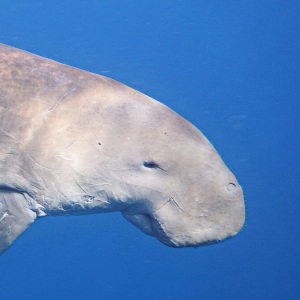
Manatees are large aquatic mammals with a rounded body, two front flippers and a wide, paddle-shaped tail. They live in fresh, brackish and salt water and have no hind limbs or dorsal fin.
Main physical characteristics:
| Characteristic | Details |
|---|---|
| Body shape | Large, rounded and streamlined |
| Size | About 2.5-4 metres long |
| Weight | Usually about 400-550 kg; up to about 1,500 kg |
| Colour | Grey to brown, often with algae and scars on the skin |
| Flippers | No dorsal fin; two front flippers, with nails in most species |
| Tail | Wide, rounded and paddle-shaped |
| Teeth | No canines or incisors, only molars for grinding plants |
| Skin | Thick and wrinkled, with sparse hairs |
| Whiskers | Stiff, sensitive bristles on the lips, used to handle food |
Special adaptations:
- Breathing - Manatees can rest underwater for up to about 20 minutes, but usually surface every 3-5 minutes.
- "Marching" teeth - Worn molars fall out at the front and are replaced by new teeth moving forward from the back throughout their lives.
- Low metabolism - They produce little body heat and cannot survive long in water colder than about 20 °C.
- Heavy bones - Dense bones help them stay underwater while feeding.
Habits and behaviour
Manatees are gentle, slow-moving animals that spend most of their time eating, resting and travelling.
Social behaviour:
- Alone or in small groups - Manatees often live alone or in small, loose groups; mothers and calves stay close together.
- No territories - They are not territorial and gather where there is warm water or plenty of food.
- Communication - They make squeaks, chirps and whistles, especially between mothers and calves.
Feeding and lifestyle:
- Plant-eaters - They eat seagrasses, freshwater plants and algae.
- A flexible upper lip - Its split upper lip works almost like a hand to pull plants into the mouth.
- Shallow waters - They feed in shallow lagoons, rivers and estuaries where plants grow.
- Seeking warmth - Florida manatees gather at warm springs and power plant outflows in winter.
Defense and Survival Strategies:
- Slow swimmers - They usually move slowly but can speed up in short bursts when disturbed.
- Few natural predators - Adults have few natural predators; the main threats come from people, especially boat strikes and habitat loss.
- Need for warm water - Cold water can make them ill or kill them, so they move to warmer waters in winter.
Habitat and geographic distribution
Manatees live in warm tropical and subtropical waters, in rivers, estuaries, lagoons and shallow coastal seas.
Habitat types:
| Habitat | Regions |
|---|---|
| Tropical rivers | The Amazon basin, rivers of West Africa |
| Coastal lagoons and estuaries | Florida, the Gulf of Mexico, the Caribbean, Brazil, West Africa |
| Warm springs | Florida springs, used by manatees in winter |
Geographic distribution:
- West Indian manatee (Trichechus manatus) — coastal waters and connected waterways of the southeastern United States, the Caribbean and parts of Central and South America. The Florida manatee is a subspecies.
- South America - The Amazonian manatee (Trichechus inunguis) lives only in fresh water, in the rivers and lakes of the Amazon basin.
- West Africa - The African manatee (Trichechus senegalensis) lives in coastal waters, estuaries and rivers from Senegal to Angola and is the least studied species.
Impact of climate change and human activities:
- Habitat loss - Coastal building, dams and pollution reduce feeding and breeding areas.
- Boat strikes - Many manatees are injured or killed by boats and propellers.
- Loss of seagrass - Pollution and algal blooms kill seagrass; in 2021, more than 1,000 manatees died in Florida, many from starvation.
- Cold and red tides - Cold spells and toxic algal blooms can kill many manatees.
Manatees depend on healthy rivers and coastal waters, and they need continued protection.
Diet and feeding
Manatees are herbivores that eat aquatic plants. Together with the dugong, they are the only plant-eating marine mammals.
Types of food consumed:
| Food group | Examples |
|---|---|
| Seagrass | Thalassia, Halodule, Syringodium |
| Algae | Various algae |
| Freshwater plants | Water hyacinth, hydrilla, water lettuce, floating grasses |
| Other plants | Mangrove leaves and plants hanging over the water |
Feeding methods:
- A prehensile upper lip - Manatees use their flexible lip to pull up seagrass and other plants.
- Constant chewing - Their replaceable teeth let them chew large amounts of tough plants every day.
- Shallow water - They feed mostly where plants grow in shallow, sunlit water.
- Swallowing sand - While feeding on seagrass, they also swallow sand, which wears down their teeth.
Ecological role:
- Grazing - By eating aquatic plants, they help shape seagrass meadows and freshwater vegetation.
- Recycling nutrients - Their droppings return nutrients to the water.
Reproduction and life cycle
Manatees breed slowly: a female usually has a single calf every 2-5 years. Mother and calf stay together for a long time.
Life cycle stages:
| Stage | Approximate duration | Characteristics |
|---|---|---|
| Gestation | About 12-14 months | The female usually has one calf; twins are rare. |
| Birth | Any time of year, often spring or summer | The calf weighs about 30 kg at birth. |
| Nursing period | About 1-2 years | The calf drinks milk from teats behind its mother's flippers and learns from her. |
| Sexual maturity | About 3-7 years | Females usually give birth every 2-5 years. |
| Lifespan | Often 40-60 years | Some manatees in human care have lived more than 65 years. |
Reproductive behavior:
- Mating herds - A female ready to mate is followed by a group of males, sometimes for weeks.
- Several partners - The female may mate with several males.
- Mother and calf - The calf learns from its mother where to find food and warm water.
- No pair bond - After mating, the male leaves, and the female raises the calf alone.
Because they breed so slowly, manatee populations take a long time to recover after many deaths.
Name and history
Manatees have been known to Europeans since the 15th century and were sometimes linked with stories of mermaids.
Origin and etymology of the name:
- "Manatee" - The word comes from the Spanish manatí, which was taken from a Caribbean Indigenous language.
- The scientific name Trichechus probably comes from the Greek thrix, "hair", referring to the bristles on the snout.
- "Sea cow" - Manatees are also called sea cows because they are large, slow and eat plants.
Taxonomic classification:
| Taxonomic category | Name |
|---|---|
| Kingdom | Animalia |
| Phylum | Chordata |
| Class | Mammalia |
| Order | Sirenia |
| Family | Trichechidae |
| Genus | Trichechus |
Manatees in history and culture:
- Christopher Columbus - In 1493, he described seeing "mermaids" in the Caribbean, which were probably manatees.
- Relatives - Manatees belong to the order Sirenia, named after the sirens of Greek myth; their closest living relatives are dugongs and, more distantly, elephants.
- Hunting - For centuries, manatees were hunted for meat, oil and hides, which reduced their numbers.
- An extinct cousin - Steller's sea cow, a giant relative in the North Pacific, was hunted to extinction by 1768.
Cultural significance and mythology
Manatees have been important to Indigenous peoples, explorers and sailors, and they are often linked with the legends of mermaids.
Manatees in mythology and popular beliefs:
- Mermaids - Sailors' reports of mermaids in warm seas may have been partly inspired by manatees and dugongs.
- The Amazon - Amazonian peoples have traditionally hunted manatees and tell stories about them.
- West Africa - In parts of West Africa, manatees are linked with water spirits, including Mami Wata, and in some places they are protected by local traditions.
- Explorers' journals - Travellers from the 16th to the 18th centuries described manatees as strange animals of tropical waters.
Manatee symbolism:
- Gentleness and calm - Because of their peaceful nature, manatees are symbols of gentleness.
- Connection with water - In many cultures, they are linked with rivers and water spirits.
- Conservation - Today, the manatee is a symbol of efforts to protect rivers and coastal waters.
Conservation status and threats
All three manatee species are listed as Vulnerable by the International Union for Conservation of Nature (IUCN). They are threatened by boats, habitat loss, pollution and hunting.
Conservation status
| Species | Status (IUCN) |
|---|---|
| West Indian manatee (Trichechus manatus), including the Florida manatee | Vulnerable |
| Amazonian manatee (Trichechus inunguis) | Vulnerable |
| African manatee (Trichechus senegalensis) | Vulnerable |
Main threats:
- Boat strikes - Because they move slowly near the surface, manatees are often hit by boats.
- Habitat loss - Coastal building, dams and loss of seagrass reduce feeding and breeding areas.
- Water pollution - Pollution causes algal blooms that kill seagrass and can poison manatees.
- Cold weather - Cold spells can kill manatees, especially in Florida.
- Entanglement - Many manatees are caught in fishing nets and lines.
- Hunting - In parts of Africa and South America, manatees are still hunted for meat, although this is illegal in most countries.
Conservation efforts:
- Protected areas - Reserves and sanctuaries protect manatees in the USA, Brazil and other countries.
- Legal protection - Hunting manatees is illegal in most countries.
- Boat speed zones - In Florida, boats must slow down in many areas used by manatees.
- Rescue and rehabilitation - Injured and orphaned manatees are cared for and released back into the wild.
The Florida manatee population grew enough for the USA to change its status from "endangered" to "threatened" in 2017, but African and Amazonian manatees remain at risk.
In popular culture
Manatees in literature:
- Columbus's journal - His 1493 description of "mermaids" is one of the earliest European records of manatees.
- Children's books - Manatees are popular subjects of educational books about the sea.
Manatees in cinematography and television:
- "South Park" (2006) - In a famous episode, the writers of another cartoon are shown as manatees choosing jokes.
- Manatee Appreciation Day - Celebrated every year in late March to raise awareness about manatees.
Manatee as a cultural symbol:
- Save the Manatee Club - Founded in 1981 by the singer Jimmy Buffett and Florida's then governor Bob Graham.
- Florida - The manatee is Florida's official state marine mammal.
- Tourism - In places such as Crystal River in Florida, people can watch manatees in the wild.