OctopusInteresting facts and information
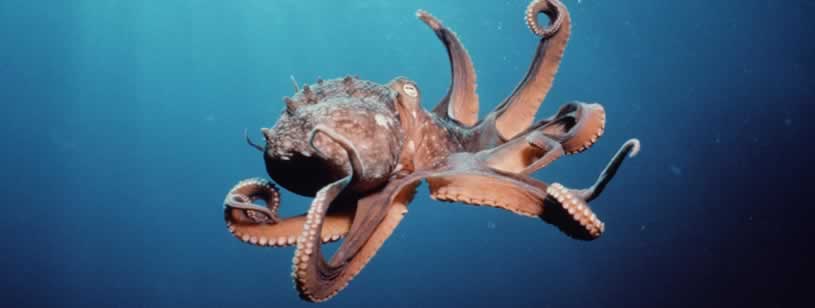
Octopuses (Octopoda) are marine molluscs with eight arms, a soft body and a beak. Many can change their appearance, solve practical problems and squeeze through narrow spaces. Their size, lifespan and behaviour differ between species.
Octopuses have three hearts and copper-containing haemocyanin, which carries oxygen in their blood. Many have flexible bodies and skin that can change appearance, but abilities differ between species.
Quick facts
| Common name | Octopus |
| Scientific name | Octopoda |
| Typical lifespan | About 1-5 years (depending on species) |
| Maximum speed | Fast in short jet-propelled bursts; speed varies by species |
| Dimensions | From a few centimetres to several metres across (depending on species) |
| Weight | Varies greatly between species; ordinary adult size should be distinguished from exceptional historical reports |
| Diet type | Carnivore (fish, crustaceans, molluscs) |
| Main predators | Sharks, seals, dolphins, eels, large fish, humans |
| Conservation status | Assessed separately for each species and population; different species and regions have different needs |
| Main species | Common octopus (Octopus vulgaris), giant Pacific octopus (Enteroctopus dofleini), blue-ringed octopuses (Hapalochlaena) |
| Distribution | Atlantic, Pacific, Indian, Arctic and Southern Oceans |
| Habitat | Coral reefs, sandy seabeds, underwater caves and deeper seabed habitats |
Interesting facts
- Octopuses have three hearts and blue blood - Two hearts pump blood through the gills, and the third pumps it around the rest of the body. Their blood carries oxygen using haemocyanin, a copper-based pigment that makes it blue.
- They are masters of camouflage - Special skin cells called chromatophores let octopuses change colour and even skin texture in an instant to match their surroundings.
- Octopuses have eight arms rather than the feeding tentacles seen in squid. Lost arms can regrow, although recovery depends on the injury and the individual.
- Many neurons occur in the arms as well as in the central brain. Arm movements involve local processing and coordination with the rest of the nervous system.
- They escape by jet propulsion - An octopus can shoot away from danger by forcing a strong jet of water out through its siphon.
- Blue-ringed octopuses are among the most venomous sea animals - Their venom contains tetrodotoxin, which can cause breathing paralysis and death in humans.
- They can solve complex problems - Studies show that octopuses can open jars, find their way through mazes and even learn by watching other octopuses.
- They have no bones - The only hard part of an octopus's body is its parrot-like beak, so it can squeeze through extremely narrow gaps.
- Mothers sacrifice their lives for their young - After laying her eggs, a female guards them, stops eating and usually dies soon after they hatch.
- Octopuses use tools - Some carry coconut shells or seashells and use them as portable shelters.
Records and remarkable features
- The giant Pacific octopus (Enteroctopus dofleini) is a large octopus with eight arms and three hearts.
Characteristics
Octopuses are cephalopod molluscs in the order Octopoda. They have eight muscular arms bearing suckers, a soft body and a complex nervous system.
Main physical features:
- A soft, flexible body - Octopuses have no skeleton, so they can squeeze through very narrow spaces.
- Eight powerful arms - Each arm is covered with very sensitive suckers that help the octopus catch prey, explore and handle objects.
- A strong beak - The octopus's only hard structure is its beak, similar to a parrot's, which it uses to crack the shells of its prey.
- Three hearts and blue blood - Two hearts pump blood through the gills, and one pumps it around the body. The blood contains haemocyanin, a copper-based pigment that makes it blue.
- Changeable skin - Octopuses can change the colour and texture of their skin in seconds, thanks to special cells called chromatophores and leucophores.
- A complex nervous system - About two-thirds of an octopus's neurons are in its arms, so each arm can act partly on its own.
Special adaptations for survival:
- Instant camouflage - Octopuses can quickly change colour and texture to blend in with their surroundings.
- Jet propulsion - They push water out through a siphon to move fast and escape predators.
- Ink for defence - When threatened, they release a cloud of ink that helps them hide and confuses attackers.
- Regrowing arms - If an octopus loses an arm, it can grow a new one over the following months.
Habits and behaviour
Octopuses are solitary animals with remarkably complex behaviour. They are known for their intelligence, their problem-solving skills and their ability to interact with their surroundings in sophisticated ways.
Social behaviour and way of life:
- Solitary - Most species live alone and meet other octopuses only to mate.
- Dens - Octopuses choose a home on the seabed and build shelters from stones, shells or pieces of coral.
- Night activity - Many octopuses are nocturnal and hunt after dark.
- Exploring with their arms - Their arms are extremely sensitive and can detect touch, texture and chemicals in the water.
Hunting and feeding techniques:
- Surprise attacks - They creep up on prey and seize it quickly with their arms.
- Paralysing prey - Many species inject venom through their beak to immobilise crabs or fish.
- Using tools - Octopuses have been seen using shells and other objects to protect themselves.
Defence and survival methods:
- Releasing ink - When attacked, octopuses release a cloud of ink that hides their escape.
- Advanced camouflage - Some species can imitate their surroundings perfectly, looking like sand, coral or rock.
- The mimic octopus (Thaumoctopus mimicus) can adopt shapes and movements resembling other sea animals.
Habitat and geographic distribution
Octopuses live in all the world's oceans, from tropical reefs to the deep sea. They prefer places with natural hiding spots, such as coral reefs, underwater caves and rocky or sandy seabeds.
Habitat types:
- Coral reefs - Many octopuses, such as the day octopus, live on reefs, where they find safe hiding places and plenty of food.
- Sandy and rocky areas - Octopuses hide in rock crevices or dig dens in the sand.
- The deep sea - Dumbo octopuses (Grimpoteuthis) have been found at depths of nearly 7,000 metres.
- Temperate and polar waters - Some species, such as the giant Pacific octopus, live in the cold waters of the North Pacific.
Geographic distribution:
| Region | Example species | Situation |
|---|---|---|
| Atlantic Ocean | Octopus vulgaris, Eledone cirrhosa | Common, but heavily fished in places |
| Pacific Ocean | Enteroctopus dofleini, Hapalochlaena | Widespread |
| Indian Ocean | Octopus cyanea, Amphioctopus marginatus | Widespread |
| Arctic Ocean | Deep-sea species | Poorly known |
| Southern Ocean | Megaleledone setebos | Poorly known |
The impact of climate change and human activities:
- Warming oceans - Change where octopuses live, pushing some towards cooler or deeper water.
- Pollution and overfishing - Affect octopuses' food and damage coral reefs, the home of many species.
- Ocean acidification - Can harm the crabs and shellfish that many octopuses eat.
Octopuses are adaptable and intelligent, which helps them cope with changes in their environment, but habitat loss and overfishing can still harm their populations.
Diet and feeding
Octopuses are carnivorous predators that use clever strategies to catch and eat their prey. Being extremely flexible and agile, they can hunt in almost any sea habitat, from coral reefs to sandy seabeds and the deep sea.
Main food:
- Crustaceans - Crabs, lobsters, shrimps.
- Small fish - Larger octopuses also catch fish.
- Molluscs and other cephalopods - They often eat clams, mussels and even smaller octopuses.
- Other soft-bodied animals - Some species also eat worms and other invertebrates.
Hunting techniques:
- Camouflage and ambush - Octopuses hide and change colour to approach their prey unseen.
- Holding prey with their arms - Strong suckers let them grab and hold prey firmly.
- Using venom - Many species inject saliva containing toxins that paralyse prey and start to break down soft tissue.
- Cracking shells - With its strong beak, an octopus can break the hard shells of crabs and clams, or drill holes in them.
Diet by habitat:
| Habitat | Main food |
|---|---|
| Coral reefs | Crustaceans, small fish |
| Sandy areas | Molluscs, marine worms |
| Deep sea | Small invertebrates and other deep-sea animals |
| Polar waters | Crustaceans, shellfish, other invertebrates |
Reproduction and life cycle
Octopuses have an unusual life cycle: they breed once and then die. Females make extreme sacrifices to protect their eggs, and males usually die within weeks or months of mating.
Mating:
- Maturity - Most octopuses breed when they are about 1-2 years old.
- Sperm transfer - Males use a specially modified arm, called a hectocotylus, to pass sperm to the female.
- The male's fate - After mating, males stop feeding and die within weeks or months.
Caring for the eggs:
- Depending on the species, a female lays from a few dozen to about 200,000 eggs.
- Guarding the eggs - The female stays with them, constantly blowing fresh water over them and chasing away predators.
- No food - The female does not eat during this period and usually dies soon after the eggs hatch.
How young octopuses develop:
- The eggs hatch after a few weeks or months, depending on the temperature and species.
- In many species, the young drift in the plankton for a while before settling on the seabed.
- Fast growth - Young octopuses grow very quickly, and many reach maturity within a year.
Lifespan:
- Small octopuses live only about 1-2 years, and some even less.
- The giant Pacific octopus can live up to about 5 years, making it one of the longest-lived species.
Name and history
Octopuses are among the most fascinating sea creatures. They appear in myths and legends and are studied intensively in biology and neuroscience.
Origin of the name:
- The word "octopus" comes from the Greek oktṓpous, meaning "eight-footed".
- It came into English through scientific Latin; the plural "octopuses" is the most common, although "octopi" and "octopodes" are also used.
Taxonomic classification:
| Taxonomic rank | Name |
|---|---|
| Kingdom | Animalia |
| Phylum | Mollusca |
| Class | Cephalopoda |
| Order | Octopoda |
| Main families | Octopodidae, Enteroctopodidae |
| Notable species | Octopus vulgaris, Enteroctopus dofleini, Hapalochlaena |
Discovery and documentation:
- Ancient times - Aristotle described octopuses and noted their cleverness.
- Sailors' legends - Scandinavian stories told of the Kraken, a giant sea monster.
- The 19th and 20th centuries - Scientists began studying octopus behaviour and intelligence in detail.
Octopuses in mythology:
- The Scandinavian Kraken - A legendary sea monster that, according to sailors' tales, attacked ships.
- A symbol of mystery - In many cultures, the octopus is linked with the mysteries of the ocean.
Octopuses remain a fascinating subject of research because of their intelligence and their remarkable ability to adapt.
Cultural significance and mythology
Octopuses have played an important role in myths and cultures around the world, as symbols of mystery, power, intelligence and even fear. They have been described both as fascinating creatures and as sea monsters able to sink ships.
Octopuses in mythology and symbolism:
- The Scandinavian Kraken - In northern legends, the Kraken was a giant octopus-like sea monster living off the coast of Norway that could drag ships underwater.
- A symbol of adaptability - Because they can change shape and escape from almost anywhere, octopuses are linked with change, flexibility and cunning.
- Pacific cultures - In some Pacific Island traditions, octopuses are powerful beings linked with the sea and creation.
- Ancient Greece - The Greeks found octopuses strange but fascinating, and Aristotle studied them in detail, describing their cleverness and behaviour.
- Japanese art and folklore - Octopuses appear often in Japanese prints and folk tales, sometimes as playful or supernatural creatures.
Modern symbolism:
- Power and control - Octopuses are often used as symbols of influence and control, because their many arms seem to reach everywhere.
- Intelligence and mystery - In art, the octopus is a symbol of complex thinking and adaptability.
Conservation status and threats
Conservation status must be checked for each octopus species. Being adaptable does not mean that a species is safe from extinction.
Conservation status
- Common octopus (Octopus vulgaris) - Widespread, but heavily fished in some regions.
- Giant Pacific octopus (Enteroctopus dofleini) - Widespread, but affected by fishing and pollution in places.
- Blue-ringed octopuses (Hapalochlaena) are venomous; their conservation status must be checked by species.
Main threats:
- Overfishing - Octopuses are caught for food in many regions, which can reduce local populations.
- Marine pollution - Chemicals and waste in the sea affect the health of octopuses and their food.
- Climate change - Ocean warming and acidification can affect their life cycle and food supply.
- Habitat destruction - Reefs and seabeds where many species shelter are damaged by human activities such as bottom trawling.
Conservation efforts:
- Fishing rules - In some areas, octopus fishing is limited by strict regulations, such as seasonal closures.
- Protecting reefs - Marine protected areas help conserve octopus habitats.
- Research - Scientists study how octopuses adapt to changing ocean conditions.
In popular culture
Octopuses are among the most popular sea creatures in modern culture and appear in films, books, video games and art.
Octopuses in film and animation:
- 20,000 Leagues Under the Sea (1954) - A film based on Jules Verne's novel, in which a giant cephalopod attacks the submarine Nautilus.
- Pirates of the Caribbean: Dead Man's Chest (2006) - Davy Jones, the villain, has a face covered in octopus-like tentacles.
- Hank is a fictional octopus character in Pixar's Finding Dory. His appearance and actions combine inspiration from real animals with animation and storytelling.
Octopuses in literature:
- Twenty Thousand Leagues Under the Seas (Jules Verne, 1870) - A classic novel that helped popularise the image of tentacled sea monsters.
- "The Call of Cthulhu" (H. P. Lovecraft, 1928) - A famous horror story about Cthulhu, a monstrous being with an octopus-like head.
- Japanese folk tales - Octopuses often appear in Japanese stories, sometimes as supernatural creatures.
Octopuses in sport:
- Paul the Octopus - An octopus at a German aquarium that became famous during the 2010 World Cup for "predicting" match results correctly.
- The Detroit Red Wings - Fans of this ice hockey team have a tradition of throwing octopuses onto the ice during play-off games.
Octopuses in video games and comics:
- Splatoon - A Nintendo game whose characters include Octolings, which can switch between octopus and human-like forms.
- Aquaman (DC Comics) - Topo the octopus is Aquaman's loyal sidekick.
Frequently asked questions
- How many hearts does an octopus have? Octopuses have three hearts. Two pump blood through the gills, while the third pumps blood around the rest of the body.
- What do octopuses eat? Their favourite foods are crabs, fish, lobsters, clams and shrimps, and large octopuses sometimes catch even small sharks or birds.
- Where do octopuses live? Octopuses live in every ocean in the world, from coral reefs and coastal waters to the open sea and the deep seabed. Many live in tropical and temperate coastal waters and spend much of their time in dens (holes and cracks in rocks and coral).
- How long does an octopus live? Octopuses have fairly short lives; some species live only about six months, while the giant Pacific octopus can live up to about 5 years.
- Are octopuses omnivores, herbivores or carnivores? Octopuses do not eat plants; they feed mainly on crustaceans, molluscs, shrimps and fish, so they are classed as carnivores.
- What is an octopus? Octopuses are cephalopod molluscs in the order Octopoda. Cephalopods have arms or tentacles, a large head and a symmetrical body.
- Octopuses have eight arms. Some arms may be used differently in particular tasks, but none of them is anatomically a separate leg.
- The giant Pacific octopus (Enteroctopus dofleini) is a very large octopus; ordinary measurements should not be confused with exceptional historical reports.
- Small octopuses include Octopus wolfi; a smallest-species claim requires a current, clearly defined comparison.