StingrayInteresting facts and information
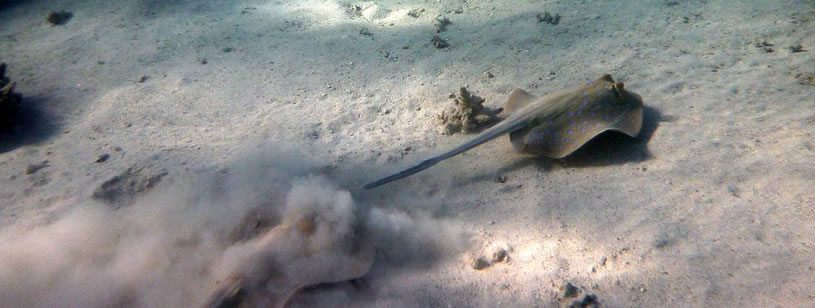
Stingrays are cartilaginous fishes related to sharks. Their broad pectoral fins form a flattened disc, and many species have a defensive spine on the tail. Body shape, habitat and diet differ between groups.
Most stingrays live in coastal seas, while some species have adapted to rivers. They are usually calm and avoid people, but many have a venomous spine on their tail, which they use for defence. Because of overfishing and habitat destruction, some species are threatened with extinction.
Quick facts
| Common name | Stingray |
| Scientific name | Myliobatiformes; Dasyatidae includes whiptail stingrays |
| Typical lifespan | About 15-25 years, depending on the species |
| Maximum speed | Mostly slow swimmers, but they can dart away quickly |
| Dimensions | From about 30 cm to over 2 m across (stingrays); their manta relatives reach about 7 m |
| Weight | From about 1 kg to about 300 kg (giant freshwater stingray) |
| Diet type | Carnivore (crustaceans, molluscs, worms, small fish) |
| Main predators | Sharks (especially hammerheads), orcas, large fish, humans |
| Conservation status | Assess separately by species and population; different taxa and regions have different needs |
| Distribution | Tropical and temperate seas around the world, as well as some rivers and estuaries |
| Living environment | Coastal waters, coral reefs, estuaries, sandy sea floors and fresh water (for some species) |
- Primary category:Marine animals
- Explore this animal's categories:
Interesting facts
- A venomous tail for defence - Most stingrays have a venomous spine, or barb, on their tail, which they use only when they feel threatened. A sting can be very painful and, in rare cases, deadly to people.
- Close relatives of sharks - Like sharks, stingrays are cartilaginous fish: they have no bones, but a flexible skeleton made of cartilage. Related profile: Shark.
- They "fly" underwater - Many stingrays swim by rippling or flapping their wide, wing-like fins, which looks like flying.
- Electric relatives - Electric rays, close relatives of stingrays, can produce electric shocks to defend themselves or stun prey.
- Freshwater stingrays - Some species, such as the ocellate river stingray (Potamotrygon motoro), live only in the rivers of South America.
- Giants of the ray family - The giant oceanic manta ray (Mobula birostris), a relative of stingrays in the same order, can be about 7 metres across, although it has no venomous spine.
- Eyes on top, mouth underneath - Stingrays have their eyes on the top of the body and their mouth on the underside, which suits life on the sea floor.
- Clever breathing - Openings behind the eyes, called spiracles, let stingrays draw in water to breathe while lying in the sand, without sucking in sand.
Records and remarkable features
- Stingrays are cartilaginous fishes related to sharks. Their broad pectoral fins form a flattened disc, and many species have a defensive spine on the tail. Body shape, habitat and diet differ between groups.
- The giant freshwater stingray (Urogymnus polylepis) of Southeast Asia is one of the largest freshwater fish in the world; a 300 kg individual was caught and released in the Mekong River in 2022.
- The short-tail stingray, from the waters of Australia, New Zealand and South Africa, is one of the largest sea stingrays, about 2 metres across.
Physical characteristics and adaptations
Stingrays have a distinctive shape, with a flat body, wide fins and a long tail, adapted for life on the sea floor or, in some relatives, in the open ocean.
Essential physical adaptations
- A flat body with wide pectoral fins - Lets them glide through the water like a bird flying.
- Eyes on top of the body - Because their mouth is underneath, stingrays cannot see their food while eating; they rely on smell, touch and special electric sensors called ampullae of Lorenzini.
- Mouth, nostrils and gills on the underside - These help them catch prey on the bottom and breathe even when partly buried in sand.
- A long tail, often with a venomous spine - Many species have a serrated spine covered with venomous tissue, used only for self-defence.
- Tough skin covered with mucus - Protects the body from parasites and scratches.
- An electric sense - The ampullae of Lorenzini detect the tiny electric fields made by animals hidden in the sand.
Habits and behaviour
Most stingrays live alone, but some species and their relatives, such as devil rays and mantas, gather in large groups.
Defence methods
- Hiding in the sand - Stingrays flip sand over their bodies to hide from predators, leaving only their eyes and spiracles showing.
- A defensive sting - If stepped on or grabbed, a stingray whips its tail up and can drive its spine into the attacker.
- Quick escapes - Stingrays can dart away quickly when disturbed.
Activity and lifestyle
- Active at dusk and night - Many species feed mainly at dawn, dusk and night.
- Bottom-dwellers and open-ocean swimmers - Most stingrays live on the sea floor, while some relatives, such as eagle rays and manta rays, swim in open water.
Habitat and geographic distribution
Stingrays live in warm and temperate seas around the world, from tropical reefs to sandy coasts, and some live in the rivers of South America, Africa and Asia.
Species distribution
| Region | Example species |
|---|---|
| Eastern Atlantic, Mediterranean and Black Sea | Common stingray (Dasyatis pastinaca) |
| Tropical Indian and Pacific Oceans | Bluespotted ribbontail ray (Taeniura lymma) |
| Rivers of South America | Ocellate river stingray (Potamotrygon motoro) |
| Temperate waters of the Southern Hemisphere | Short-tail stingray (Bathytoshia brevicaudata) |
Habitats
- Coral reefs and lagoons - Tropical species prefer warm, clear water with plenty of food.
- Coastal waters and sandy bottoms - Many species live on the sea floor, where they can hide in sand or mud.
- Estuaries and rivers - Some species live in brackish water or in large rivers.
Impact of climate change and human activities
- Warming seas - Rising water temperatures can change where species live.
- Water pollution - Plastic and chemicals harm stingrays, especially those living near coasts.
- Overfishing - Many stingrays are caught by accident in fishing nets meant for other fish, which contributes to their decline.
Diet and feeding
Stingrays are bottom-feeding predators that use their special senses to find prey hidden in the sand. They are carnivores that feed mainly on crustaceans, molluscs, worms and small fish.
What do stingrays eat?
| Type of food | Examples |
|---|---|
| Crustaceans | Crabs, shrimps, small lobsters |
| Molluscs | Clams, mussels, snails, squid |
| Small fish | Small bottom-dwelling fish |
| Marine worms | Bristle worms and other worms living in the sand |
Feeding methods
- Finding prey with electricity - The ampullae of Lorenzini pick up the faint electric signals of animals hidden in the sand.
- Digging in the sand - Stingrays flap their fins to stir up sand and uncover hidden prey.
- Water jets - Some species squirt water from their mouths to blow away sand and expose buried animals.
- Crushing shells - They have flat, hard tooth plates that crush the shells of crabs and clams.
Reproduction and life cycle
Stingrays give birth to live young. The young develop inside the mother, where they are fed first by the yolk and then by a nutritious "uterine milk".
Breeding season
- The breeding season varies with the species and habitat.
- During mating, males hold on to females by gripping them with their teeth.
Pregnancy and birth
| Feature | Details |
|---|---|
| Type of reproduction | Live birth (the young develop inside the mother) |
| Pregnancy | About 3-12 months (depending on the species) |
| Young per litter | Usually 2-10 |
| At birth | The pups are fully formed and independent |
Young stingrays
- The pups look like miniature adults and can swim and feed as soon as they are born.
- They get no care from their parents and rely on camouflage and instinct to survive.
- Many young stingrays are eaten by predators, such as sharks and large fish.
Name and history
Origin of the name
- The English name "stingray" combines "sting" and "ray"; in Romanian, the stingray is called pisică de mare, "sea cat", perhaps because of its long, whip-like tail, like that of a cat.
- The family name Dasyatidae comes from Greek and means "rough rays", referring to their rough skin.
Taxonomic classification
| Classification | Name |
|---|---|
| Kingdom | Animalia |
| Phylum | Chordata |
| Class | Chondrichthyes (cartilaginous fish) |
| Order | Myliobatiformes |
| Family | Dasyatidae (whiptail stingrays) and several other stingray families |
Evolution and fossils
- Rays have an evolutionary history of more than 150 million years, going back to the Jurassic period, and they are close relatives of sharks.
- Fossil stingrays look quite similar to modern species, showing that their flat body shape has worked well for a very long time.
Cultural significance and mythology
In different cultures, stingrays and their relatives have been honoured, feared and respected, often as symbols of the sea, strength and danger.
Stingrays in myths and beliefs
- Polynesia - Manta and stingray designs are common in traditional Polynesian tattoos, where they stand for grace, freedom and protection.
- The Maya - Maya kings and priests used stingray spines as sacred tools in bloodletting rituals offered to the gods.
- Ancient Greece - According to one ancient legend, the hero Odysseus was killed by a spear tipped with a stingray spine.
- Japan - Rough ray skin, called samegawa, was wrapped around the handles of samurai swords to give a firm grip.
Conservation status and threats
Many stingray species are threatened by human activities, especially overfishing, habitat destruction and climate change.
Conservation status
| Species | IUCN status | Situation |
|---|---|---|
| Common stingray (Dasyatis pastinaca) | Vulnerable | Declining because of fishing |
| Giant oceanic manta ray (Mobula birostris) | Endangered | Reduced by fishing for its gill plates |
| Giant freshwater stingray (Urogymnus polylepis) | Endangered | Threatened by overfishing and dams |
| Bluespotted ribbontail ray (Taeniura lymma) | Least Concern | Widespread, but affected locally by reef damage |
Major threats
- Overfishing and bycatch - Stingrays are caught for food and are often caught by accident in nets meant for other fish.
- Trade in body parts - Manta and devil rays are hunted for their gill plates, which are sold in traditional medicine markets.
- Ocean pollution - Plastic and heavy metals in the water harm stingrays' health.
- Habitat destruction - Coral reefs, mangroves and sandy coasts are damaged by building and coastal development.
- Climate change - Rising water temperatures affect stingrays' food and movements.
Protection measures
- Fishing limits - Some countries have strict rules to protect threatened rays, and manta rays are protected by CITES.
- Marine protected areas - Reefs and coasts are protected to help stingrays survive.
- Education and ecotourism - Responsible diving and snorkelling with rays helps people understand their importance.
In popular culture
Stingrays appear in films, documentaries and stories, fascinating people with their unusual shape and graceful swimming.
Film and documentaries
- Finding Nemo (2003) - Mr Ray, a spotted eagle ray, is the friendly teacher who takes the young fish on school trips.
- The Blue Planet (BBC, 2001) - The documentary series shows the amazing behaviour of rays in the wild.
Famous stories
- Steve Irwin - The famous Australian wildlife presenter died in 2006 after being struck in the chest by a stingray's spine while filming; such deaths are extremely rare.
- Stingray City - In the Cayman Islands, visitors can swim with friendly southern stingrays in shallow water, one of the most famous wildlife experiences in the Caribbean.