GuppyPoecilia reticulata — habitat, diet and reproduction
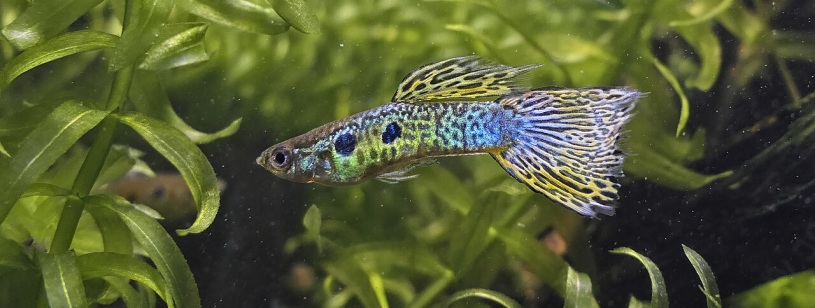
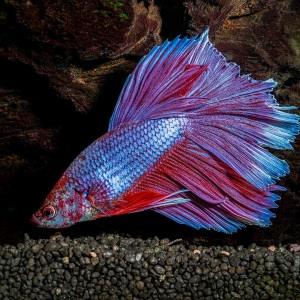
Male guppy (Poecilia reticulata), an ornamental variety. · 5snake5 / CC0 (http://creativecommons.org/publicdomain/zero/1.0/deed.en).
The guppy is a small freshwater fish native to northern South America and parts of the Caribbean. Males are generally smaller and more colourful than females. Females give birth to young that can swim immediately. Ornamental varieties have more diverse tails and patterns than wild populations.
Quick facts
| Common name | Guppy |
| Scientific name | Poecilia reticulata |
| Lifespan | Several years under good care conditions |
| Length | Males to 2.5 cm; females to 6 cm, excluding the tail fin |
| Diet | Omnivore: small animals, algae and organic material |
| Predators | Larger fish and other aquatic predators |
| Conservation status | Least Concern (LC) |
| Distribution | Northern South America and southern Lesser Antilles; introduced elsewhere |
| Habitat | Streams, pools, canals and vegetated margins |
| Family | Poeciliidae |
| Reproduction | Internal fertilisation and live birth |
| Sex differences | Males are smaller and have a gonopodium |
- Primary category:Fish
- Explore this animal's categories:
Interesting facts
- Females can retain sperm and produce successive broods after mating.
- The male anal fin is modified into a reproductive organ.
- Newborn fry can feed independently.
- Ornamental tails may be triangular, rounded or elongated into other shapes.
Characteristics
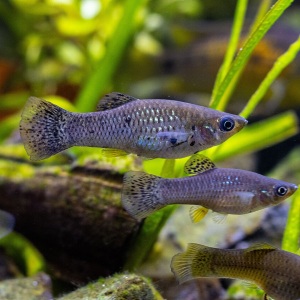
Males often carry contrasting spots on the body and tail. Females are usually larger, with fuller abdomens and less conspicuous colour. Ornamental forms vary greatly in colour and tail shape.
The gonopodium is the male’s modified anal fin, used to transfer sperm. Females retain a triangular anal fin. This distinction helps identify the sexes.
Endler’s livebearer, Poecilia wingei, is a related aquarium species. Identification matters when maintaining breeding lines.
Behaviour
Guppies move in groups and explore water and food-bearing surfaces. Males pursue females during courtship. Plants and adequate space offer retreat and reduce pressure on individual fish.
Stocking must match tank volume and filtration. OATA suggests at least 45 litres for a small group of smaller species. Rapid reproduction can soon change the aquarium’s load. Long-finned varieties may be injured by aggressive tankmates or rough ornaments.
Habitat and distribution
The native range includes northern South America and the southern Lesser Antilles. Human introductions have greatly expanded distribution.
Habitats include streams, canals, pools and vegetated margins. Conditions differ between populations. Stable water, effective filtration and swimming space are important in aquariums.
Diet and feeding
Guppies eat small invertebrates, zooplankton, algae and organic particles. They forage in the water and on surfaces, using local resources.
Captive fish need suitable complete omnivore food in small portions, with appropriate variety. Excess food decomposes and affects water quality. Overfeeding and rapid population growth can overload biological filtration.
Reproduction and life cycle
Fertilisation is internal, and embryos develop within the female. After roughly four to six weeks, a brood may contain around 20–40 young. Brood size and timing vary with size, age and conditions.
Fry swim and feed immediately. Adults provide no care and may eat them; dense vegetation offers refuge. Females can store sperm, so further broods may appear after separation from males.
Name and history
Peters published Poecilia reticulata in 1859. Older literature also uses Lebistes reticulatus.
Selective breeding has produced many ornamental forms. Trade names often describe colours or tail patterns while referring to the same species.
Conservation and threats
The species is globally Least Concern. Introduced populations can alter interactions with native fish and invertebrates. Its broad distribution partly reflects human activity.
Aquarium fish should remain in controlled systems rather than being released. Local ecosystem protection matters even for familiar companion species.
Frequently asked questions
How can males and females be distinguished?
Males are usually smaller and have a narrow, modified anal fin called a gonopodium. Females have a triangular anal fin.
Can a female produce young after males are removed?
Yes. Stored sperm can be used for later fertilisation.
Do adults care for fry?
Fry feed independently, and adults may eat them. Dense plants provide hiding places.
Are guppies and Endler’s livebearers the same species?
They are Poecilia reticulata and Poecilia wingei respectively. They are closely related but distinct species.