NarwhalInteresting facts and information
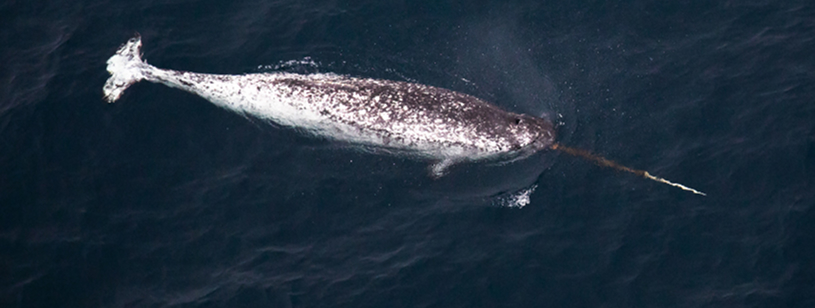
The narwhal (Monodon monoceros) is an Arctic whale. Many males have a long tusk that develops from an upper tooth, while females usually do not. Narwhals feed on fish and other marine animals.
Narwhals live in the cold waters of the Arctic and are adapted to life among the ice. They feed on fish, squid and shrimp, and their only close living relative is the beluga; together they form the family Monodontidae.
For centuries, narwhal tusks were sold in Europe as unicorn horns. Today, the narwhal is not considered threatened, but it is sensitive to climate change, noise and other human activities.
Quick facts
| Common name | Narwhal |
| Scientific name | Monodon monoceros |
| Typical lifespan | Often about 50 years; possibly much longer |
| Maximum speed | Varies with species or individual, distance and conditions |
| Length | About 4-5.5 m (males), 3.5-4.5 m (females), without the tusk |
| Weight | About 800 - 1,600 kg |
| Diet type | Carnivore (fish, squid, shrimp) |
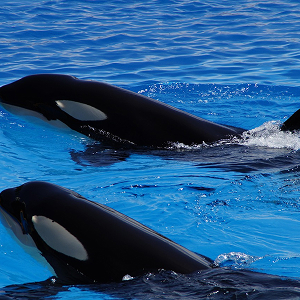
| Main predators | Orcas, polar bears, humans (Inuit hunting) |
| Conservation status | Least Concern (IUCN) |
| Habitat | Arctic waters, bays, fjords and areas of pack ice |
| Distribution (continents) | Arctic waters of North America (Canada), Greenland, Europe and Russia |
Interesting facts
- A tooth, not a horn - The narwhal's tusk is a very long upper left canine tooth that grows in a spiral through the upper lip and can be up to about 3 metres long.
- Two tusks - Very rarely, a narwhal grows two tusks, and some females also have a tusk.
- A sensitive tusk - The tusk has many tiny channels leading to nerves, and studies suggest it may help narwhals sense changes in the water.
- Hard to study - Narwhals live in remote, ice-covered Arctic waters, so much about their lives is still unknown.
- "Unicorn horns" - In medieval Europe, narwhal tusks were sold as unicorn horns, and kings paid huge sums for them.
Records and remarkable features
- The narwhal (Monodon monoceros) is an Arctic whale. Many males have a long tusk that develops from an upper tooth, while females usually do not. Narwhals feed on fish and other marine animals.
- Deep divers - Narwhals can dive to depths of about 1,500-1,800 metres to feed.
Physical characteristics and adaptations
The narwhal is one of the most distinctive marine mammals, thanks to its tusk and its adaptations to life among the Arctic ice.
Distinguishing physical appearance
- No dorsal fin - Instead of a dorsal fin, narwhals have a low ridge on the back, which may help them swim under ice.
- Thick blubber - A thick layer of fat keeps them warm in near-freezing water.
- Changing colours - Calves are blue-grey, adults are mottled grey and white, and old narwhals can be almost white.
The narwhal's tusk - what is it and what is it for?
The narwhal's tusk is a tooth, usually the upper left canine, that grows out through the lip in a left-handed spiral. Most males have a tusk, while only a small number of females do.
Possible functions of the tusk
- Sensing the environment - The tusk is full of tiny channels connected to nerves, which may let narwhals sense changes in the water.
- Social behaviour - Males are sometimes seen rubbing their tusks together, perhaps to communicate.
- Attracting females - Long tusks may show that a male is healthy and strong, making them attractive to females.
- Hunting - Drone footage has shown narwhals tapping Arctic cod with their tusks, stunning the fish before eating them.
Habits and behaviour
Narwhals are social, migratory whales adapted to life in cold, ice-covered Arctic waters.
Life mode and daily routine
- Life in the dark - In winter, they live under the ice in near-total darkness, relying on echolocation to find their way and their food.
- Deep dives - In winter, narwhals dive many times a day to depths of over 1,000 metres.
- Migrations - They travel hundreds of kilometres each year between summer areas in coastal bays and fjords and winter areas offshore under dense pack ice.
Social behaviour and interactions
- Groups - Narwhals usually live in groups of a few to about 20 animals, but in summer hundreds or even thousands may gather together.
- Separate groups - Groups are often made up of females with calves, young animals or adult males.
- Sounds - Narwhals use clicks, whistles and pulsed calls to communicate and to echolocate.
Strategies for avoiding predators
- Hiding in shallow water or under ice - When orcas are near, narwhals often move close to shore or into ice-covered areas.
- Staying under ice - Narwhals can swim far under the ice, using small cracks to breathe.
- Staying together - Moving in groups may help protect them from predators.
Habitat and geographic distribution
Narwhals live only in the Arctic, mainly in the Atlantic part of the Arctic Ocean, in cold, deep waters near sea ice.
Geographical distribution
| Region | Areas |
|---|---|
| Canada | Baffin Bay, the Canadian Arctic islands, northern Hudson Bay |
| Greenland and Europe | Greenland, Svalbard and the Greenland Sea |
| Russia | Parts of the Russian Arctic, such as Franz Josef Land |
Habitats
- Coastal bays and fjords - In summer, many narwhals gather in the ice-free bays and fjords of Canada and Greenland.
- Pack ice - In winter, they live offshore in deep water under heavy pack ice.
- Openings in the ice - Cracks and openings in the ice, called leads and polynyas, are essential for breathing.
Habitat threats
- Climate change - Shrinking sea ice changes their habitat and lets orcas reach new areas.
- Shipping and noise - More ships and noise in the Arctic can disturb narwhals, which are very sensitive to sound.
- Hunting - Inuit communities in Canada and Greenland hunt narwhals for food and tusks under quota systems.
Diet and feeding
Narwhals feed on fish, squid and shrimp. Although the tusk looks like a weapon, narwhals find prey mainly by echolocation and swallow it by suction.
What do narwhals eat?
| Type of prey | Examples |
|---|---|
| Fish | Greenland halibut, Arctic cod, polar cod |
| Cephalopods | Squid (especially Gonatus) |
| Crustaceans | Shrimps |
| Bottom-living fish | Fish living near the deep seabed |
Method of feeding
- Echolocation - Narwhals send out clicks to find prey in dark, deep water.
- Suction - Narwhals have no functional teeth in the mouth, so they suck prey in and swallow it whole.
- Deep feeding - They dive to great depths to catch Greenland halibut and squid near the seabed.
- Stunning fish - They have been seen using their tusk to stun fish.
Food behaviour
- Most feeding in winter - Studies suggest narwhals feed most heavily in winter under the ice and eat much less in summer.
- Building reserves - Their thick blubber stores energy for periods with less food.
- Swallowing whole - Narwhals do not chew their food.
Reproduction and life cycle
Narwhals breed slowly: females usually have a single calf every three years or so, after a long pregnancy.
Breeding and birth
| Characteristic | Details |
|---|---|
| Sexual maturity | About 6 to 9 years (females), later in males |
| Breeding season | Spring (about March - May) |
| Gestation | About 14 - 15 months |
| Number of calves | 1 calf |
| Length of the calf at birth | About 1.5 m |
| Nursing | About 20 months |
| Birth interval | About 3 years |
Reproductive behaviour
- Competition between males - Males may cross or rub tusks, perhaps to compare strength; broken tusks and scars suggest occasional fights.
- Birth in summer - Calves are usually born in summer, often in coastal bays.
- Rich milk - The mother's fatty milk helps the calf build up blubber quickly.
- Long dependence - Calves stay with their mothers for about two years.
Longevity
- Narwhals often live about 50 years, and studies of their eye lenses suggest some may live much longer.
- Scientists estimate the age of narwhals using growth layers in the tusk or chemical changes in the eye lens.
Name and history
The origin of the name "Narwhal"
- The name comes from Old Norse nár, "corpse", and hvalr, "whale", perhaps because its mottled grey skin reminded sailors of a drowned body.
- The scientific name Monodon monoceros comes from Greek and means "one tooth, one horn".
Taxonomic Classification
| Kingdom | Animalia |
|---|---|
| Phylum | Chordata |
| Class | Mammalia |
| Order | Artiodactyla (cetaceans) |
| Family | Monodontidae |
| Genus | Monodon |
| Species | Monodon monoceros |
History and documentation
- The sea unicorn - In medieval Europe, narwhal tusks were sold as unicorn horns, believed to protect against poison.
- The truth revealed - From the 17th century, naturalists showed that "unicorn horns" were in fact narwhal tusks, and their value fell.
- The closest relative - The narwhal's only close living relative is the beluga; together they form the family Monodontidae.
Cultural significance and mythology
The narwhal is important to the Inuit and helped create European legends of the unicorn.
The narwhal in mythology and traditions
- The sea unicorn in Europe - Narwhal tusks sold as "unicorn horns" were treasures of kings; Queen Elizabeth I of England was given one said to be worth as much as a castle, and the Danish royal Throne Chair is made largely of narwhal tusks.
- Inuit legend - According to an Inuit story, a woman was dragged into the sea by a harpooned whale, and her twisted braid of hair became the narwhal's tusk.
- Inuit life - For Inuit communities, the narwhal is an important source of food, including mattaaq (skin and blubber), which is rich in vitamin C.
The narwhal in cultural symbolism
| Culture | Meaning |
|---|---|
| Medieval Europe | The unicorn, symbol of purity and protection against poison |
| Inuit | An important animal for food, tools and traditions |
| Danish monarchy | Royal power, as in the narwhal-tusk throne |
| The modern world | A symbol of the Arctic and its mysterious wildlife |
Conservation status and threats
The narwhal is listed as Least Concern by the IUCN, but it is sensitive to climate change, noise and other human activities.
Main threats to narwhals
- Climate change - Loss of sea ice changes their habitat, prey and migration routes.
- Shipping and industry - Ships, seismic surveys and mining bring noise that can disturb narwhals.
- Hunting - Inuit communities in Canada and Greenland hunt narwhals, with catches managed by quotas.
- Pollution - Mercury and other pollutants build up in Arctic food webs.
- Orcas - As sea ice shrinks, orcas reach narwhal areas more often and hunt them.
Conservation status (IUCN)
| Species | Status |
|---|---|
| Monodon monoceros (narwhal) | Least Concern (since 2017; previously Near Threatened) |
Conservation efforts
- Research - Scientists use satellite tags, underwater microphones and drones to study narwhals.
- Managed hunting - Hunting is limited by quotas, and international trade in tusks is controlled under CITES.
- Protected areas - Large marine protected areas in the Canadian Arctic, such as Tallurutiup Imanga, protect important narwhal habitats.
In popular culture
The narwhal has become a popular, almost magical animal in modern culture.
The narwhal in films and television
- "Elf" (2003) - Mr. Narwhal, a friendly stop-motion narwhal, says goodbye to Buddy as he leaves the North Pole.
- Nature documentaries show narwhals gathering in Arctic bays and using their tusks.
The narwhal in books
- "Moby-Dick" (Herman Melville, 1851) - Melville describes the narwhal as the "unicorn whale".
- "Narwhal and Jelly" (Ben Clanton) - A popular series of children's books about a cheerful narwhal and his friend Jelly.
The narwhal in digital culture
- "Narwhals" (2009) - A funny animated song about narwhals became a viral internet hit.
- Merchandise - Narwhals, often called "the unicorns of the sea", are popular on toys, clothes and stickers.