Blue whaleInteresting facts and information
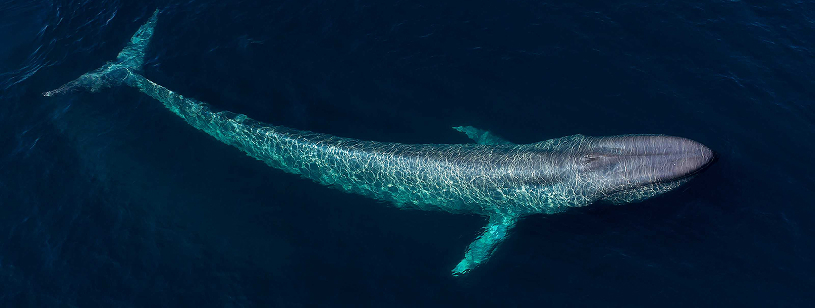
The blue whale (Balaenoptera musculus) is the largest living animal and a highly specialised marine mammal. It can grow to roughly 30 metres, with size varying between populations and individuals.
Blue whales belong to the family Balaenopteridae. They feed mainly on krill, using baleen to separate prey from water. They are often seen alone or in small groups, though feeding aggregations occur.
Due to excessive hunting in the 19th and 20th centuries, the blue whale populations have fallen dramatically, and the species is now considered endangered, although conservation efforts have led to a slow recovery of some populations.
Quick facts
| Common name | Blue whale |
| Scientific name | Balaenoptera musculus |
| Typical lifespan | Estimated around 80–90 years; age estimates have uncertainty |
| Length | About 24-30 m (females are larger than males) |
| Weight | Large adults can exceed 100 tonnes; mass varies by individual |
| Diet type | Carnivorous (feeds almost only on krill) |
| Main predators | Killer whales (mainly calves); people (hunting in the past) |
| Conservation status | Endangered; NOAA also lists the species as endangered under the US Endangered Species Act |
| Distribution | All the world's oceans except the Arctic |
| Living environment | Coastal and oceanic waters, in krill-rich areas |
- Primary category:Mammals
- Explore this animal's categories:
Interesting facts
- Large organs – A blue whale has an enormous heart and tongue, but common comparisons with cars or elephants should not be treated as precise measurements.
- Feeding – Blue whales engulf prey-filled water and filter krill through their baleen. Food intake depends on the animal, prey availability and season.
- Underwater sound – Blue whales produce powerful low-frequency calls. Underwater decibel values cannot be directly compared with airborne jet-engine noise.
- Long journeys - Many blue whales migrate thousands of kilometres between rich feeding areas and warmer waters where they are thought to breed.
- A tall blow - When a blue whale breathes out at the surface, its spout can reach about 9 m high.
- A very slow heartbeat - During deep dives, a blue whale's heart can slow to just two beats a minute.
Records and remarkable features
- Exceptional size – Blue whales are the largest living animals and among the largest animals known to science.
- Low-frequency calls – Blue whale calls can travel long distances underwater; range depends on the sound and environmental conditions.
- The largest heart - A blue whale heart measured in 2014 weighed about 180 kg, and each beat can pump about 200 litres of blood.
- Large calves – Newborn blue whales are several metres long and weigh several tonnes.
- The fastest growth - A baby blue whale can gain about 90 kg a day while drinking its mother's milk.
Physical characteristics and adaptations
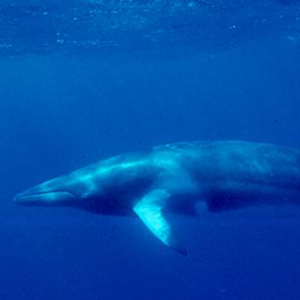
The blue whale (Balaenoptera musculus) is the largest animal known to have ever lived. Despite its enormous size, its long, streamlined body moves gracefully through the water, usually at about 8-20 km/h, with short bursts of more than 30 km/h.
Key physical adaptations
- A long, streamlined body - Reduces drag and allows efficient swimming.
- Throat pleats - About 60-90 grooves running along the throat let it expand like a balloon to take in huge mouthfuls of water and krill.
- Baleen instead of teeth - About 270-400 black baleen plates hang from each side of the upper jaw and filter krill from the water.
- A powerful tail - The tail flukes push the whale through the water.
- Large lungs - It can stay underwater for about 10-20 minutes, sometimes longer.
- Two blowholes - On top of the head, they let it breathe while barely breaking the surface.
What does the blue whale look like?
| Characteristic | Details |
|---|---|
| Colour | Blue-grey with lighter mottling; looks blue underwater |
| Length | Usually about 24-30 m (females are larger than males) |
| Weight | Usually about 100-150 tonnes; the largest may reach about 190 tonnes |
| Baleen plates | Black, up to about 1 m long |
| Flippers | About 3-4 m long |
| Dorsal fin | Very small, far back on the body |
Habits and behaviour
Blue whales are usually seen alone or in pairs, although several may gather where krill is plentiful.
Daily life
- Mostly alone - Blue whales usually travel alone or in pairs, often a mother and calf.
- Migration - Many populations move between cold feeding waters and warmer waters, but some stay in the same region all year.
- Low calls - Blue whales make very low, powerful calls, mostly too low for people to hear, which can travel hundreds of kilometres underwater.
- Speed - They usually cruise at about 8-20 km/h.
Specific behaviors
- Diving - They usually dive for about 10-20 minutes and then come up to breathe several times.
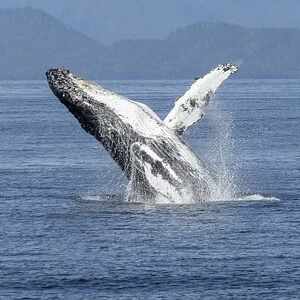
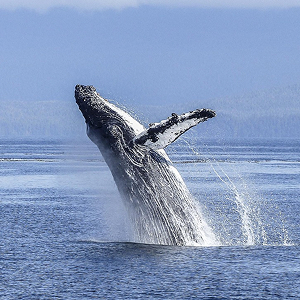
- Showing the tail - Blue whales sometimes lift their tail flukes before a deep dive; researchers use markings on the body to recognise individuals.
- Gatherings - Several whales may feed in the same area when there is a lot of krill.
Survival strategies
- Predators – Killer whales can attack blue whales, including some adults. Great size does not make a blue whale invulnerable.
- Long-distance calls may help whales keep in touch and find mates.
- Blue whales follow the seasons to areas where krill is most plentiful.
Habitat and geographic distribution
Blue whales live in all the world's oceans except the Arctic, especially in waters rich in krill.
Distribution context
| Region | Population information | Habitat examples |
|---|---|---|
| Southern Ocean (Antarctica) | Hit hardest by whaling; slowly recovering | Krill-rich waters around Antarctica |
| Eastern North Pacific | The largest known population, about 2,000 whales | Waters off California and Mexico |
| North Atlantic | Small numbers | Gulf of St Lawrence, waters off Iceland and the Azores |
| Indian Ocean | Pygmy blue whales and other populations | Waters off Sri Lanka and Australia |
| Southern Pacific | Several populations | Waters off Chile and New Zealand |
Habitat types
- Cold, productive waters - Polar and temperate seas with plenty of krill are key feeding areas.
- Warmer waters - Blue whales are thought to breed and give birth in warmer waters in winter.
- Upwelling areas - Places where cold, nutrient-rich water rises to the surface attract lots of krill and blue whales.
Environmental change
- Climate change - Warming seas and melting sea ice may reduce krill in some areas.
- Noise - Noise from ships and sonar can mask whale calls.
- Ship traffic - Collisions with large ships kill blue whales in busy shipping lanes.
Diet and feeding
The blue whale eats almost only krill, small shrimp-like crustaceans that form huge swarms. Although it is the largest animal on Earth, it feeds on some of the smallest animals in the sea.
What does the blue whale eat?
| Food group | Examples |
|---|---|
| Krill | Antarctic krill (Euphausia superba), Thysanoessa species |
| Other small crustaceans | Copepods and other tiny crustaceans, occasionally |
| Small fish | Swallowed by accident along with krill |
Feeding methods
- Filtering - The whale takes in a huge mouthful of water and krill, then pushes the water out through its baleen, trapping the krill inside.
- Lunge feeding – The throat pleats expand as a whale engulfs prey-filled water.
- Feasting - In the feeding season, a blue whale can eat several tonnes of krill a day; some studies suggest up to about 16 tonnes on a good day.
- Fasting - During migration and in breeding areas, blue whales eat much less, living on their fat reserves.
Reproduction and life cycle
Blue whales breed slowly, which is why their populations have been slow to recover from whaling.
Breeding season
- Females usually give birth every 2-3 years, mostly in winter.
- Males may sing low songs to attract females; each population has its own song.
- Mating and births are thought to take place in warmer waters, but have rarely been seen.
Developmental stages
| Stage | Duration | Characteristics |
|---|---|---|
| Gestation | About 10-12 months | The female gives birth to a single calf |
| Newborn calf | About 7 m long | Weighs about 2.5-3 tonnes |
| Nursing | About 6-7 months | Gains about 90 kg a day |
| Independence | After weaning | The young whale learns to feed itself |
| Sexual maturity | About 5-15 years | Depending on the individual and population |
Survival strategies
- Rich milk - Blue whale milk contains about 35-50% fat, which helps calves grow very fast.
- Protective mothers - Mothers stay close to their calves, which may be attacked by killer whales.
- Long lives - Blue whales can live about 80-90 years; scientists estimate their age by counting layers in their earwax plugs.
Name and history
Origin of the name
- "Blue whale" comes from the blue-grey colour of its skin, which looks bright blue underwater.
- The scientific name Balaenoptera musculus comes from Latin and Greek: Balaenoptera means "winged whale", and musculus can mean both "muscular" and "little mouse"; the naturalist Carl Linnaeus may have intended a joke.
Taxonomic classification
| Classification | Name |
|---|---|
| Kingdom | Animalia |
| Phylum | Chordata |
| Class | Mammalia |
| Order | Artiodactyla (cetaceans) |
| Family | Balaenopteridae |
| Genus | Balaenoptera |
| Species | Balaenoptera musculus |
Evolution and fossils
- The ancestors of whales were land mammals related to hippos, which began to adapt to life in water about 50 million years ago.
- Fossils of early whales, such as Basilosaurus, still had tiny hind legs, showing the move from land to sea.
- Giant filter-feeding whales appeared only in the last few million years, when ocean conditions produced huge swarms of krill.
Cultural significance and mythology
As the largest animal on Earth, the blue whale has become a symbol of the power and mystery of the oceans and of the fight to save endangered species.
- "Hope" - Since 2017, the skeleton of a blue whale named Hope has hung in the main hall of the Natural History Museum in London, as a symbol of humanity's power to protect nature.
- A famous model - A life-size model of a blue whale, about 29 m long, hangs in the American Museum of Natural History in New York.
- The "52-hertz whale" - A whale, possibly a blue whale hybrid, that calls at an unusually high frequency has been nicknamed "the loneliest whale in the world".
Conservation status and threats
The blue whale is listed as Endangered by the IUCN. It was hunted almost to extinction, and today it faces new threats such as ship strikes and noise.
Main pressures
- Past whaling - In the 20th century, about 360,000 blue whales were killed, most of them in the Antarctic, reducing that population by more than 99%.
- Noise pollution - Ship noise and sonar can interfere with whale communication.
- Less krill - Ocean warming and krill fishing may reduce their food.
- Ship strikes - Large ships hit and kill blue whales in busy shipping lanes.
- Pollution - Plastics and chemicals in the ocean may affect whale health.
Protection efforts
| Measure | Organization / Action |
|---|---|
| Ban on commercial hunting | Blue whales have been protected by the International Whaling Commission since 1966 |
| Marine protected areas | Protected areas in Chile, Canada, the USA, Australia and elsewhere |
| Slower ships | Voluntary slow-down zones for ships, for example off California, reduce collisions |
| Research and monitoring | Scientists, NOAA and conservation groups track blue whales with photographs, tags and underwater microphones |
Current population
- Before modern whaling, there were probably more than 300,000 blue whales, most of them in the Southern Ocean.
- Today, there are thought to be about 5,000-15,000 adult blue whales in the world.
- Some populations are slowly recovering, but the species is still endangered.
Blue whale in popular culture
Because of its huge size, the blue whale appears in books, films and documentaries as a symbol of the greatness and mystery of the ocean.
Blue whale in books and documentaries
- The Blue Planet (BBC, 2001) - The series opens with remarkable footage of blue whales.
- Moby-Dick (Herman Melville, 1851) - The novel is about a white sperm whale, not a blue whale, but it describes many kinds of great whales.
- Children's books - The blue whale is a favourite subject of books about the biggest animals on Earth.