European eelAnguilla anguilla — habitat, diet and reproduction
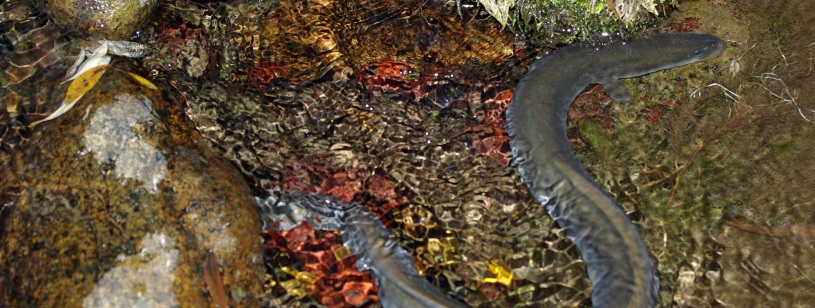
European eel (Anguilla anguilla) with a long body and fins continuous around the tail. · David Pérez (DPC) / Wikimedia Commons / CC BY 3.0 (https://creativecommons.org/licenses/by/3.0/). Cropped and resized. Source: https://commons.wikimedia.org/wiki/File:Anguilla_anguilla_01_by-dpc.jpg
European eels (Anguilla anguilla) are long-bodied fish that grow in rivers, lakes, estuaries or coastal waters. They eventually migrate towards the Sargasso Sea. Before departure, the belly becomes silvery and the eyes enlarge.
Quick facts
| Common name | European eel |
| Scientific name | Anguilla anguilla |
| Lifespan | Variable; continental growth often lasts 5–20 years, with some individuals living much longer |
| Length | Adults roughly 20–120 cm in the DiadSea guide; females are generally larger |
| Diet | Aquatic invertebrates and small fish |
| Predators | Predatory fish, fish-eating birds and otters, depending on habitat |
| Conservation status | Critically Endangered (CR) |
| Distribution | Europe, northern Africa and the North Atlantic |
| Habitat | Rivers, lakes, estuaries and coastal waters; oceanic migration |
| Family | Anguillidae |
| Activity | Mainly nocturnal and crepuscular |
| Reproduction | Migration to the Sargasso Sea region |
Interesting facts
- The oceanic larva is transparent and leaf-shaped.
- Near the coast, larvae transform into nearly transparent glass eels.
- Eyes enlarge during the change to the silver stage.
- The growth phase can last for decades.
Records and extremes
The spawning migration covers thousands of kilometres. Satellite tagging has tracked adults from the Azores to the Sargasso Sea region.
Inland Fisheries Ireland reports individuals up to 50 years old in its monitoring programme. This is a regional observation rather than a typical lifespan.
Characteristics
The body is cylindrical towards the front and more compressed near the tail. The long dorsal and anal fins join the tail fin, while small pectoral fins sit behind the head.
Tiny scales are embedded in the skin. The lower jaw projects slightly beyond the upper. Females generally grow larger than males.
Yellow eels have brownish or greenish backs and pale yellowish undersides. Silver eels have more contrasting colours and larger eyes.
Behaviour
Eels are most active at night and around twilight. During daylight they shelter beneath stones, among plants or in soft sediment.
They are catadromous, growing in continental or coastal waters before migrating to the ocean to reproduce. Dark nights and increased flows can encourage downstream departure.
Habitat and distribution
European eels occupy the North Atlantic, European waters and northern Africa. Some grow in freshwater, while others remain in estuaries or coastal habitats.
The Sargasso Sea lies east of North America. Small larvae collected there and adult tracking data support its role as the spawning region.
Diet and feeding
Growing eels eat aquatic invertebrates and small fish, including insect larvae, worms and crustaceans. They forage near the bottom and around cover.
An Irish lake study found differences in movement and activity between eels with different feeding specialisms. Individual diets can therefore influence habitat use.
Reproduction and life cycle
Oceanic larvae travel towards European and North African coasts, becoming cylindrical glass eels near the continental shelf. Pigmentation develops as they enter the growth phase.
Silvering prepares the fish for oceanic migration, and reproductive maturation continues during the journey.
The species is understood to spawn once and then die. Spawning itself remains unobserved in the wild in the consulted sources; the 2022 study tracked arrival in the presumed breeding region.
Name and history
Linnaeus described the species in 1758. European eels belong to Anguillidae and are related to American eels, Anguilla rostrata.
Early twentieth-century larval surveys led Johannes Schmidt towards the Sargasso Sea. Satellite tags later provided direct information about adult migration routes.
Conservation and threats
European eels are Critically Endangered. The decline in juveniles reaching continental waters is a central concern.
Barriers, habitat loss, fishing, pollution and parasites affect survival. The parasite Anguillicola crassus can damage the swim bladder, an organ involved in buoyancy control.
Conservation needs connected habitats and protection across the growth and migration stages. Monitoring both incoming juveniles and departing silver eels helps assess recovery.
Frequently asked questions
Is a European eel a snake?
It is a fish with gills and fins, belonging to Anguillidae.
Does it have scales?
It has tiny scales embedded in its skin.
What is a glass eel?
The nearly transparent juvenile stage formed from an oceanic larva.
Do all European eels grow in rivers?
Some grow in estuaries or coastal waters instead.
Why is it called a silver eel?
The underside becomes silvery as the fish prepares for oceanic migration.
Has wild spawning been directly observed?
Larvae and adult tracking support the Sargasso Sea breeding region, but the spawning act remains unobserved in the consulted sources.