Oscar fishAstronotus ocellatus — habitat, diet and reproduction
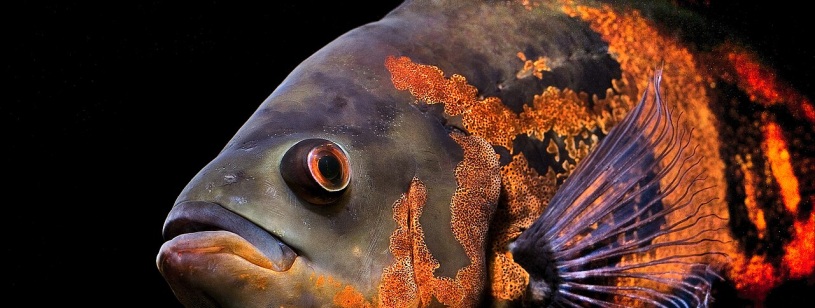
Oscar (Astronotus ocellatus) in an aquarium. · Jón Helgi Jónsson (Amything) / CC BY-SA 3.0 (http://creativecommons.org/licenses/by-sa/3.0/). Cropped and resized.
The Oscar is a large cichlid from the Amazon basin and one of the most intelligent aquarium fish. It can exceed 30 centimetres and quickly learns to recognise its owner. At the tail base it has an eye-like spot that can fool predators.
Quick facts
| Common name | Oscar |
| Scientific name | Astronotus ocellatus |
| Lifespan | About 10–20 years |
| Length | Usually about 30–35 cm; up to about 45 cm |
| Weight | Up to about 1.6 kg |
| Diet | Carnivore: small fish, crayfish, insects, larvae |
| Predators | Large fish, waterbirds, caimans |
| Conservation status | Not considered threatened |
| Distribution | South America: Amazon and Orinoco basins |
| Habitat | Slow rivers, lakes and flooded forests |
| Family | Cichlidae |
| Reproduction | Eggs on stones, guarded by both parents |
- Primary category:Fish
- Explore this animal's categories:
Interesting facts
- The black, orange-ringed spot on the tail is called an ocellus and looks like an eye.
- Oscars can learn to eat from their owner’s hand.
- In South America, the Oscar is also fished for food.
- It has been introduced to Florida, where it now lives in canals and lakes.
Characteristics
The Oscar has an oval, deep, sturdy body with a large head and thick lips. The wild form is dark olive with irregular orange patches. The aquarium trade offers red, albino, “tiger” and long-finned forms.
The eyes are red, and at the tail base is an ocellus: a dark spot ringed with orange. Males and females look almost identical.
Behaviour
Oscars are curious fish that watch what happens outside the aquarium. Many owners say their fish recognises them and “begs” for food when it sees them.
They can be territorial and aggressive towards smaller fish and like to rearrange stones and plants, so aquarium decor must be solid.
Habitat and distribution
The species naturally lives in the Amazon and Orinoco basins of Peru, Colombia, Brazil and French Guiana, in slow waters, lakes and flooded forests with soft bottoms.
People have introduced the Oscar to Florida, China and other warm regions.
Diet and feeding
The Oscar is a predator. In the wild it eats small fish, crayfish, aquatic insects, larvae and snails.
In aquariums it gets pellets for large cichlids plus shrimp, worms and insects. Feeding only live feeder fish can bring disease and imbalance, so it is avoided.
Reproduction and life cycle
A male and female pair up and clean a flat stone, where the female lays 300 to 2,000 eggs fertilised by the male.
Both parents guard and fan the eggs, then lead the young through the water. Young grow fast and first feed on tiny organisms.
Name and history
The scientific name Astronotus ocellatus means “star-backed, with an eye spot”, after the body markings and tail spot.
The Oscar is one of the best-known cichlids, a fish family with more than 1,700 species. It suits experienced aquarists because it needs a very large tank.
Conservation and threats
The Oscar is not considered threatened and is widespread in its native range. Almost all traded fish are farm-bred.
Where released, it can compete with local fish. Like all aquarium fish, it must never be released into the wild.
Frequently asked questions
How big does an Oscar get?
Usually 30–35 cm, and some reach about 45 cm.
How long does an Oscar live?
About 10–20 years with good care.
Why does the Oscar have a tail spot?
The eye-like spot (ocellus) may trick predators into attacking the tail rather than the head.
What aquarium does an Oscar need?
A very large tank with strong filtration and solid decor, because it grows big.