European anchovyEngraulis encrasicolus — habitat, diet and reproduction
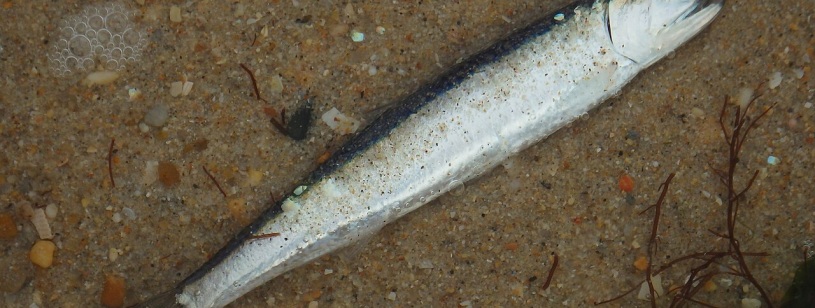
European anchovy (Engraulis encrasicolus) on the seabed. · duarte / CC BY 4.0 (https://creativecommons.org/licenses/by/4.0). Cropped and resized.
The European anchovy is a small, slender, silvery fish with a bluish-green back. It lives in huge schools of millions of fish in the Black Sea, the Mediterranean and the eastern Atlantic. In the Black Sea it is one of the most fished species and an important food for dolphins, seabirds and larger fish.
Quick facts
| Common name | European anchovy |
| Scientific name | Engraulis encrasicolus |
| Lifespan | Usually 2–3 years; at most about 5 years |
| Length | About 12–15 cm in the Black Sea; up to about 20 cm |
| Diet | Plankton feeder: small crustaceans, larvae, fish eggs |
| Predators | Dolphins, porpoises, large fish, gulls, cormorants |
| Conservation status | Least Concern (LC) |
| Distribution | Black Sea, Mediterranean, eastern Atlantic |
| Habitat | Coastal and open waters, usually above 50 m in summer |
| Family | Engraulidae |
| Lifestyle | In very large schools |
Interesting facts
- Anchovy schools move so synchronously that they look like a single animal.
- Anchovy eggs float in the water for only one to three days before larvae hatch.
- In autumn, anchovies from the northern Black Sea migrate south to warmer waters near Turkey.
- In the late 1980s an accidentally introduced comb jelly, Mnemiopsis, ate so many eggs that the anchovy population fell sharply.
Characteristics
The anchovy has a slim, cylindrical body with a bluish or greenish back and silvery sides. The pointed snout projects beyond a very large mouth that reaches behind the eyes.
Scales fall off easily when touched. It is a small fish: in the Black Sea adults are usually 12–15 cm long.
Behaviour
Anchovies live in large schools that can contain millions of fish. Swimming together helps them avoid predators and find food.
By day schools stay deeper, and at night they rise towards the surface after plankton. In spring and summer they approach the Romanian coast, and in autumn they migrate south to wintering areas in the southern Black Sea.
Habitat and distribution
The anchovy lives in the eastern Atlantic from Norway to South Africa, the Mediterranean, the Black Sea and the Sea of Azov.
The Black Sea holds a population adapted to less salty water. On the Romanian coast it is one of the most common marine fish.
Diet and feeding
The anchovy feeds on plankton: tiny crustaceans, mollusc and fish larvae, and eggs, filtering food by swimming with its mouth wide open.
In turn it feeds dolphins, porpoises, turbot, horse mackerel, gulls and cormorants. Without anchovy, many Black Sea animals would have less food.
Reproduction and life cycle
Anchovies breed in summer when the water is warm. Females release eggs many times during the same summer, and the eggs float near the surface.
Larvae hatch after one to three days. The fish grow quickly and can breed in their first year, at about 12–13 cm.
Name and history
The Romanian word “hamsie” comes from the Turkish “hamsi”, used across the Black Sea region, where anchovy is part of traditional cooking.
The scientific name Engraulis encrasicolus was given by Carl Linnaeus in the eighteenth century. In Spain fresh anchovies are called “boquerones”, and salted ones “anchoas”.
Conservation and threats
The species is assessed as Least Concern, but populations depend on fishing pressure and the state of the sea. In the Black Sea, the fishery matters to several countries and must be monitored carefully.
In the 1980s, the invasive comb jelly Mnemiopsis leidyi, brought in ships’ ballast water, ate many anchovy eggs and larvae, and catches fell sharply. The anchovy is a key link in the food of porpoises and other marine animals.
Frequently asked questions
How big does the anchovy grow?
In the Black Sea adults are usually 12–15 cm, and the largest reach about 20 cm.
What does the anchovy eat?
Plankton: tiny crustaceans, larvae and eggs filtered from the water.
Where do anchovies go in autumn?
Schools from the northern Black Sea migrate south to warmer waters near Turkey.
Are anchovy and sprat the same fish?
No. They are different fish; the sprat belongs to the herring family and has a shorter snout.