English Toy TerrierCharacteristics, history, training and care
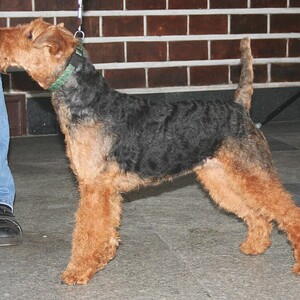
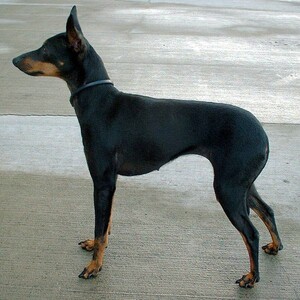
English Toy Terrier. · Sannse, Pleple2000 / Wikimedia Commons, CC BY-SA 3.0. Cropped and resized.
The English Toy Terrier is a toy-sized black and tan terrier with erect ears shaped like a candle flame. It descends from the old English Black and Tan Terrier and is related to the Manchester Terrier. The standard describes it as a toy dog with a terrier temperament: alert, lively and never overly nervous.
Quick facts
| Common name | English Toy Terrier (Black & Tan) |
| Scientific name | Canis lupus familiaris |
| Country of origin | United Kingdom |
| Official recognition | FCI, definitively since 17 September 1963 (group 3, toy terriers; standard no. 13) |
| Lifespan | No published data for the breed; toy breeds usually live 12–15 years |
| Size (males) | ideally 25–30 cm at the withers; 2.7–3.6 kg |
| Size (females) | ideally 25–30 cm at the withers; 2.7–3.6 kg |
| Coat type | Short, dense, close-lying and glossy |
| Common colours | Black and tan |
| Energy level | Moderate to high |
| Suited to an apartment? | Yes |
| Temperament | Alert, lively, with a terrier temperament |
| Tendency to aggression | Low |
| Good with children | Average; it is very small and fragile |
| Good with other animals | Good with dogs; hunting instinct towards rodents |
| Genetic predispositions | No known breed-specific diseases; toy breeds often have patellar luxation and dental problems |
- Primary category:Dog breeds
- Explore this animal's categories:
History and origin
Wikipedia says the breed developed from the old English Black and Tan Terrier and is closely related to the Manchester Terrier. Its origins are linked to the “rat pit”, a popular betting sport in the towns of Victorian England: the winner was the terrier that killed the required number of rats the fastest. Small dogs were highly prized.
When these contests were banned, the Black and Tan Terrier moved into dog shows. The small variety was registered separately from 1903, and the current name, English Toy Terrier (Black & Tan), was adopted in 1960.
How the breed developed
- 1848 – Tiny the Wonder, a 2.5 kg terrier, kills 200 rats in less than an hour.
- Second half of the 19th century – Black and Tan Terriers enter the show ring, divided by weight.
- 1903 – The first Black and Tan Terrier (Miniature) is registered.
- 1960 – The breed is named English Toy Terrier (Black & Tan).
- 17 September 1963 – The FCI recognises the breed.
- 8 September 2026 – the current FCI standard is published.
Breed rating
| Feature | Stars |
|---|---|
| Training and intelligence | ★★★★☆ |
| Easy to train | ★★★★☆ |
| Intelligence | ★★★★☆ |
| Independence | ★★★☆☆ |
| Stubbornness | ★★★☆☆ |
| Behaviour and temperament | ★★★★☆ |
| Affectionate with family | ★★★★★ |
| Friendly with children | ★★★☆☆ |
| Good with other dogs | ★★★★☆ |
| Good with cats and other animals | ★★☆☆☆ |
| Loyalty | ★★★★★ |
| Tendency to be aggressive | ★★☆☆☆ |
| Tendency to bark | ★★★★☆ |
| Needs and care | ★★★★☆ |
| Shedding | ★★☆☆☆ |
| Needs frequent grooming | ★☆☆☆☆ |
| Activity and lifestyle | ★★★★☆ |
| Energy level | ★★★★☆ |
| Daily exercise needs | ★★★☆☆ |
| Suited to apartment life | ★★★★★ |
| Health and longevity | ★★★★☆ |
| Life expectancy | ★★★★☆ |
| Predisposition to genetic diseases | ★★☆☆☆ |
| Working abilities and uses | ★★★☆☆ |
| Good watchdog | ★★★★☆ |
| Good companion dog | ★★★★★ |
Indicative rating: 5 stars means the highest level. The breed has no AKC profile; the rating is based on the FCI standard (“a toy dog with terrier temperament, alert, never overly nervous”) and on the description in Wikipedia.
Physical characteristics
It is a toy-sized, elegant and compact terrier. Wikipedia says its movement resembles the extended trot of a horse.
General appearance
The head is long and narrow, wedge-shaped. The eyes are almond-shaped, and the erect ears are shaped like a candle flame. The short, glossy coat shows off the lines of the body.
| Feature | English Toy Terrier |
|---|---|
| Size | Dwarf |
| Height at the withers | ideally 25–30 cm |
| Weight | ideally 2.7–3.6 kg |
| Coat | Short, dense, glossy |
| Eyes | Almond-shaped |
| Ears | Erect, like a candle flame |
The only accepted colour is black and tan. The black should be like ebony and the tan like a new chestnut. The colours must not blend but meet abruptly, in clear lines.
Training and socialisation
The standard describes it as a toy dog with terrier characteristics, alert, a reminder that it once did well in the rat pit. It must never be overly nervous.
It responds well to rewards and short sessions. As it is so small, gentle socialisation as a puppy helps it become self-assured.
Tips for effective training
- Use small rewards. A few grams make a big difference to its weight.
- Socialise it gently. It helps it become self-assured.
- Be careful with rodents. The ratting instinct is still there.
- Protect it from big dogs. It is very small and fragile.
Activity needs and lifestyle
Although a toy breed, it is a lively terrier that needs daily walks and play. It does well in a flat.
| Activity | How often | Why it matters |
|---|---|---|
| Short walks | twice a day | Daily exercise |
| Play indoors | daily | Burns off energy |
| Search games | several times a week | Terrier instinct |
Tips for a balanced life
- In winter it may need a coat, as its own coat is very short.
- Be careful with stairs and jumps off furniture.
- Young children must be supervised.
Care and health
Coat and skin care
The short, glossy coat is very easy to care for: a wipe with a grooming mitt or a soft brush once a week.
Common health problems
There are no published health studies for the breed. As with any toy breed, the following are worth watching:
| Condition | Description | Common symptoms |
|---|---|---|
| Patellar luxation | The kneecap slips out of place | Suddenly holds a hind leg up for a few steps, then uses it again |
| Dental problems | Small, crowded teeth easily build up tartar | Bad breath, red gums |
Other care
- Brush its teeth often.
- Trim the nails regularly.
- Check the ears weekly.
Diet and nutrition
Such a small dog needs small but frequent meals. Choose food for toy breeds, with small kibble.
Tips for a healthy diet
The table gives a starting estimate, calculated with the formula from the Merck Veterinary Manual. The first two calorie columns show the calories per day for a healthy adult dog. The last column shows what this means in dry food with 3,500–4,000 kcal per kilogram.
| Dog's weight | Calories per day (neutered) | Calories per day (not neutered) | Dry food per day (approximate) |
|---|---|---|---|
| 2.7 kg | 240 kcal | 270 kcal | 60–77 g |
| 3.2 kg | 270 kcal | 300 kcal | 68–86 g |
| 3.6 kg | 290 kcal | 330 kcal | 72–94 g |
- Feed puppies several times a day so that their blood sugar does not drop.
- Training treats count towards the daily portion.
- A dog is at the right weight when you can feel its ribs without pressing hard.
Foods to avoid
Some human foods are dangerous for dogs: chocolate, coffee, grapes and raisins, onions, garlic, xylitol (a sweetener used in chewing gum), macadamia nuts and alcohol.
Reproduction and development
Physical and emotional maturity
In dogs, sexual maturity usually comes between 6 and 12 months. Small breeds become adults faster than large ones, usually at around one year.
Mating and pregnancy
Pregnancy lasts about 63 days, counted from ovulation. Mating a female on her first heat is not recommended. The FCI standard requires that only healthy dogs of typical breed appearance are used for breeding.
Caring for the puppies
In small breeds, a litter has 3–4 puppies on average. The puppies are very small and fragile in the first weeks, so they must be kept warm and handled with care. Socialisation starts early: gentle handling, everyday noises and new people.
Interesting facts
- 200 rats in an hour. In 1848, Tiny the Wonder, weighing 2.5 kg, killed 200 rats in less than an hour.
- Ears like a flame. The erect ears are shaped like a candle flame.
- A horse's trot. Its movement resembles the extended trot of a horse.
- Related to the Manchester Terrier. It is closely related to the larger Manchester Terrier.
- A name from 1960. The current name was adopted in 1960.
Frequently asked questions
What colour is the English Toy Terrier?
It is always black and tan.
How big does it get?
It ideally measures 25–30 cm at the withers and weighs 2.7–3.6 kg.
Can it live in a block of flats?
Yes, it is suited to flat life, if it goes out every day.
Is it good with children?
With older, gentle children; it is very small and can easily be hurt.