Atlantic salmonSalmo salar — habitat, diet and reproduction
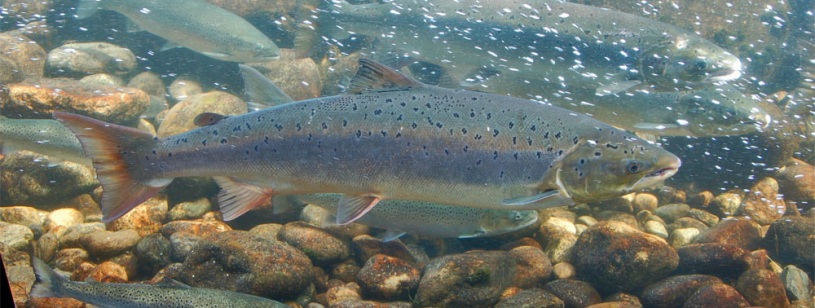
Atlantic salmon (Salmo salar) swimming in an aquarium. · Islandmen / CC BY 3.0 (https://creativecommons.org/licenses/by/3.0). Cropped and resized. Source: https://commons.wikimedia.org/wiki/File:Villakssenter03.jpg
Atlantic salmon (Salmo salar) hatch in freshwater, grow at sea and usually return to their home river to reproduce. The smell of the water helps guide them. They belong to the salmonid family, alongside trout. Several Pacific fishes also bear the name salmon, but this article follows the Atlantic species.
Quick facts
| Common name | Atlantic salmon |
| Scientific name | Salmo salar |
| Lifespan | Often 4–6 years, varying with population and life history |
| Length | About 71–76 cm on average for two-sea-winter adults in NOAA’s account |
| Weight | About 3.6–5.4 kg for that same group; larger fish exceed these values |
| Diet | Aquatic invertebrates and fish |
| Predators | Predatory fish, fish-eating birds and marine mammals, depending on life stage |
| Conservation status | Near Threatened (NT), globally |
| Distribution | North Atlantic and connected rivers; some landlocked populations |
| Habitat | Cool rivers, estuaries and marine waters |
| Family | Salmonidae |
| Reproduction | Autumn and winter spawning in gravel nests |
Interesting facts
- Young salmon learn the chemical signature of their river before leaving for sea.
- Their gills and other organs change to cope with saltwater.
- Some Atlantic salmon survive spawning and reproduce again.
- Landlocked populations use lake tributaries for spawning.
Records and extremes
Migrations can cover thousands of kilometres. Irish salmon reach feeding areas around the Norwegian Sea and Greenland.
NOAA describes two-sea-winter adults averaging about 71–76 cm and 3.6–5.4 kg in its North American account. Time at sea strongly affects returning size.
Characteristics
The streamlined body is silvery at sea, with a darker back and dark spots. Breeding fish can become mottled brown-red.
Males may develop a hooked lower jaw, called a kype. Juveniles have side bars and spots that help them blend into river habitats.
Behaviour
Atlantic salmon are anadromous: they move from freshwater to sea and return to rivers to spawn. Adults recognise their home river partly through smell.
Water flow and temperature influence upstream movement. Fish may wait in estuaries or deeper pools until conditions improve. Stored energy fuels the migration.
Habitat and distribution
The range includes the North Atlantic and rivers along European and North American coasts, extending into northern basins towards western Siberia.
Spawning needs loose gravel with well-oxygenated water flowing through it. Young fish require cool rivers and cover; marine stages use productive feeding grounds.
Landlocked populations grow in lakes and reproduce in connected rivers.
Diet and feeding
River juveniles mainly consume aquatic invertebrates, including insect larvae. At sea, fish and crustaceans provide abundant food.
Marine feeding builds the energy reserves needed for migration and reproduction. Adults generally stop feeding after entering freshwater to spawn.
Reproduction and life cycle
Spawning usually takes place in autumn or winter. Females dig gravel nests with their tails; eggs are fertilised in the water and covered.
Newly hatched larvae initially use their attached yolk sac. Later, juveniles feed in the river before becoming silvery smolts prepared for seawater.
The duration of each stage varies among populations. Many adults die after spawning, but survivors can repeat the cycle.
Name and history
Linnaeus established the name Salmo salar in 1758. USFWS links salar with the meaning “leaper”.
Atlantic salmon belong to Salmo. Pacific pink, sockeye, coho and Chinook salmon belong to Oncorhynchus. Their life histories and sizes are best described separately.
Conservation and threats
The global IUCN assessment published in 2023 lists Atlantic salmon as Near Threatened. Local populations can face much greater risk.
Barriers restrict access to spawning habitat. Fine sediment can clog gravel, while warming water and changes in marine food affect other life stages.
Restoring river connectivity, water quality and juvenile habitat supports recovery across the migration route.
Frequently asked questions
Do Atlantic salmon live in both fresh and salt water?
Most populations begin life in rivers, grow at sea and return to freshwater to spawn.
How do they recognise their home river?
Chemical smells learned before the journey to sea help guide returning adults.
What is a smolt?
A young, silvery salmon undergoing the changes needed for marine life.
Do all Atlantic salmon die after spawning?
Some survive and can reproduce again.
Why do males develop a hooked jaw?
The breeding-season structure is associated with contests between males.
Can Atlantic salmon remain in lakes?
Landlocked populations use lakes for growth and tributaries for spawning.