PapillonCharacteristics, history, training and care
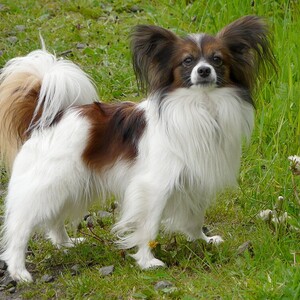
Papillon. · Gvdmoort / Wikimedia Commons, CC BY-SA 3.0. Cropped and resized.
The Papillon is a dwarf spaniel from France and Belgium, with large ears shaped like a butterfly's wings. “Papillon” means butterfly in French. The breed has two varieties: the Papillon, with erect ears, and the Phalène (“moth”), with drooping ears. It is lively, intelligent, easy to train and very attached to its family.
Quick facts
| Common name | Papillon (Continental Toy Spaniel; drop-eared variety: Phalène) |
| Scientific name | Canis lupus familiaris |
| Country of origin | France and Belgium |
| Official recognition | FCI, definitively since 1954 (group 9, companion and toy dogs; standard no. 77); AKC, since 1935 |
| Lifespan | 14–16 years, according to the AKC; a 2024 British study found 14.5 years |
| Size (males) | About 28 cm at the withers; under 2.5 kg or 2.5–4.5 kg |
| Size (females) | About 28 cm at the withers; under 2.5 kg or 2.5–5 kg |
| Coat type | Long, wavy, glossy, no undercoat |
| Common colours | White, with patches of any colour |
| Energy level | High |
| Suited to an apartment? | Yes |
| Temperament | Lively, intelligent, affectionate, eager to please its owner |
| Tendency to aggression | Low |
| Good with children | Good, with gentle children; it is very small |
| Good with other animals | Good; be careful with big dogs |
| Genetic predispositions | Patellar luxation, open fontanelle, eye diseases, dental problems |
- Primary category:Dog breeds
- Explore this animal's categories:
History and origin
Small spaniel-type dogs appear in paintings as early as the 16th century, in the works of Titian, Veronese, Mignard, Watteau and Fragonard. They were the companion dogs of the royal courts and nobility of Europe.
The modern breed was recognised by the AKC in 1935, when the American breed club was founded. The FCI standard comes from France and Belgium, and the Papillon and the Phalène are considered the same breed, differing only in the shape of the ears.
How the breed developed
- 16th century – Dwarf spaniels appear in the paintings of the great masters.
- 1737 – Antoine Pesne paints Queen Sophia Dorothea of Prussia with a dwarf spaniel.
- 1935 – The AKC recognises the Papillon.
- 1954 – The FCI recognises the breed.
- 1999 – The Papillon “Kirby” wins Best in Show at Westminster.
- 2019 – The Papillon “Dylan” wins Best in Show at Crufts.
Breed rating
| Feature | Stars |
|---|---|
| Training and intelligence | ★★★★★ |
| Easy to train | ★★★★★ |
| Intelligence | ★★★★★ |
| Independence | ★★☆☆☆ |
| Stubbornness | ★★☆☆☆ |
| Behaviour and temperament | ★★★★★ |
| Affectionate with family | ★★★★★ |
| Friendly with children | ★★★★★ |
| Good with other dogs | ★★★☆☆ |
| Good with cats and other animals | ★★★☆☆ |
| Loyalty | ★★★★★ |
| Tendency to be aggressive | ★☆☆☆☆ |
| Tendency to bark | ★★★★★ |
| Needs and care | ★★★★☆ |
| Shedding | ★★★☆☆ |
| Needs frequent grooming | ★★☆☆☆ |
| Activity and lifestyle | ★★★★☆ |
| Energy level | ★★★★☆ |
| Daily exercise needs | ★★★☆☆ |
| Suited to apartment life | ★★★★★ |
| Health and longevity | ★★★★★ |
| Life expectancy | ★★★★★ |
| Predisposition to genetic diseases | ★★☆☆☆ |
| Working abilities and uses | ★★★★☆ |
| Good watchdog | ★★★★☆ |
| Good companion dog | ★★★★★ |
Indicative rating: 5 stars means the highest level. It is based on the ratings the American Kennel Club gives the breed and on the FCI standard.
Physical characteristics
The standard describes it as an elegant, harmonious, graceful yet sturdy dwarf spaniel, with a proud bearing and a light gait. The body is slightly longer than it is tall.
General appearance
The large, almond-shaped eyes are dark and very expressive. The large ears are either erect and set obliquely, like a butterfly's wings (Papillon), or drooping (Phalène). The high-set tail has abundant fringes that form a handsome plume.
| Feature | Papillon |
|---|---|
| Size | Dwarf |
| Height at the withers | about 28 cm |
| Weight | Two categories: under 2.5 kg and 2.5–4.5 kg (females up to 5 kg); minimum 1.5 kg |
| Coat | Long, wavy, no undercoat |
| Ears | Erect (Papillon) or drooping (Phalène) |
| Tail | High-set, with an abundant plume |
All colours on a white background are accepted. On the body and legs, white must predominate. On the head, a white blaze down the middle is preferred. The nose, lips and eyelids must be pigmented.
Training and socialisation
The AKC says Papillons are intelligent and eager to please the people they have bonded with. They learn quickly and excel at agility and obedience.
Early socialisation and obedience classes are important. It is a companion dog: left alone for long periods, it can become unhappy and get up to mischief.
Tips for effective training
- Do not spoil it too much. The AKC says the owner also learns in classes not to give in all the time.
- Try agility. It is one of the best small breeds at this sport.
- Work on the barking. The AKC gives it the top score for barking.
- Be careful around big dogs. It does not realise how small it is.
Activity needs and lifestyle
The AKC says that, although it is small, it is active and needs play and exercise. Indoors it loves to fetch a small ball, and outdoors it happily chases squirrels and insects.
| Activity | How often | Why it matters |
|---|---|---|
| Walks | daily | Exercise and socialisation |
| Indoor fetch | daily | It quickly learns to bring back the ball |
| Agility or tricks | several times a week | Mental activity |
Tips for a balanced life
- Be careful with stairs and high furniture, especially with puppies.
- Small children must be supervised: it is easily injured.
- It adapts to any climate and to city life.
Care and health
Coat and skin care
The AKC says that, although it has long, silky hair, it needs surprisingly little grooming because it has no undercoat. Combing behind the ears, on the legs and on the thighs prevents mats. It is bathed every few months, and the nails are trimmed often.
Common health problems
The AKC says the breed is generally healthy, and responsible breeders test their dogs for:
| Condition | Description | Common symptoms |
|---|---|---|
| Patellar luxation | The kneecap slips out of place | Suddenly holds a hind leg up for a few steps, then uses it again |
| Open fontanelle | A soft spot on the top of the head that does not close | Usually no signs; the head must be protected |
| Progressive retinal atrophy | An inherited disease that gradually destroys the retina | Sees less and less well at night, then in the daytime too |
Other care
- Brush its teeth regularly: small breeds often have dental problems.
- Trim the nails often, including the dewclaw.
- Check the ears weekly.
Diet and nutrition
Such a small dog needs small, frequent meals. A few extra grams make a big difference to its weight.
Tips for a healthy diet
The table gives a starting estimate, calculated with the formula from the Merck Veterinary Manual. The first two calorie columns show the calories per day for a healthy adult dog. The last column shows what this means in dry food with 3,500–4,000 kcal per kilogram.
| Dog's weight | Calories per day (neutered) | Calories per day (not neutered) | Dry food per day (approximate) |
|---|---|---|---|
| 2 kg | 190 kcal | 210 kcal | 48–60 g |
| 3 kg | 260 kcal | 290 kcal | 65–83 g |
| 4.5 kg | 350 kcal | 390 kcal | 88–111 g |
- Feed puppies several times a day so that their blood sugar does not drop.
- Choose small kibble suited to toy breeds.
- A dog is at the right weight when you can feel its ribs without pressing hard.
Foods to avoid
Some human foods are dangerous for dogs: chocolate, coffee, grapes and raisins, onions, garlic, xylitol (a sweetener used in chewing gum), macadamia nuts and alcohol.
Reproduction and development
Physical and emotional maturity
In dogs, sexual maturity usually comes between 6 and 12 months. Small breeds become adults faster than large ones, usually at around one year.
Mating and pregnancy
Pregnancy lasts about 63 days, counted from ovulation. Mating a female on her first heat is not recommended. The FCI standard requires that only healthy dogs of typical breed appearance are used for breeding.
Caring for the puppies
In small breeds, a litter has 3–4 puppies on average. The puppies are very small and fragile in the first weeks, so they must be kept warm and handled with care. Socialisation starts early: gentle handling, everyday noises and new people.
Interesting facts
- Butterfly and moth. “Papillon” means butterfly and “Phalène” means moth in French.
- In the paintings of the masters. It appears in paintings by Titian, Watteau and Fragonard.
- Westminster champion. In 1999, the Papillon Kirby won Best in Show at Westminster.
- Crufts champion. In 2019, the Papillon Dylan won Best in Show at Crufts.
- It lives a long time. A 2024 British study found a life expectancy of 14.5 years.
In popular culture
In European painting
Dwarf spaniels similar to the Papillon appear in paintings by Titian, Paolo Veronese, Pierre Mignard, Antoine Watteau and Jean-Honoré Fragonard. In 1737, Antoine Pesne painted Queen Sophia Dorothea of Prussia with such a dog.
Frequently asked questions
What is the difference between the Papillon and the Phalène?
Only the ears: the Papillon has erect ears and the Phalène drooping ones. They are the same breed.
How big does it get?
It measures about 28 cm at the withers and weighs between 1.5 and 5 kg.
Is it easy to train?
Yes, it is very intelligent and eager to please its owner.
Does it shed a lot?
Moderately. It has no undercoat, so the coat is easy to care for.
How long does it live?
The AKC gives 14–16 years.