Red mulletMullus barbatus — habitat, diet and reproduction
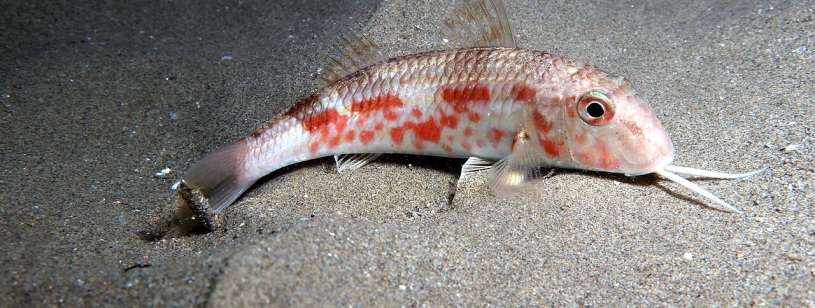
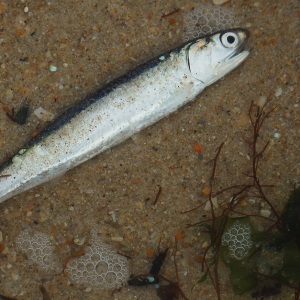
Red mullet (Mullus barbatus) on a sandy bottom, showing its barbels. · Julien Renoult / CC BY 4.0 (https://creativecommons.org/licenses/by/4.0). Cropped and resized.
The red mullet is a small marine fish with a pinkish-silver body and two long barbels under its chin. It uses them to probe sand and mud for worms and crustaceans. It lives in the Black Sea, the Mediterranean and the eastern Atlantic and has been prized since ancient times.
Quick facts
| Common name | Red mullet |
| Scientific name | Mullus barbatus |
| Lifespan | A few years |
| Length | Usually 14–20 cm; up to about 30 cm |
| Weight | Up to about 680 g |
| Diet | Carnivore: small crustaceans, worms, molluscs |
| Predators | Predatory fish, dolphins, seabirds |
| Conservation status | Least Concern (LC) |
| Distribution | Eastern Atlantic, Mediterranean, Black Sea, Sea of Azov |
| Habitat | Sand, mud and gravel bottoms, from 10 to over 300 m |
| Family | Mullidae |
| Lifestyle | In groups, on the bottom |
Interesting facts
- The red mullet’s barbels carry taste receptors, letting it “taste” the sand for food.
- At night or when frightened, its colour becomes more blotchy and reddish.
- The Romans paid huge sums for large red mullets and sometimes watched them die to see their colours change.
- A distinct subspecies, the Black Sea red mullet, lives off the Romanian coast.
Characteristics
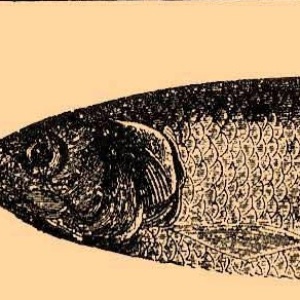
The red mullet has an elongated body with large scales and an almost vertical head profile. Its small mouth is under the snout, and two long chin barbels can fold into a groove.
It is silvery with pink or red tones and yellowish fins, with two well-separated dorsal fins. Its colour changes with activity and light.
Behaviour
Red mullets live in small groups near the seabed. They swim slowly, probing the sand with their barbels and raising clouds of mud.
Other fish sometimes follow them to catch small animals they uncover. In winter they retreat to deeper water and in summer come closer to shore.
Habitat and distribution
The species lives in the eastern Atlantic, the Mediterranean, the Black Sea and the Sea of Azov, on sand, mud or gravel bottoms of the continental shelf.
The subspecies Mullus barbatus ponticus, smaller than Mediterranean red mullets, lives off the Romanian coast.
Diet and feeding
The red mullet eats small bottom animals: crustaceans, marine worms and small molluscs, found with its barbels, which sense taste and movement.
By probing the bottom, it mixes sediment and helps nutrients circulate.
Reproduction and life cycle
Red mullets spawn in June and July in open water. Eggs float, and larvae first live among the plankton, far from the bottom.
At about 5 cm the young move towards the coast and start living on the bottom. They mature in their first year, at 10–14 cm.
Name and history
The scientific name Mullus barbatus roughly means “bearded mullet”, after the chin barbels. The Romanian “barbun” also comes from the Latin word for beard.
In ancient times, Greeks and Romans considered red mullet a delicacy, and Roman writers describe fish sold at very high prices as a sign of wealth.
Conservation and threats
The species is assessed as Least Concern. In the Mediterranean there are signs of overfishing, and many fish caught are too young to have bred.
Respecting minimum sizes and closed seasons helps populations.
Frequently asked questions
Why does the red mullet have barbels?
The barbels sense taste and movement, helping it find food hidden in sand and mud.
What does the red mullet eat?
Small crustaceans, marine worms and small molluscs from the seabed.
How big does it grow?
Usually 14–20 cm; the largest reach about 30 cm.
Where does it live in Romania?
On sand and mud bottoms along the Black Sea coast.