BisonInteresting facts and information
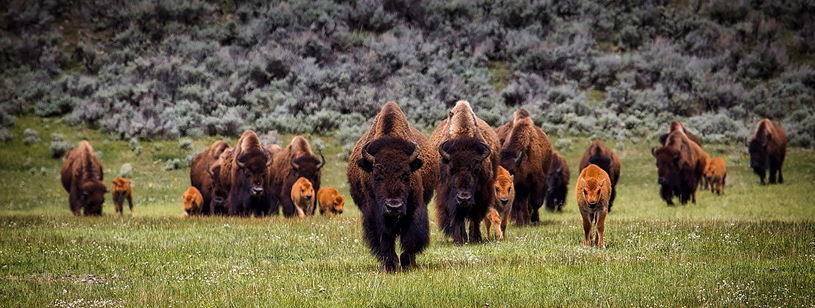
Bison are large hoofed mammals in the cattle family. Two living species are recognised: the American bison (Bison bison) of North America and the European bison, or wisent (Bison bonasus). Both have a history of severe population loss and conservation efforts.
Both bison species were severely reduced by hunting and habitat changes. Conservation and reintroduction have helped, but population histories and pressures differ between regions.
Quick facts
| Common name | Bison |
| Scientific name | Bison bison (American bison); Bison bonasus (European bison) |
| Typical lifespan | About 15-20 years in the wild, up to about 25-30 years in captivity |
| Maximum speed | About 55-65 km/h |
| Height at shoulder | About 1.5-2 m |
| Length | About 2.1-3.5 m |
| Weight | About 400-550 kg (females), 600-1,000 kg (males) |
| Diet type | Herbivore (grasses, herbs, leaves, shoots, bark) |
| Main predators | Wolves, bears (mainly calves), people |
| Conservation status | Both species Near Threatened (IUCN) |
| Distribution | North America (American bison); Europe (European bison) |
| Living environment | Prairies, grasslands, forests with meadows, mountain valleys |
- Primary category:Mammals
- Explore this animal's categories:
Interesting facts
- Fast for their size - Bison can run at about 55-65 km/h and jump over fences about 1.8 m high.
- Bellowing bulls - In the breeding season, bulls give deep, roaring bellows to impress cows and warn rivals.
- Built for winter - Their thick winter coat lets them survive temperatures of -40 °C, and snow can lie on their backs without melting.
- Big eaters - An adult bison eats about 10-15 kg of dry plant food a day, spending much of its time grazing.
- Dust baths - Bison roll in dusty hollows called wallows, which helps them get rid of biting insects and loose hair.
- European bison in Romania – European bison have been reintroduced through conservation projects.
Records and remarkable features
- Adult male bison can be substantially larger than females.
- The largest land animals of their continents - The American bison is the heaviest land animal in North America, and the European bison the heaviest in Europe.
- European bison occur in several restored wild and managed populations. Their numbers change and require dated assessments.
- A national symbol - In 2016, the American bison became the national mammal of the United States.
Physical characteristics and adaptations
Bison are large, powerful and very hardy animals, with features that help them survive harsh winters and hot summers.
Key physical adaptations
- A massive body - Bulls usually weigh about 700-900 kg or more, and cows about 400-500 kg.
- Thick fur and mane - A woolly winter coat and a shaggy mane on the head and front of the body protect them from cold and wind.
- A muscular hump - The hump over the shoulders supports the strong neck muscles that bison use to swing their heads like snowploughs to clear snow.
- Short, curved horns - Both sexes have horns, used in fights and for defence.
- Strong legs - Allow them to run fast and travel long distances.
- Hard hooves - Give them a firm footing on rough or muddy ground.
- A large head - The massive head and thick skull protect bulls during head-butting contests.
Differences between American and European bison
| Characteristic | American bison (Bison bison) | European bison (Bison bonasus) |
|---|---|---|
| Build | Heavier at the front, with a lower head and a bigger hump | Taller and longer-legged |
| Fur | Longer, shaggier hair on the head and front legs | Shorter hair; less shaggy |
| Habitat | Mainly open grassland | Mainly forests with clearings |
| Head position | Carried low, good for grazing | Held higher, good for browsing leaves |
| Diet | Mainly grasses | Grasses plus many leaves, shoots and bark |
Habits and behaviour
Bison are social animals that live in herds and have interesting ways of feeding, communicating and defending themselves.
Daily life
- Herds - Cows, calves and young bulls live in herds, while adult bulls live alone or in small groups for most of the year.
- Seasonal groups - In the breeding season, bulls join the cow herds, and large herds may form.
- Dominance - Bulls compete for status with displays, bellowing and fights.
- Travelling - American bison once migrated over huge distances across the Great Plains; today most herds live in limited areas.
Social interactions
- Communication - Bison grunt, snort and bellow to keep in touch and show their mood.
- Wallowing and rubbing - They roll in dust wallows and rub against trees and rocks to remove insects and moulting hair.
- Protective mothers - A cow will fiercely defend her calf against predators.
Defence techniques
- Running - When in danger, bison can run at up to about 65 km/h.
- Grouping together - Herds bunch up to protect calves and weaker animals.
- Fighting - Bulls push and butt heads, and the winner gains the right to mate.
Habitat and geographic distribution
Bison are hardy animals that live in habitats from open prairies to mixed forests.
Regional distribution
| Region | Species Present |
|---|---|
| North America (USA, Canada, northern Mexico) | Bison bison (American bison, including the plains bison and the wood bison) |
| Central and Eastern Europe | Bison bonasus (European bison) |
| Russia, Belarus, Lithuania, Ukraine and the Caucasus | Reintroduced European bison |
Habitat types
- Prairies and grasslands - American plains bison prefer open grassland with plenty of grass.
- Forests and meadows - Wood bison in Canada and European bison live in forests with open meadows.
- Mountains - European bison live in mountain forests, such as in the Carpathians, and American bison live in high valleys such as Yellowstone.
Climate and habitat change
- Less grassland - Farming and towns have replaced most of the original prairies.
- Climate change - Droughts and hotter summers can change the plants bison eat.
- Fences and roads - Make it hard for herds to move freely.
Diet and feeding
Bison are herbivores that eat large amounts of plants to fuel their huge bodies.
What do bison eat?
| Food group | Examples and context |
|---|---|
| Grasses and sedges | The main food of the American bison |
| Herbs and flowers | Eaten especially in summer |
| Leaves, shoots and bark | Important for the European bison and wood bison, especially in winter |
| Lichens and mosses | Eaten in winter in northern areas |
Feeding methods
- Grazing - Bison spend much of the day grazing and then lie down to chew the cud.
- Clearing snow - In winter, they swing their heads from side to side to sweep away snow and reach the plants underneath.
- Efficient digestion - As ruminants, they can get nutrients from tough, low-quality plants.
Reproduction and life cycle
Bison breed once a year, and bulls compete fiercely for cows during the breeding season.
Breeding season
- The breeding season (rut) of the American bison is from about July to September; that of the European bison from August to October.
- Bulls bellow, wallow and push each other head to head to win access to cows.
- After the rut, bulls leave the cow herds again.
Gestation and birth
| Characteristic | Details |
|---|---|
| Gestation | About 9-9.5 months |
| Number of calves per birth | 1 calf |
| Weight at birth | About 15-30 kg |
| Nursing period | About 7-12 months |
Raising young
- Calves can walk within a few hours of birth and stay close to their mothers.
- American bison calves are born reddish-orange and are nicknamed "red dogs"; they turn brown after a few months.
- Young bulls leave the herd at about 2-3 years old, while young cows usually stay.
Survival
- Calves are most vulnerable in their first months, when wolves and bears may attack them.
- Bison can live about 15-20 years in the wild and up to about 25-30 years in captivity.
Name and history
Origin of the name
- The word "bison" comes, through Latin, from an old Germanic word for the European bison.
- The American bison is often called "buffalo", probably from the French word bœuf, "ox", but it is not closely related to the true buffaloes of Africa and Asia.
Taxonomic classification
| Classification | Name |
|---|---|
| Kingdom | Animalia |
| Phylum | Chordata |
| Class | Mammalia |
| Order | Artiodactyla |
| Family | Bovidae |
| Genus | Bison |
| Species | Bison bison, Bison bonasus |
Evolution and fossils
- Bison evolved in Asia from earlier wild cattle about 2 million years ago.
- Steppe bison crossed the Bering land bridge into North America about 200,000 years ago, and their descendants include the American bison.
- Studies suggest that the European bison may have originated from ancient mixing between steppe bison and aurochs, the wild ancestors of cattle.
Cultural significance and mythology
Bison have important cultural roles for many Indigenous peoples of North America; traditions and relationships differ between communities.
Bison in culture and legends
- American bison have supplied food and materials to many Indigenous communities. It is important to describe each community’s traditions in its own context.
- The White Buffalo Calf Woman - For the Lakota, a sacred woman who appeared as a white buffalo calf brought them their sacred pipe and ceremonies; the birth of a white bison calf is still seen as a sacred event.
- Cave art - Bison are among the most common animals painted in Ice Age caves, such as Altamira in Spain and Lascaux in France.
Bison as symbols
- Coins and banknotes - The American bison appeared on the US 10-dollar note of 1901 and on the famous "buffalo nickel" (1913-1938).
- National animal - The American bison is the national mammal of the United States, and the European bison is a symbol of Poland's Białowieża Forest.
- Flags and emblems - Bison appear on the flags and seals of several US states and Canadian provinces, such as the flag of Manitoba.
Conservation status and threats
Both bison species came close to extinction, but conservation programmes saved them.
Conservation status
| Species | IUCN status | Population information |
|---|---|---|
| American bison (Bison bison) | Near Threatened | About 400,000 or more in total, but most are raised commercially; only about 20,000-30,000 live in conservation herds |
| European bison (Bison bonasus) | Near Threatened | More than 10,000, many of them free-living |
Main pressures
- Past overhunting - Tens of millions of American bison roamed North America before the 19th century, but by 1889 fewer than a thousand were left; the European bison was wiped out in the wild by the 1920s.
- Habitat loss - Farming and towns have replaced much of their former habitat.
- Genetic problems - Many American bison carry cattle genes, and European bison descend from very few animals.
- Disease - Diseases shared with cattle, such as brucellosis, cause conflicts with ranchers.
- Limited space - Fences, roads and farms prevent herds from moving freely.
Protection measures
- Reintroduction - European bison have been released in Poland, Romania, Germany and other countries, and American bison have been returned to tribal lands and national parks.
- National parks - Yellowstone in the USA, where bison have lived continuously since prehistoric times, and Białowieża in Poland and Belarus are key refuges.
- Hunting rules - Hunting of wild bison is banned or strictly controlled.
- Breeding programmes - Conservation herds are managed to keep them genetically healthy.
In popular culture
Bison appear in films, songs, sport and art as symbols of strength, the wild prairies and survival.
Film and music
- Dances with Wolves (1990) - Includes a famous buffalo hunt with the Lakota people.
- "Home on the Range" - A 19th-century song that begins "Oh, give me a home where the buffalo roam"; it is the state song of Kansas.
Mascots and symbols
- Sports teams - Teams such as the NFL's Buffalo Bills use the bison as their symbol.
- Brands - Many outdoor and food brands use the bison as a symbol of strength and the wild.
- Wildlife watching - Seeing bison in places such as Yellowstone and Białowieża attracts many visitors.