WarthogPhacochoerus — habitat, diet and reproduction
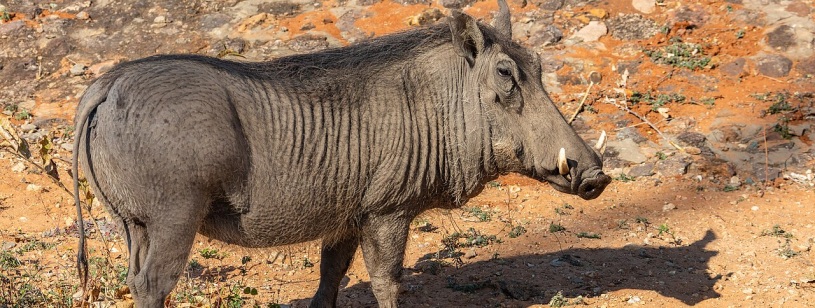
Warthog (Phacochoerus africanus) in the savanna. · Diego Delso / CC BY-SA 4.0 (https://creativecommons.org/licenses/by-sa/4.0). Cropped and resized.
The warthog is a wild pig of the African savannas, with a big head, curved tusks and thick bumps on its face. Unlike other pigs, it grazes while kneeling on its front wrists. At night it shelters in burrows, which it enters backwards so its tusks face the entrance.
Quick facts
| Common name | Warthog |
| Scientific name | Phacochoerus (genus; common species P. africanus) |
| Lifespan | About 12–15 years in the wild |
| Height | About 63–85 cm at the shoulder |
| Weight | About 50–150 kg; males are heavier |
| Diet | Omnivore: grass, roots, bulbs, fruit, sometimes carrion |
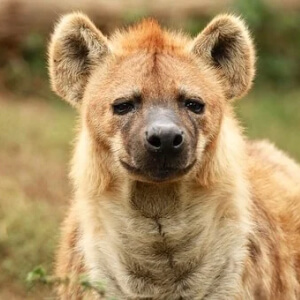
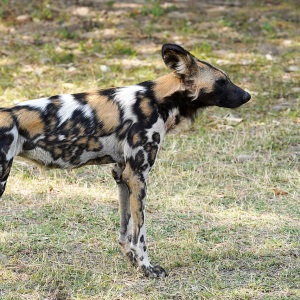
| Predators | Lions, leopards, cheetahs, hyenas, African wild dogs, crocodiles |
| Conservation status | Least Concern (LC) |
| Distribution | Sub-Saharan Africa |
| Habitat | Savannas, grassland, open woodland |
| Family | Suidae |
| Shelter | Burrows, often dug by aardvarks |
- Primary category:Mammals
- Explore this animal's categories:
Interesting facts
- When running, the warthog holds its tail straight up like an antenna, and piglets follow it through tall grass.
- The facial “warts” are thick skin pads that protect males in fights.
- It can run at up to about 48 km/h.
- Pumbaa from The Lion King is a warthog.
Characteristics
The warthog has a grey, sparsely haired body and a long mane from the neck along the back. The head is large and flat, with high-set eyes so it can watch around while feeding.
Upper tusks are long and curve upwards; lower tusks are shorter and razor-sharp. Males have two pairs of facial bumps, females one smaller pair.
Behaviour
Warthogs are active by day and shelter in burrows at night. Females live in small groups called sounders with their young, while adult males are mostly solitary.
They wallow in mud to cool down and remove parasites. Small birds and mongooses sometimes pick ticks from their skin.
Habitat and distribution
Warthogs live in Africa south of the Sahara, in savannas, grassland and open woodland, avoiding dense forest and very dry deserts.
There are two species: the common warthog across much of the continent and the desert warthog in East Africa.
Diet and feeding
The warthog mainly eats short grass. In the dry season it digs with snout and tusks for roots, bulbs and tubers.
It also eats fruit, bark, fungi and occasionally insects, eggs or carrion. Calloused pads on its front wrists let it kneel for long periods. It can go months without drinking if it finds juicy plants.
Reproduction and life cycle
Females usually give birth to 2–4 piglets after about five to six months, inside a burrow, where piglets stay for a few weeks.
Mothers may join groups and sometimes nurse other females’ young. Youngsters mature at one and a half to two years.
Name and history
The scientific name Phacochoerus comes from Greek and means “warty pig”, after the facial bumps. The Romanian name “facocer” comes from the same word.
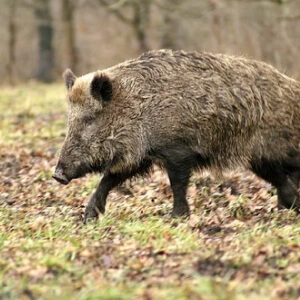
The warthog is related to the European wild boar but has adapted to savanna life.
Conservation and threats
The common warthog is widespread and assessed as Least Concern, although it has vanished from some regions due to hunting and drought.
It is hunted for meat and sometimes seen as a crop pest. Protected areas in Africa hold large populations.
Frequently asked questions
Why does the warthog kneel?
Its neck is short and grass is low, so it rests on calloused front wrists to reach it.
Is the warthog dangerous?
It usually flees, but if cornered it can defend itself fiercely with sharp tusks.
Why does it enter its burrow backwards?
So its tusks face the entrance and it can defend itself if a predator tries to get in.
What does the warthog eat?
Mostly short grass, and roots and bulbs in the dry season.