PheasantInteresting facts and information
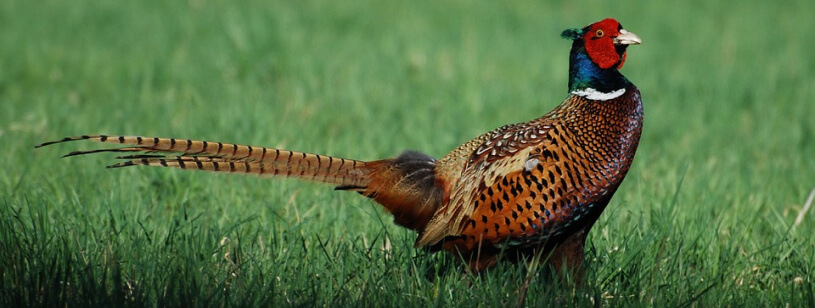
The common pheasant (Phasianus colchicus) is a ground-feeding bird native to Asia and introduced to many other regions. Males typically have brighter plumage and longer tails than females.
This ground-living omnivore usually runs away from danger, but when surprised it bursts into a short, fast flight. Pheasants eat seeds, insects, fruit and leaves.
In Asia, the pheasant has long been a symbol of beauty and good fortune. The common pheasant is not threatened, but wild populations depend on farmland with enough cover and food.
Quick facts
| Common name | Pheasant |
| Scientific name | Phasianus colchicus |
| Typical lifespan | Usually 1-3 years in the wild, up to about 15-18 years in captivity |
| Maximum speed | About 13-16 km/h running; about 60-90 km/h in short flights |
| Length | About 50 - 90 cm (including tail) |
| Weight | About 0.5 - 1.2 kg (females), 1 - 1.6 kg (males) |
| Diet type | Omnivore (seeds, grain, insects, fruit, leaves) |
| Main predators | Foxes, stoats, goshawks, owls, raccoons (eggs), people |
| Conservation status | Common pheasant: Least Concern (IUCN); several other pheasant species are threatened |
| Distribution | Native to Asia; introduced to Europe, North America, New Zealand and elsewhere |
| Habitat | Farmland, woodland edges, hedges, grasslands, reed beds |
- Primary category:Birds
- Explore this animal's categories:
Interesting facts
- Colourful males - Male common pheasants have shiny copper, green, red and gold plumage, a red face and often a white neck ring, while females are brown for camouflage.
- Runners first - Pheasants can run at about 13-16 km/h and usually run away from danger instead of flying.
- Short but fast flights - When frightened at close range, they burst into the air and can fly fast for short distances, sometimes reaching about 60-90 km/h.
- Showy courtship - In spring, males crow loudly, beat their wings with a whirring sound and display their colours to attract females.
- Camouflaged eggs - Females nest on the ground and lay about 8-15 olive-brown eggs that are hard to spot.
- Tough birds - Pheasants live in many climates, from cold northern farmland to dry semi-desert areas in Asia.
- They can swim - Although they live on land, pheasants can swim across streams if they need to.
- Neighbours of people - In some places, pheasants live in parks, gardens and on the edges of towns.
- Honoured in Asia - In China, pheasants appeared on the robes of emperors, and in Japan the green pheasant is the national bird.
- Many forms - The common pheasant has about 30 subspecies, with different plumage patterns depending on where they live.
Records and remarkable features
- The common pheasant (Phasianus colchicus) is a ground-feeding bird native to Asia and introduced to many other regions. Males typically have brighter plumage and longer tails than females.
- One of the most widely introduced birds - People have released common pheasants in Europe, North America, New Zealand, Australia, Hawaii and many other places.
- A long tail - The male's tail can make up more than half of his total length.
- A state bird - The ring-necked pheasant is the state bird of South Dakota in the United States.
Characteristics
The pheasant is a medium-sized bird with a sturdy body, short rounded wings and a long tail, built for life on the ground. Males and females look very different.
Main physical characteristics:
| Characteristic | Males (Phasianus colchicus) | Females (Phasianus colchicus) |
|---|---|---|
| Length | About 70 - 90 cm (including tail) | About 50 - 65 cm |
| Weight | About 1 - 1.6 kg | About 0.5 - 1.2 kg |
| Plumage | Copper, gold, green and purple, with a red face and often a white neck ring | Light brown and buff, with dark markings |
| Tail | Very long (up to about 50 cm), barred with black | Shorter (about 20 - 30 cm) |
| Legs | Strong, with spurs | No spurs |
| Calls | A loud, harsh "kok-kok" crow in spring | Quieter calls, mainly to their chicks |
Special adaptations for survival:
- Camouflage - The female's brown plumage hides her perfectly in grass and leaves while she sits on her nest.
- Strong legs - Pheasants are good runners and usually prefer to run rather than fly.
- Long tail - Helps with balance and is used by males in courtship displays.
- Explosive take-off - Powerful breast muscles let pheasants rise almost vertically into the air to escape predators.
- Wide field of view - Their eyes are on the sides of the head, so they can see almost all around them.
Habits and behaviour
Pheasants are most active in the early morning and evening. They spend most of their time on the ground and roost in trees or dense cover at night.
Social behaviour:
- Territorial males - In spring, males defend territories against other males, crowing and sometimes fighting with their spurs.
- Harems - Females gather in small groups within a male's territory.
- Winter flocks - In winter, pheasants often gather in larger groups, sometimes of a single sex, in areas with food and shelter.
Breeding season:
- Breeding takes place in spring and early summer (about March to June), when males display and crow loudly.
- One male, several females - A male usually mates with several females.
- Choosy females - Females tend to choose males with long spurs and bright colours, which are signs of good health.
Defence and survival methods:
- Camouflage - Females on their ground nests are almost invisible.
- Running - Their first defence is to run and hide in cover.
- Bursting into flight - When surprised at close range, they explode into the air with loud wingbeats.
- Alarm calls - Males give loud calls when they are startled.
Habitat and geographic distribution
The common pheasant is very adaptable and lives in many habitats, especially farmland mixed with hedges, woods and reed beds.
Habitat types:
| Habitat | Characteristics |
|---|---|
| Grasslands and steppes | Open areas with low vegetation, good for feeding. |
| Woodland edges and hedges | Provide shelter from predators and safe nesting places. |
| Farmland | Fields of wheat, maize and other crops, where they find plenty of food. |
| Wetlands | Especially areas with dense reeds and tall vegetation. |
Geographic distribution and estimated population:
| Region | Estimated population |
|---|---|
| Caucasus, Central and East Asia | Native range; widespread |
| Europe | Introduced in ancient and medieval times; very common, partly because of birds released for shooting |
| North America | Introduced in the 1880s; common in farmland, especially in the Great Plains |
| New Zealand and other islands | Introduced in the 19th century; established in many areas |
Impact of climate change and human activities:
- Habitat loss - Removing hedges and rough grassland reduces nesting places and food.
- Hunting - Pheasants are one of the most hunted birds in Europe and North America.
- Pesticides and intensive farming - Fewer insects mean less food for chicks.
- Predators - Foxes, crows and other predators take many eggs and chicks.
The pheasant is a tough, adaptable bird, but wild populations depend on farmland with enough cover and food.
Diet and feeding
The pheasant is an omnivore that eats seeds, grain, insects, fruit and leaves. Its food changes with the seasons.
Main food:
| Food group | Examples |
|---|---|
| Seeds and cereals | Wheat, maize, oats, weed seeds |
| Insects and other invertebrates | Beetles, ants and their eggs, caterpillars, grasshoppers, snails, worms |
| Fruit and berries | Blackberries, haws, rose hips, grapes |
| Leaves and shoots | Young grass, clover |
| Roots and tubers | Dug up occasionally, especially in winter |
Diet by season:
| Season | Type of food consumed |
|---|---|
| Spring | Insects, shoots, larvae |
| Summer | Insects, seeds, berries |
| Autumn | Grain, acorns, nuts, berries |
| Winter | Seeds, spilled grain, roots, leaves |
Feeding methods:
- Scratching - They scratch the ground with their feet and dig with their beaks to find seeds and insects.
- Catching insects - Young chicks eat mainly insects, which give them protein for fast growth.
- Grinding food - Like other birds, they have no teeth; their muscular gizzard, helped by small stones, grinds their food.
Reproduction and life cycle
The common pheasant is polygamous: a male can have several females in one season. Only the female incubates the eggs and raises the chicks.
Mating:
| Characteristic | Details |
|---|---|
| Breeding season | About March - June |
| Females per male | Usually about 2 - 7 |
| Male display | Crowing, wing-whirring and showing off his colours |
| Choice of males | Females prefer healthy males with long spurs and bright colours |
Eggs and nest:
| Characteristic | Details |
|---|---|
| Incubation | About 23 - 26 days |
| Number of eggs per nest | About 8 - 15 eggs |
| Egg colour | Olive-brown, well camouflaged |
| Location of the nest | A shallow scrape on the ground, under thick bushes or tall grass |
The development of the chicks:
| Age | Development |
|---|---|
| 1 day | The chicks are covered with down, can walk and soon leave the nest with their mother |
| First days | They peck at insects and seeds themselves, guided by their mother |
| About 2 weeks | They can already make short flights |
| About 5-6 weeks | They fly well enough to escape most predators |
| About 10-12 weeks | They become independent |
Longevity:
- In the wild - Usually only 1-3 years, because of predators, hunting and harsh weather.
- In captivity - Up to about 15-18 years.
Name and history
The pheasant has been hunted and kept by people for thousands of years and appears in the art and traditions of many cultures.
Origin and etymology of the name:
- The word "pheasant" comes from the Greek and Latin phasianus, "bird of the Phasis", the ancient name of the Rioni River in Georgia.
- The scientific name Phasianus colchicus refers to Colchis, the ancient land on the eastern shore of the Black Sea (now western Georgia); according to legend, Jason and the Argonauts brought pheasants back from there.
Taxonomic classification:
| Taxonomic category | Name |
|---|---|
| Kingdom | Animalia |
| Phylum | Chordata |
| Class | Aves |
| Order | Galliformes |
| Family | Phasianidae |
| Genus | Phasianus |
| Species | Phasianus colchicus |
History and dissemination:
- Ancient Greece and Rome - Greeks and Romans kept and ate pheasants, and the Romans spread them around their empire.
- Britain - Pheasants were probably brought to Britain by the Romans or the Normans and were well established by the 11th century.
- The Middle Ages - Pheasants were a luxury food, served at the feasts of kings and nobles.
- North America - Pheasants from China were successfully introduced in Oregon in 1881 and soon became a favourite game bird.
The role of the pheasant in mythology and culture:
- Royalty - In medieval Europe, roast pheasant, sometimes decorated with its own feathers, was served at royal banquets.
- Heraldry - Pheasants appear on some coats of arms.
- Japanese stories - In Japan, the pheasant (kiji) is one of the animal helpers of the hero Momotarō.
- Country sports - In Britain, pheasant shooting has been a major country tradition since the 19th century.
The pheasant remains a familiar bird in many cultures because of its striking appearance and its long history with people.
Cultural significance and mythology
The pheasant has long been a symbol of beauty, nobility and good fortune, especially in Asia.
Pheasant in mythology and popular beliefs:
- China and Japan - In China, the pheasant was one of the Twelve Symbols of imperial authority embroidered on emperors' robes. In Japan, the green pheasant (kiji) is the national bird and appears in the legend of Momotarō, helping a boy hero to defeat demons.
- Medieval Europe - Pheasants were linked with nobility and luxury and were served at grand feasts.
- Earthquake warnings - In Japan, people believed that pheasants could sense earthquakes before they happened, because they call loudly when the ground shakes.
- Feathers - Pheasant feathers have long been used to decorate hats and in fly fishing.
Pheasant in gastronomy:
- Roast pheasant was a royal dish in medieval Europe, served at great banquets.
- In France and England, pheasant became a symbol of fine cooking.
- Today, pheasant is eaten as game in many countries and is valued for its lean meat.
Conservation status and threats
The common pheasant is one of the most widespread game birds in the world, but wild populations depend on suitable farmland, and many other pheasant species are threatened.
Conservation status
- The common pheasant is listed as Least Concern by the IUCN.
- Other pheasant species - Several Asian pheasants, such as Edwards's pheasant of Vietnam, are endangered or critically endangered because of hunting and forest loss.
Main threats:
- Hunting - Pheasants are among the most hunted birds in Europe and North America.
- Habitat loss - Intensive farming and the removal of hedges and rough grassland reduce nesting places and food.
- Pesticides - Fewer insects mean less food for chicks.
- Predators - Foxes, crows, stoats and raccoons take many eggs and chicks.
- Weather - Cold, wet springs and hard winters can kill many young and adult birds.
Conservation efforts:
- Captive breeding - In Britain alone, tens of millions of pheasants are bred and released every year for shooting.
- Better habitat - Many farmers plant hedges, wildflower strips and cover crops that help pheasants and other wildlife.
- Hunting rules - Hunting seasons are set to protect birds during the breeding season.
In popular culture
Pheasant in literature:
- Danny the Champion of the World (Roald Dahl, 1975) - Danny and his father invent clever ways to poach pheasants, including raisins filled with sleeping powder.
- Momotarō - In this Japanese folk tale, a pheasant joins a dog and a monkey to help the hero.
- Children's books - Pheasants often appear in stories about countryside wildlife.
Pheasant in cinematography and television:
- Danny the Champion of the World (1989) - A film of Roald Dahl's book, starring Jeremy Irons and his son Samuel.
Pheasant in video games and comic books:
- Hunting games - Pheasants are popular birds in many hunting simulation games.
- Tongue twisters - "I'm not the pheasant plucker" is a famous English tongue twister.
Pheasant in sport and emblem:
- South Dakota - The ring-necked pheasant is the state bird, and the state is famous for pheasant hunting.
- Art and heraldry - Pheasants appear on coats of arms, porcelain and paintings, especially in China and Japan.