European squidLoligo vulgaris — habitat, diet and reproduction
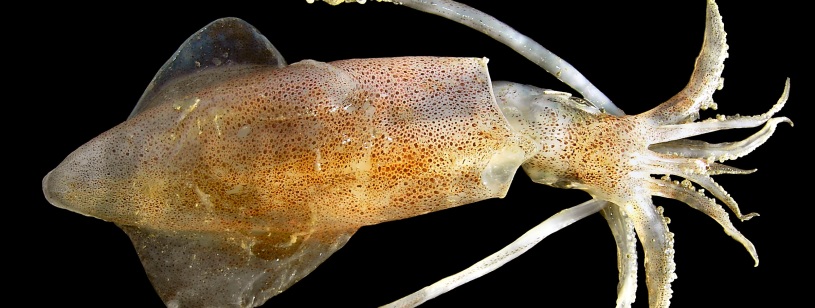
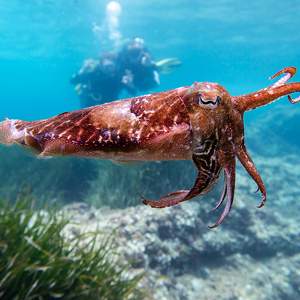
European squid (Loligo vulgaris) with an elongated mantle, side fins and tentacles. · Hans Hillewaert / Wikimedia Commons / CC BY-SA 4.0 (https://creativecommons.org/licenses/by-sa/4.0/). Cropped and resized. Source: https://commons.wikimedia.org/wiki/File:Loligo_vulgaris.jpg
The European squid (Loligo vulgaris) is a marine mollusc with eight arms and two longer feeding tentacles. It lives in the eastern Atlantic and Mediterranean. Its muscular mantle, side fins and colour-changing skin support an active predatory life.
Quick facts
| Common name | European squid |
| Scientific name | Loligo vulgaris |
| Lifespan | Around one year in Adriatic populations described by FAO; varies regionally |
| Size | Mantle commonly 15–25 cm; arms and tentacles add to total length |
| Diet | Fish, crustaceans and other cephalopods |
| Predators | Predatory fish and marine mammals |
| Conservation status | Data Deficient (DD), IUCN assessment cited by SeaLifeBase |
| Distribution | Eastern Atlantic and Mediterranean Sea |
| Habitat | Marine waters over the continental shelf |
| Family | Loliginidae |
| Movement | Fins and jet propulsion |
| Reproduction | Egg capsules attached to the seabed |
Interesting facts
- Two hearts send blood towards the gills; a third supplies the rest of the body.
- Copper-containing haemocyanin turns blue when carrying oxygen.
- Muscles control pigment sacs in the skin, changing their visible area.
- A thin internal support called the gladius runs through the mantle.
Records and extremes
A West Saharan shelf study examined 294 squid and estimated age using daily growth increments in statoliths, structures involved in balance.
One male had a 49.8 cm mantle and an estimated age of 396 days. This was a measured individual, not a typical size or a verified global record.
Characteristics
The cylindrical mantle bears broad, diamond-shaped fins towards the rear. Large eyes sit on either side of the head.
Eight sucker-bearing arms hold prey, while two longer tentacles have expanded feeding clubs. A beak lies at the centre of the arms. Mantle length excludes the head and appendages.
Behaviour
Water expelled through the muscular funnel produces thrust in the opposite direction. The fins help with smoother movements and control.
Muscle-controlled chromatophores change the appearance of the skin for camouflage and signalling. Ink can interfere with a predator’s pursuit during escape.
Habitat and distribution
The species occurs in the eastern Atlantic and Mediterranean, including the Adriatic. FAO describes its Atlantic range from the North Sea towards the Gulf of Guinea.
It occupies continental shelf waters and can move inshore for reproduction. Suitable surfaces are needed for attachment of egg capsules.
Diet and feeding
European squid eat fish, crustaceans and other cephalopods, sometimes including their own species. Food choices change with body size and local prey availability.
The long tentacles catch prey and the arms draw it towards the mouth. The beak breaks it into pieces.
Reproduction and life cycle
Females lay elongated capsules in attached clusters. Embryos develop within the capsules before hatching as small squid.
Spawning schedules vary by region. Adriatic populations can reproduce throughout the year, with a winter-to-spring peak described by FAO. Most adults die after the reproductive season.
Rapid growth allows maturity within a short life cycle. Temperature and hatching season affect development.
Name and history
Lamarck described Loligo vulgaris in 1798. It belongs to Loliginidae, a family of coastal squid.
The word squid covers many species. Giant squid measurements and deep-sea habits should not be transferred to this European coastal species.
Conservation and threats
SeaLifeBase cites an IUCN Data Deficient assessment from 2015. This means the available information was insufficient for a full evaluation of extinction risk.
The species is commercially fished. Short generations and changing sea conditions can cause substantial fluctuations, making repeated monitoring useful.
Information about catches, spawning grounds and distribution supports assessment. Protecting places where egg capsules develop helps maintain the reproductive cycle.
Frequently asked questions
Is a squid a fish?
It is a cephalopod mollusc, related to octopuses and cuttlefish.
How many arms does it have?
Eight arms and two longer feeding tentacles.
Why is its blood blue?
Copper-containing haemocyanin becomes blue when oxygenated.
How does it change colour?
Muscles expand or contract pigment sacs called chromatophores.
What is mantle length?
The length of the muscular trunk, excluding the head, arms and tentacles.
Where are the eggs laid?
In clustered capsules attached to surfaces on the seabed.