CoatiNasua — habitat, diet and reproduction
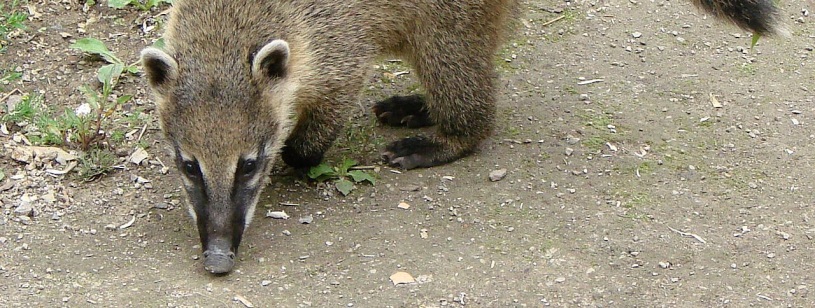
A young South American coati, Nasua nasua, photographed at Amiens Zoo. · Vassil / Public domain ().
Coatis are American mammals related to raccoons, recognised by long mobile snouts and often ringed tails. This article covers the genus Nasua, including the South American coati pictured here. These omnivores explore the ground and climb readily. Females and young form bands, while adult males are often solitary.
Quick facts
| Common name | Coati; species of Nasua |
| Scientific group | Nasua spp.; photograph shows Nasua nasua |
| Diet | Omnivore: fruit, invertebrates and other small animals |
| Main predators | Cats, birds of prey and large snakes, depending on region |
| Conservation status | Varies by species and population |
| Distribution | North, Central and South America, depending on species |
| Habitat | Forests, woodland edges and other landscapes with shelter |
| Length | Nasua nasua: head and body 41–67 cm, tail 32–69 cm |
| Weight | Nasua nasua: approximately 3–6 kg |
| Family | Procyonidae |
| Activity | Mainly diurnal |
| Reproduction | Females initially raise young in a sheltered nest |
- Primary category:Mammals
- Explore this animal's categories:
Interesting facts
- A flexible snout helps search among fallen leaves.
- The long tail assists balance in trees.
- Females are usually more social than adult males.
- Coatimundi was historically associated with solitary males.
Characteristics
A narrow head, small ears and an elongated mobile snout give the coati its distinctive appearance. Fur may be brown, grey or reddish, with paler facial markings.
In Nasua nasua, head-and-body length is approximately 41–67 cm, with another 32–69 cm of tail. Confusing total and body length exaggerates apparent size. Strong forelimbs and claws help digging and climbing, while the tail assists balance and is often held upright on the ground.
Behaviour
Females and young travel and forage in bands. Contact, grooming and calls maintain relationships. Adult males often spend much of their time alone, approaching female groups during the breeding season.
Coatis are mainly active by day. They may search leaf litter and later climb for rest or shelter. A sighting on the ground therefore captures only part of their daily use of the habitat.
Habitat and distribution
Nasua narica ranges from southwestern North America through Central America into northwestern South America. Nasua nasua occupies much of South America.
Several forest types and woodland edges provide food, climbing supports and refuge. Coatis may also appear near places visited by people, but apparent familiarity does not turn these wild mammals into domestic animals.
Diet and feeding
Fruit and other plant resources combine with invertebrates and small animals in an omnivorous diet. Smell and the mobile snout help locate food under leaves or in decaying wood.
Claws expose hidden material as the animal searches many small sites. Diet changes with seasonal availability. Human food scraps can attract coatis, and deliberate feeding encourages approaches to visitors; observation without feeding avoids changing their behaviour.
Reproduction and life cycle
A male may join a female band during breeding. Before giving birth, a female withdraws to a sheltered nest, often in a tree.
Nasua nasua has a pregnancy of roughly two and a half months and gives birth to several dependent young. Once sufficiently developed to move about, the mother and offspring return to the band. Social surroundings provide opportunities to explore and respond to danger.
Name and history
Coati is a common name, while Nasua identifies the genus discussed here. Mountain coatis are related animals and should not automatically be assigned the same measurements or conservation status.
The term coatimundi was associated with solitary males once mistaken for a different kind of animal from female bands. Social behaviour thus contributed to an identification error. Coatis belong to the raccoon family, Procyonidae.
Conservation and threats
Conditions differ among species and regions. Forest loss, hunting and capture for trade can affect populations even where some individuals tolerate modified landscapes.
Coatis eat fruit and small animals and are themselves prey for cats, raptors and large snakes. Preserving wild habitat and avoiding feeding at visitor sites helps maintain these relationships and reduce conflict.
Frequently asked questions
Is a coati a raccoon?
It is not the same animal, but coatis and raccoons share the family Procyonidae.
What is the long snout for?
Its flexibility and sense of smell help locate food among leaves and other material.
Why are some coatis alone?
Adult males are often solitary, while females and young form bands.
Does it live only in trees?
No. Much foraging occurs on the ground, although trees provide shelter and resting places.