White wagtailMotacilla alba — habitat, diet and reproduction
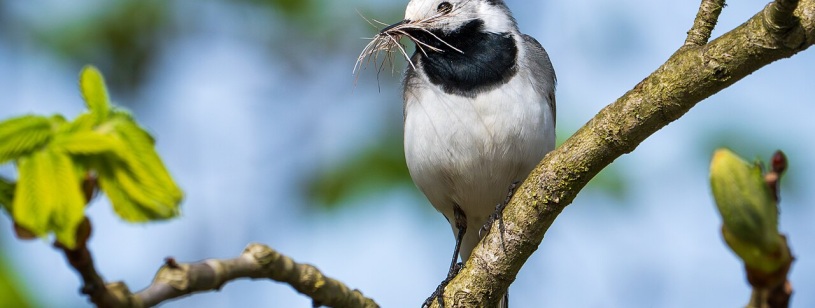
White wagtail (Motacilla alba) carrying nest material. · NorbertNagel / CC BY-SA 4.0 (https://creativecommons.org/licenses/by-sa/4.0). Cropped and resized.
The white wagtail is a small grey, white and black bird that pumps its long tail almost constantly. It runs across lawns, riverbanks, farmyards and roofs. Insects are picked from the ground or snatched in short, quick flights.
Quick facts
| Common name | White wagtail |
| Scientific name | Motacilla alba |
| Lifespan | About 2 years in the wild; some individuals live much longer |
| Length | About 16.5–19 cm, including the tail |
| Weight | About 17–25 g |
| Diet | Insectivore: insects and other small invertebrates |
| Predators | Sparrowhawks and cats; crows and magpies take eggs and chicks |
| Conservation status | Least Concern (LC), globally |
| Distribution | Europe, Asia and North Africa; also winters in Africa |
| Habitat | Riverbanks, grassland, villages, towns and farmland |
| Family | Motacillidae |
| Nest | In cavities: walls, woodpiles, lofts and banks |
- Primary category:Birds
- Explore this animal's categories:
Interesting facts
- The tail pumps up and down even when the bird is standing still.
- In winter, dozens or hundreds can gather at night in trees in towns, where it is warmer.
- Its flight is bouncing: a few wingbeats, then a short glide.
- A darker subspecies, the pied wagtail, lives in Britain and Ireland.
Characteristics
The white wagtail has a slim body, thin black legs and a long black tail with white edges. The face and forehead are white, while the crown, nape and bib are black. The back is grey.
In summer, males show cleaner and more extensive black than females. In winter, the black bib shrinks to a narrow breast band. Juveniles are olive-grey without the sharp adult pattern.
Behaviour
It is active by day and feeds by running over the ground, with quick steps and short pauses. It may jump after a fly or catch it in the air before returning to the same spot.
During breeding, pairs defend their territory against other wagtails. Outside this period, birds gather easily, especially at night roosts. The call is a short, sharp “tchizzik”, often heard as the bird takes off.
Habitat and distribution
The species breeds across almost all of Europe and much of Asia. Northern and eastern populations migrate to southern Europe, Africa and southern Asia for the winter.
In Romania it is common, mainly from March to October. Some birds stay in winter in milder areas and near unfrozen water. It prefers open ground with bare soil or short grass: riverbanks, lakes, farms and yards.
Diet and feeding
The main food is insects: flies, midges, small beetles, larvae and mayflies emerging from water. Spiders and small snails are also taken.
At the water’s edge it picks insects from stones and mud. On lawns and in parks it follows insects disturbed by people or grazing animals, eating large numbers around gardens and farms.
Reproduction and life cycle
The nest is built in a cavity: a hole in a wall, a bank, a woodpile, a loft or even parked farm machinery. It is made of grass stems and roots, lined with hair and feathers.
The female usually lays 4–6 eggs and incubates them for about two weeks. Both parents feed the chicks, which leave the nest after about 12–15 days. A pair may raise two broods in a year.
Name and history
The scientific name Motacilla alba comes from Latin. “Alba” means white, and “Motacilla” has been linked to the moving tail.
The Romanian name “codobatură” describes the gesture that makes the bird easy to recognise: the one that “beats its tail”. The white wagtail is the national bird of Latvia.
Conservation and threats
The white wagtail has a very large population and is assessed globally as Least Concern. In many regions it has adapted well to people.
Heavy insecticide use reduces its food, and renovating old buildings can remove nest sites. Free-roaming cats catch adults and chicks. Natural riverbanks and less intensively mown grassland help wagtails and other migratory birds.
Frequently asked questions
Why does the wagtail pump its tail?
There is no single agreed answer. The movement may help balance, flush insects or signal alertness to other birds.
Do white wagtails stay in Romania in winter?
Most move south in autumn, but some winter in milder areas near unfrozen water.
What does the white wagtail eat?
Mostly insects and larvae, caught on the ground, at the water’s edge or in flight.
How can you tell males from females?
In summer, males show more black on the head and back, although the difference is not always clear.