MillipedeDiplopoda — habitat, diet and reproduction
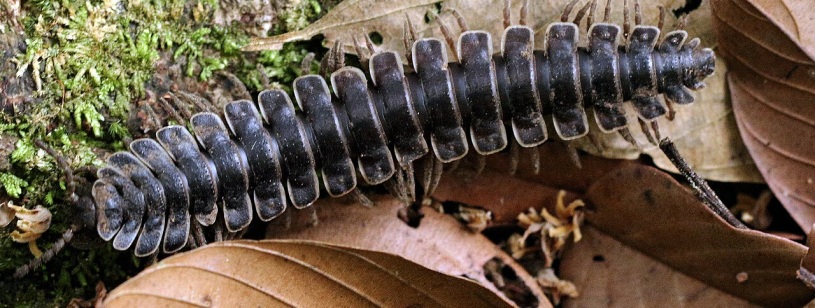
Millipede (Diplopoda) among dry leaves. · Charles J. Sharp / CC BY-SA 4.0 (https://creativecommons.org/licenses/by-sa/4.0). Cropped and resized.
Millipedes, scientifically called diplopods, are invertebrates with long bodies made of many segments, each bearing two pairs of legs. They live in soil, under leaves and logs, where they eat decaying plant matter. When frightened, they curl into a spiral and may release a foul-smelling fluid.
Quick facts
| Common name | Millipede, diplopod |
| Scientific name | Diplopoda (class) |
| Lifespan | From one year to over 7 years, by species |
| Length | From about 2 mm to about 35 cm, by species |
| Diet | Detritivore: dead leaves, rotting wood, fungi |
| Predators | Birds, hedgehogs, frogs, lizards, centipedes |
| Conservation status | Most species not evaluated |
| Distribution | Every continent except Antarctica |
| Habitat | Moist soil, leaf litter, under stones and logs, caves |
| Family | Several orders and families in class Diplopoda |
| Legs | Two pairs on most segments |
- Primary category:Invertebrates
- Explore this animal's categories:Animals of AfricaAnimals of AsiaAnimals of AustraliaAnimals of EuropeAnimals of North AmericaAnimals of RomaniaAnimals of Romania’s forestsAnimals of Romania’s gardens and parksAnimals of South AmericaArthropodsBurrowing animalsEgg-laying animalsForest animalsInvertebratesMNocturnal animalsWild animals
Interesting facts
- The English name “millipede” means “thousand feet”, but until 2021 no millipede with that many was known.
- In 2021 a millipede with 1,306 legs, Eumillipes persephone, was described from Australia.
- Millipedes have no venom and do not bite people, unlike centipedes.
- Some species glow in the dark or release substances that smell of bitter almonds.
Characteristics
Millipedes have long, cylindrical or flattened bodies covered with a hard shell. Most segments carry two pairs of short legs, hence the scientific name diplopods, “double-footed”.
The head has a pair of short antennae. Colours vary: brown, black, grey, or red and yellow in tropical species. With each moult they add new segments and legs.
Behaviour
Millipedes move slowly, with waves passing along their rows of legs. They are active mainly at night and in damp weather, as they dry out easily.
When touched, they curl into a spiral to protect their soft underside. Many have glands that release an unpleasant fluid that can stain skin but is not dangerous if you wash your hands.
Habitat and distribution
Millipedes live on every continent except Antarctica, from rainforests to caves and gardens. More than 12,000 species are known.
In Romania they are common in woods, under leaves and logs, in gardens and sometimes in damp cellars.
Diet and feeding
Millipedes feed mainly on dead leaves, rotting wood and fungi. They shred plant debris and help form humus, the fertile layer of soil.
A few species eat roots or seedlings and can do minor damage in gardens and greenhouses. They are food for many small forest animals.
Reproduction and life cycle
Males transfer sperm using modified legs. The female lays eggs in soil, sometimes in a small nest of earth and droppings.
The hatchling has few segments and only a few pairs of legs. Each moult adds segments and legs until it becomes adult, after one or more years.
Name and history
The word “myriapod” comes from the Greek “myrias” (ten thousand) and “pous” (foot). In the broad sense, myriapods include both millipedes and centipedes such as scolopendras.
The difference is easy to see: millipedes have two pairs of legs per segment, are slow and have no venom, while centipedes have one pair per segment, are fast and have venomous claws.
Conservation and threats
Most millipede species have not been assessed. Some cave species or those with tiny ranges are vulnerable to habitat destruction.
In gardens millipedes are useful, turning plant debris into soil. Keeping leaf litter and dead wood helps them. If they come indoors, they can be carried outside, where they find the moisture they need.
Frequently asked questions
Is the millipede venomous?
No. Millipedes have no venom and do not bite. Some release an unpleasant fluid, so wash your hands after touching them.
How does a millipede differ from a centipede?
A millipede has two pairs of legs per segment and is slow; a centipede has one pair per segment, is fast and venomous.
What is the “house millipede”?
The long-legged creature found in homes is usually Scutigera, a centipede related to scolopendras, not a millipede.
How many legs does a millipede have?
Usually from a few dozen to a few hundred; the record is 1,306 legs.