CassowaryCasuarius — habitat, diet and reproduction
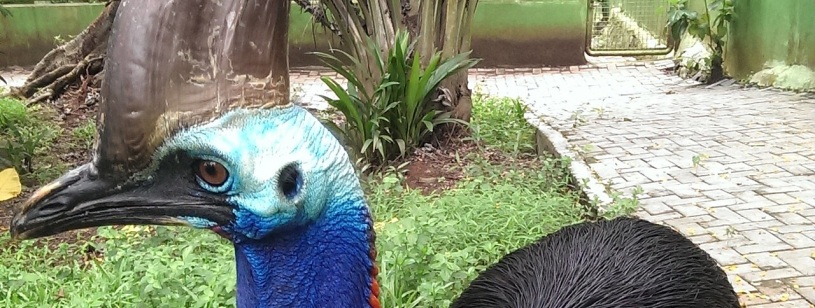
Southern cassowary (Casuarius casuarius) on a path. · 22Kartika / CC BY-SA 3.0 (https://creativecommons.org/licenses/by-sa/3.0). Cropped and resized.
The cassowary is a large flightless bird of the rainforests of New Guinea and north-eastern Australia. It has black plumage, a blue neck, red wattles and a horny casque on its head. Its inner toe bears a long, dagger-like claw used in defence.
Quick facts
| Common name | Cassowary |
| Scientific name | Casuarius (genus of three species) |
| Lifespan | About 18–20 years in the wild; up to 40 in captivity |
| Height | About 1.5–1.8 m in the southern cassowary |
| Weight | Up to about 76 kg; females are heavier |
| Diet | Omnivore, mostly fallen fruit; sometimes fungi, snails, small animals |
| Predators | Adults have few enemies; dogs and feral pigs attack chicks |
| Conservation status | Southern cassowary: Least Concern (LC); Australian population endangered |
| Distribution | New Guinea and nearby islands; north-eastern Australia |
| Habitat | Tropical rainforest |
| Family | Casuariidae |
| Flight | Flightless |
- Primary category:Birds
- Explore this animal's categories:
Interesting facts
- The claw on the inner toe can be about 12 cm long.
- A cassowary can run almost 50 km/h through forest and jump high.
- The male incubates the eggs and raises the chicks alone.
- By spreading seeds, the cassowary helps hundreds of plant species grow.
Characteristics
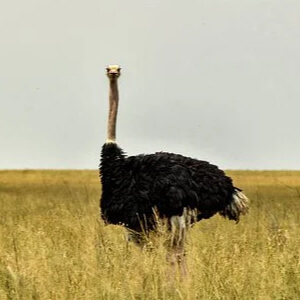
The cassowary is the third-tallest bird in the world, after the ostrich and emu, and one of the heaviest. Its coarse black feathers look like hair. The wings are tiny, with a few stiff, spine-like quills.
On its head is a horny crest called a casque, which grows with age. Its function is still debated: it may help with cooling, communication or moving through vegetation. Females are larger and more colourful than males.
Behaviour
The cassowary is usually solitary and shy, most active in the morning and evening. It communicates with very low booming sounds that people can barely hear.
If threatened or defending chicks, it can kick powerfully. Most incidents with people happened when people fed it. It swims well.
Habitat and distribution
The southern cassowary lives in New Guinea and in the rainforests of north-eastern Australia, in Queensland. The other two species, the dwarf and northern cassowaries, live only in New Guinea and nearby islands.
It prefers lowland tropical rainforest.
Diet and feeding
Its main food is fruit fallen from trees, swallowed whole. Seeds pass through the gut unharmed and sprout more easily.
It also eats fungi, snails, insects, frogs and sometimes carrion. By spreading seeds, the cassowary is an important rainforest “gardener”.
Reproduction and life cycle
The female lays 3–5 large green eggs on a bed of leaves on the ground, then leaves. The male incubates them for about 50 days, hardly eating.
Chicks have brown and cream stripes for camouflage. The male guards them and teaches them what to eat for about nine months.
Name and history
The word “cassowary” comes from the Malay “kasuari”, as does the scientific name Casuarius.
The cassowary is often called “the world’s most dangerous bird” because its kicks can cause serious injury. Attacks are rare, however, and mostly occur when people feed or corner it.
Conservation and threats
The southern cassowary is assessed globally as Least Concern, but in Australia its population is considered endangered.
Main threats include deforestation, roads where cassowaries are hit by cars, dogs and feral pigs. In Queensland towns, special road signs warn drivers to slow down.
Frequently asked questions
Is the cassowary dangerous?
Its kicks and claws can cause serious injury, but attacks are rare and mostly occur when people feed or corner it.
Can the cassowary fly?
No. Its wings are tiny, but it runs fast, jumps and swims well.
What does the cassowary eat?
Mostly fallen fruit, plus fungi, snails, insects and small animals.
Who incubates cassowary eggs?
The male. He incubates the eggs for about 50 days and then raises the chicks.