RoosterInteresting facts and information
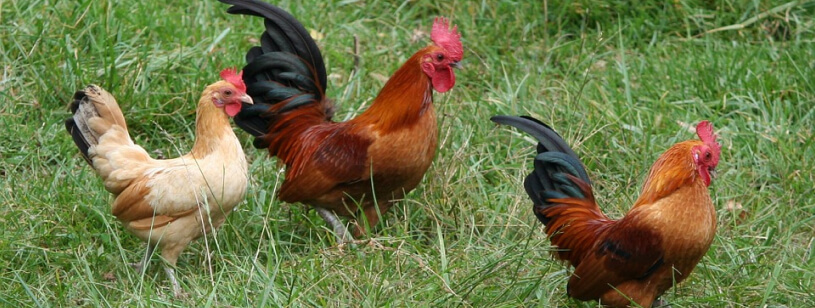
A rooster is a male domestic chicken (Gallus gallus domesticus), rather than a separate species from the hen. Roosters use calls and displays in social interactions and reproduction. Breeds differ greatly in size, plumage and behaviour.
Domestic chickens descend mainly from red junglefowl (Gallus gallus), with a complex history of domestication and breeding. Roosters and hens belong to the same domestic species.
Quick facts
| Common name | Rooster |
| Scientific name | Gallus gallus domesticus |
| Typical lifespan | About 5-8 years, up to 10-15 years in ideal conditions |
| Maximum speed | About 14 km/h when running |
| Height | About 50 - 70 cm (by breed) |
| Weight | About 2 - 5 kg (by breed); bantams under 1 kg |
| Diet type | Omnivore (grains, seeds, insects, plants, food scraps) |
| Main predators | Foxes, weasels and other mustelids, birds of prey, dogs, people |
| Conservation status | Domestic animal; domestic breed conservation is separate from assessment of wild junglefowl |
| Main breeds | Brahma, Plymouth Rock, Sussex, Leghorn, Rhode Island Red, Silkie |
| Distribution | Worldwide; the most common domestic bird |
| Habitat | Farms, backyards, villages and towns; wild ancestor in Asian forests |
- Primary category:Birds
- Explore this animal's categories:
Interesting facts
- Good memory for faces - Chickens can recognise around 100 other chickens and also learn to recognise people.
- Crowing is not only for sunrise - Roosters crow at dawn, but also during the day, to mark their territory, show their status and respond to other roosters.
- Pecking order - In a flock, roosters and hens have a clear ranking, which decides who eats first and who roosts in the best place.
- Colourful vision - Chickens see more colours than people, including ultraviolet light.
- Many different calls - Roosters have special calls for food, for danger from the air and for danger on the ground.
- Short flights - Roosters are not strong flyers, but they can fly up onto fences, branches and roofs to escape predators or to roost.
- Brave protectors - When danger appears, a rooster warns the hens and may attack the predator with its spurs and beak.
- An internal clock - Research has shown that roosters crow at dawn because of their internal body clock, even when kept in dim light all day.
- Long crowers - Some breeds, such as the Japanese Tomaru and the Turkish Denizli, are famous for very long crows that can last 10 seconds or more.
- No penis - Like most birds, roosters mate by briefly pressing their cloaca against the hen's.
Records and remarkable features
- Roosters have the same species identity as hens, while body size and plumage differ between breeds and sexes.
- The chicken is the most numerous bird on Earth, with tens of billions alive at any time.
- Roosters of long-crowing breeds can hold a single crow for 15-20 seconds or more.
Characteristics
Roosters are sturdy birds with bright plumage, large combs and spurs, which make them easy to tell apart from hens. These features come both from their wild ancestor and from thousands of years of breeding by people.
Main physical characteristics:
- Size and weight - Depending on the breed, roosters usually weigh about 2-5 kg; large breeds such as Brahma and Jersey Giant can reach about 5-6 kg, while bantams weigh under 1 kg.
- Colourful plumage - Roosters usually have brighter feathers than hens, with shining shades of red, gold, black and green, and long curved tail feathers.
- Large combs and wattles - These red skin structures help release body heat and are bigger in males than in females.
- Strong spurs - Sharp spurs on the back of the legs are used in fights and for defence.
- A strong beak - Used for pecking food and for fighting.
- Limited flight - Roosters can fly only short distances.
- Excellent eyesight - They have a wide field of view and can see colours that people cannot, including ultraviolet light.
Special adaptations for survival:
- Good hearing - Chickens hear well and recognise the calls of members of their flock.
- A loud crow - It announces the rooster's presence and territory.
- Social ranking - Dominant roosters show their status with displays, calls and sometimes fights.
- Intelligence and memory - Chickens can recognise around 100 other individuals and learn quickly.
Habits and behaviour
Roosters are active birds with complex behaviour related to feeding, defence, mating and life in the flock.
Social behaviour:
- The "pecking order" - In a flock, dominant birds get first access to food and the best roosting places.
- Guarding the flock - Roosters keep watch and warn or defend the hens when they sense a threat.
- Alarm calls - They make different calls for danger from the air (birds of prey) and on the ground (foxes, dogs, weasels).
Breeding season:
- Breeding all year - Domestic chickens can breed at any time of year, although they breed most in spring and summer.
- Courtship dance - The rooster drops one wing and circles the hen in a "wing-dropping" dance.
- Many partners - One rooster usually lives with about 8-12 hens.
Defence and survival methods:
- Spurs and beak - Roosters fight rivals and predators with their spurs and beak.
- Escaping - Chickens run or fly up into trees and other high places to escape danger, and they roost high off the ground at night.
- Warning calls - Besides crowing, roosters give alarm calls to warn the flock.
Habitat and geographic distribution
Domestic chickens are kept all over the world, from small villages to huge farms. Their wild ancestor, the red junglefowl (Gallus gallus), still lives in the forests of South and Southeast Asia.
Habitat types:
- Farms and backyards - Most roosters live with people, in coops and yards.
- Tropical forests and forest edges - Wild red junglefowl live in forests and bamboo thickets in Asia.
- Towns and cities - Some cities allow people to keep chickens, but many forbid roosters because of the noise.
Geographic distribution and estimated population:
| Region | Species present | Estimated population |
|---|---|---|
| South and Southeast Asia | Gallus gallus (wild red junglefowl) | Not known exactly; widespread |
| The whole world | Gallus gallus domesticus | About 25-35 billion chickens (hens and roosters) |
| Islands such as Hawaii (Kauai) | Feral domestic chickens | Large free-living populations |
Impact of climate change and urbanisation:
- Heat - Very hot weather causes heat stress in chickens and can reduce egg laying.
- Urban growth - Many towns ban roosters because of their crowing.
- Adaptability - Chickens live in almost every climate, from deserts to cold northern regions.
Chickens are a vital part of farming around the world, and roosters are also important cultural symbols.
Diet and feeding
Roosters are omnivores with a varied diet. On farms, people give them feed, but free-ranging roosters also find much of their own food.
Main food:
- Grains and seeds - Maize, wheat, oats, barley and sorghum are their main food on farms.
- Insects and other small animals - Worms, grasshoppers, beetles, caterpillars and snails provide protein; chickens even catch mice and small lizards.
- Greens - Grass, clover and other leaves are an important part of their diet.
- Fruit and vegetables - Apples, melons, tomatoes and courgettes are eaten when available.
- Kitchen scraps - In backyards, chickens eat bread, cooked rice and vegetable scraps.
Diet by season:
| Season | Main food type |
|---|---|
| Spring | Insects, grass, young leaves |
| Summer | Seeds, fruit, insects, grains |
| Autumn | Seeds, wheat, maize, acorns |
| Winter | Grains, scraps and feed given by people |
Feeding methods:
- Scratching and pecking - Chickens scratch the ground with their feet to uncover insects and seeds.
- Choosing food - They pick out the food they like and avoid some unpleasant-tasting things.
- Calling hens to food - A rooster makes a special call and picks up and drops food, called "tidbitting", to call hens to something good to eat.
Reproduction and life cycle
Roosters fertilise the hens' eggs, and in a flock they also help keep order and protect the hens.
Mating:
- No fixed breeding season - In good conditions, chickens can breed all year.
- Courtship dance - The rooster spreads or drops a wing and dances around the hen.
- Several hens - One rooster usually mates with about 8-12 hens in a flock.
Reproductive process:
- Cloacal contact - Roosters have no penis; mating happens through a brief "cloacal kiss".
- Fertilised eggs - After one mating, a hen may lay fertile eggs for about two to three weeks.
- Incubation - Hens sit on the eggs for about 21 days.
The development of the chicks:
- Chicks hatch covered with fluffy down and can walk and peck at food within hours.
- Growing up - Chicks stay close to their mother for about 6-8 weeks, until they grow their feathers.
- Sexual maturity - Young roosters (cockerels) start crowing and become mature at about 4-6 months.
Longevity:
- In backyards and small farms - Roosters usually live about 5-8 years.
- In ideal conditions - Some live up to 10-15 years, but on commercial farms they live much shorter lives.
Name and history
Chickens are among the most important domestic animals, and the rooster has played a big role in human culture for thousands of years.
Origin and etymology of the name:
- The word "cock" comes from Old English cocc and probably imitates the bird's call; "rooster", from "roost", came into use in America in the 18th century.
- In the scientific name Gallus gallus domesticus, the Latin word gallus means "rooster" and domesticus means "of the house". In Latin, gallus also meant "a Gaul", which is one reason why the rooster became a symbol of France.
Taxonomic classification:
| Taxonomic category | Name |
|---|---|
| Kingdom | Animalia |
| Phylum | Chordata |
| Class | Aves |
| Order | Galliformes |
| Family | Phasianidae |
| Genus | Gallus |
| Species | Gallus gallus domesticus |
Discovery and Documentation:
- Domestication - Recent research suggests that chickens were domesticated from red junglefowl in Southeast Asia around 3,500 years ago, alongside rice and millet farming.
- Antiquity - In ancient Greece and Rome, roosters were symbols of courage and were used in cockfights and religious rituals.
- The Middle Ages - The rooster became a Christian symbol, and weathercocks were placed on top of church towers.
- The 19th century - Breeders created many new breeds, and poultry shows became popular.
The role of roosters in culture and religion:
- A symbol of watchfulness - In many cultures, the rooster stands for waking up, vigilance and protection.
- A national emblem - The Gallic rooster is a national symbol of France, standing for pride and courage.
- Weather lore - Many folk sayings link a rooster crowing at unusual times with a change in the weather.
Roosters have played an important role in human history, as a source of food and as a cultural symbol.
Cultural significance and mythology
The rooster is one of the most symbolic birds in the world, with a strong presence in mythology, religion and folk traditions. It is linked with dawn, courage and protection.
Rooster in mythology and popular beliefs:
- Greek mythology - The rooster was linked to Ares, god of war; in one myth, Ares turned the young guard Alectryon into a rooster for falling asleep on watch. Roosters were also sacred to Asclepius, the god of healing.
- Chinese culture - The rooster is one of the twelve animals of the Chinese zodiac, and an old Chinese text praises it for five virtues, including courage, kindness and trustworthiness.
- Norse mythology - At Ragnarök, the end of the world, three roosters crow, including the golden-combed Gullinkambi, who wakes the gods.
- Christianity - The rooster is a symbol of vigilance and repentance; in the Gospels, Peter denies Jesus three times before the rooster crows.
- Folk beliefs - In many cultures, a rooster crowing at night was thought to be a bad omen.
Rooster symbolism:
- Dawn and light - Because roosters crow at sunrise, they are linked with the start of a new day and with spiritual awakening.
- Protection - The weathercock on church towers was seen as a guardian watching over the town.
- Fertility and plenty - In many farming cultures, the rooster was a symbol of prosperity.
Conservation status and threats
Domestic chickens (Gallus gallus domesticus) are not threatened and are kept all over the world. Their wild ancestor, the red junglefowl (Gallus gallus), is also widespread, but its wild genes are threatened by crossing with domestic chickens.
Conservation status
- Domestic chickens - Not at risk, with tens of billions kept worldwide; some old local breeds, however, are rare.
- The red junglefowl (Gallus gallus) - Listed as Least Concern by the IUCN, but in many areas wild birds mix with domestic chickens.
Main threats:
- Habitat loss - Deforestation and farming reduce the forests where wild junglefowl live.
- Hybridisation - Breeding with domestic chickens threatens the genetic purity of wild junglefowl.
- Hunting and trapping - In some regions, wild junglefowl are caught for food or for cockfighting.
Conservation efforts:
- Protecting forests - Protected areas in South and Southeast Asia help preserve wild red junglefowl.
- Banning cockfighting - In many countries, cockfighting is illegal because it is cruel to the birds.
- Saving rare breeds - Breeders and organisations work to keep traditional chicken breeds alive and protect their genetic diversity.
In popular culture
Roosters have had a big influence on human culture, appearing in heraldry, literature, sport, food and entertainment.
Heraldic rooster and national symbols:
- The Gallic rooster (Le Coq Gaulois) - A national symbol of France, standing for the courage and pride of the French people.
- Sports emblem - The French national football and rugby teams wear a rooster on their shirts, and Footix, the mascot of the 1998 FIFA World Cup in France, was a rooster.
- Heraldry - Roosters appear on many coats of arms in Europe as symbols of vigilance.
Roosters in cinematography and animations:
- Rock-a-Doodle (1991) - An animated film about Chanticleer, a rooster who believes his crowing makes the sun rise.
- Chicken Run (2000) - In this animated film, Rocky, a rooster, helps a group of hens plan their escape from a farm.
- Looney Tunes - Foghorn Leghorn, a loud rooster with a Southern accent, is one of its best-known characters.
Roosters in literature:
- "The Nun's Priest's Tale" (Geoffrey Chaucer, 14th century) - The story of Chauntecleer, a proud rooster who is caught by a fox but tricks his way to freedom.
- "Town Musicians of Bremen" (Brothers Grimm) - A rooster is one of four old farm animals who set off together and scare away a band of robbers.
- Folk tales - Roosters are often heroes in folk tales, clever and brave enough to defeat evil forces.
Roosters in sport and food:
- Coq au vin - A traditional French dish in which a rooster is cooked slowly in red wine.
- Brands - A rooster called Cornelius has long appeared on boxes of Kellogg's Corn Flakes.
Roosters in music and art:
- The Rooster of Barcelos - A brightly painted rooster that is one of the best-known symbols of Portugal, based on a local legend.
- Music - Many pieces imitate the rooster's crow, such as the rooster in Saint-Saëns's The Carnival of the Animals ("Hens and Roosters").