Wels catfishSilurus glanis — habitat, diet and reproduction
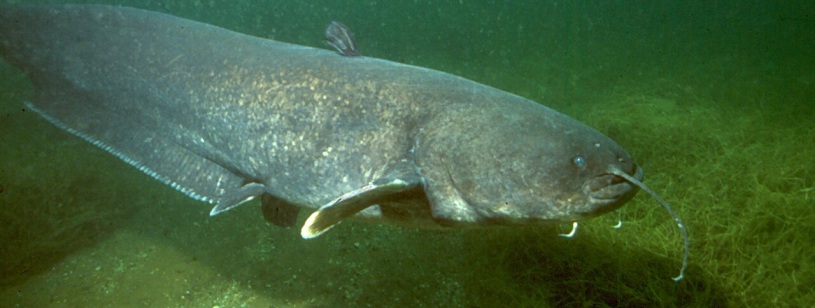
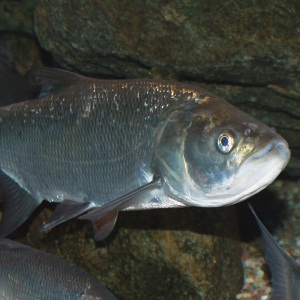
Wels catfish (Silurus glanis) swimming underwater. · Dieter Florian / CC BY-SA 3.0 de (https://creativecommons.org/licenses/by-sa/3.0/de/deed.en). Cropped and resized. Source: https://commons.wikimedia.org/wiki/File:Silurus_glanis_02.jpg
Wels catfish (Silurus glanis) are large freshwater predators with broad heads and six barbels around the mouth. They inhabit rivers and lakes, including the Danube and its delta. Their elongated bodies have smooth, scaleless skin.
Quick facts
| Common name | Wels catfish |
| Scientific name | Silurus glanis |
| Lifespan | Can exceed 20 years; varies greatly between populations |
| Length | Large individuals exceed 2 m |
| Weight | Large adults can weigh tens of kilograms; exceptional fish exceed 100 kg |
| Diet | Carnivorous: fish, invertebrates and other aquatic animals |
| Predators | Predatory fish and birds take young catfish; large adults have few natural predators |
| Conservation status | Least Concern (LC), globally |
| Distribution | Europe and parts of Asia; introduced to other basins |
| Habitat | Lowland rivers, lakes and reservoirs with shelter |
| Family | Siluridae |
| Reproduction | Eggs laid in nests guarded by males |
Interesting facts
- Six barbels help the fish explore its surroundings.
- Males guard the eggs and keep water moving around the nest.
- Some individuals in France’s Tarn River have been observed catching pigeons at the water’s edge.
- Small eyes are supplemented by well-developed senses useful in murky water.
Records and extremes
Large wels catfish can exceed 2 m and 100 kg. Their growth varies with food, temperature and habitat. These dimensions describe exceptionally large fish.
Individuals aged 26 years have been reported from the Danube. A Swedish study estimated much greater ages from the slow growth of marked and recaptured fish. Those estimates are model-based and specific to the studied northern populations.
Characteristics
The broad, flattened head carries a large mouth and small eyes. Two long barbels flank the mouth, while four shorter ones sit beneath the lower jaw. The body is scaleless and covered in mucus.
A tiny dorsal fin contrasts with a very long anal fin. Colour can be grey, olive or dark green, often with mottling and a paler belly.
Behaviour
Catfish often feed around dusk and at night. Roots, submerged timber, boulders and deep holes provide resting places. In cold weather, activity decreases and fish retreat to deeper water.
They forage near the bottom and in the water column. Sensory adaptations help them locate food when visibility is poor. Activity changes with water temperature and prey availability.
Habitat and distribution
The native range covers much of central and eastern Europe and parts of western Asia. Suitable habitats include lowland rivers, lakes and reservoirs. Slow water and submerged structures offer cover.
In Romania, catfish occur in the Danube, major rivers and the Danube Delta. Fisheries research documents their place in the delta’s fish community. Shallow, vegetated margins provide breeding and nursery habitat.
Diet and feeding
Young catfish eat small invertebrates, while larger fish take increasingly large prey. The diet includes fish, crayfish, molluscs and amphibians. Birds and small mammals can be captured occasionally.
Researchers on the Tarn River documented certain individuals partially beaching themselves to catch pigeons. This was a local feeding technique used by some fish. Most feeding takes place within the aquatic food web.
Reproduction and life cycle
Spawning usually occurs in late spring and summer. Males prepare shallow nests among vegetation or roots. Females deposit adhesive eggs, which are fertilised externally.
Males guard the eggs and maintain water circulation around them. Incubation may take roughly 2–10 days, depending on temperature. Newly hatched larvae initially use their yolk sacs, then begin feeding independently.
Maturity is often reached at around 3–4 years, with differences between sexes and populations. Adults may breed in successive years.
Name and history
Carl Linnaeus described Silurus glanis in 1758. The species belongs to the family Siluridae and is also called European catfish.
It has long been important in European fisheries. Preserved specimens in natural-history collections, including Romania’s Oltenia Museum, provide records for studying the species.
Conservation and threats
Wels catfish are globally classified as Least Concern. River engineering and the loss of shallow spawning habitat can still affect local populations.
In introduced ranges, predation can harm native fish and waterbirds. The USFWS ecological assessment documents these impacts. Conserving native populations and managing introductions therefore require different approaches.
Vegetated margins, submerged roots and connections between habitats support feeding, shelter and reproduction.
Frequently asked questions
What are the barbels for?
They help the fish sense its surroundings and locate food.
Does it have scales?
It has smooth, mucus-covered skin without scales.
Why does it use deep holes?
They provide shelter, particularly while resting and during cold periods.
Which parent guards the eggs?
The male guards the nest and moves water around the eggs.
Do all wels catfish hunt birds on land?
This behaviour has been documented in certain individuals and populations; aquatic prey forms the usual diet.
Is it the same fish as a bullhead catfish?
Wels catfish are Silurus glanis. Bullheads belong to different species and a different family.