Field SpanielCharacteristics, history, training and care
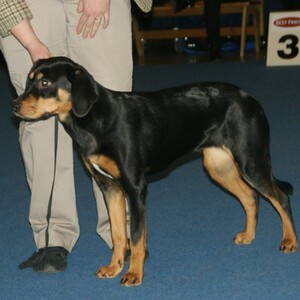
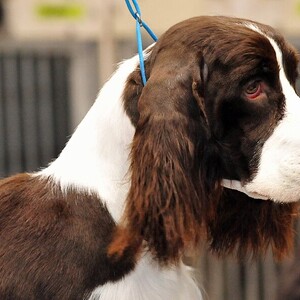
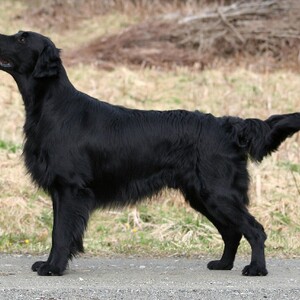
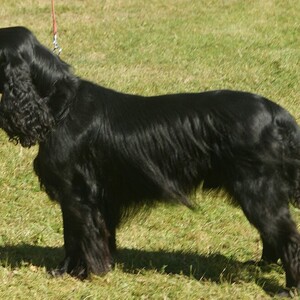
Field Spaniel. · Canarian / Wikimedia Commons, CC BY-SA 4.0. Cropped and resized.
The Field Spaniel is a medium-sized English spaniel with a long, glossy, silky coat, black or liver. It was formed in the late 19th century and came close to disappearing twice. The standard describes it as unusually docile, active, sensitive and independent, and the AKC says it is very easy to train.
Quick facts
| Common name | Field Spaniel |
| Scientific name | Canis lupus familiaris |
| Country of origin | United Kingdom |
| Official recognition | FCI, definitively since 27 December 1954 (group 8, flushing dogs, with a working trial; standard no. 123); also recognised by the AKC |
| Lifespan | 12–13 years, according to the AKC |
| Size (males) | about 46 cm at the withers; 18–25 kg |
| Size (females) | about 46 cm at the withers; 18–25 kg |
| Coat type | Long, flat, glossy and silky, with abundant feathering |
| Common colours | Black, liver, blue roan or liver roan, with or without tan |
| Energy level | Moderate |
| Suited to an apartment? | Yes, if it gets regular exercise |
| Temperament | Docile, active, sensitive, independent |
| Tendency to aggression | Very low |
| Good with children | Very good |
| Good with other animals | Good |
| Genetic predispositions | Hip dysplasia, eye diseases, hypothyroidism, autoimmune haemolytic anaemia, allergies |
History and origin
The FCI standard says the Field Spaniel appeared in the late 19th century, from crosses between the old Sussex Springer and the Cocker Spaniel. Wikipedia says the first breeders wanted an all-black spaniel for the show ring; the long, low dogs of that time were not practical for hunting, and their dark colour was hard to see in the field.
The breed came close to disappearing twice: in the early 1900s, because of show fashions, and in the 1950s, when there were so few dogs that the Kennel Club withdrew its championship status. This was restored in 1969, thanks to the efforts of breeders, who rebuilt a longer-legged dog suited to fieldwork.
How the breed developed
- Late 19th century – The breed is formed from the Sussex Springer and the Cocker Spaniel.
- 1909 – A Field Spaniel, Clareholm Dora, is named best champion at Crufts.
- Early 1900s – The breed almost disappears because of show fashions.
- 27 December 1954 – The FCI recognises the breed.
- 1950s – The Kennel Club withdraws championship status because there are too few dogs.
- 1969 – Championship status is restored.
Breed rating
| Feature | Stars |
|---|---|
| Training and intelligence | ★★★★★ |
| Easy to train | ★★★★★ |
| Intelligence | ★★★★☆ |
| Independence | ★★★★☆ |
| Stubbornness | ★★★☆☆ |
| Behaviour and temperament | ★★★★☆ |
| Affectionate with family | ★★★★★ |
| Friendly with children | ★★★★★ |
| Good with other dogs | ★★★★☆ |
| Good with cats and other animals | ★★★☆☆ |
| Loyalty | ★★★★★ |
| Tendency to be aggressive | ★☆☆☆☆ |
| Tendency to bark | ★★★☆☆ |
| Needs and care | ★★★★☆ |
| Shedding | ★★★☆☆ |
| Needs frequent grooming | ★★☆☆☆ |
| Activity and lifestyle | ★★★★☆ |
| Energy level | ★★★☆☆ |
| Daily exercise needs | ★★★☆☆ |
| Suited to apartment life | ★★★★☆ |
| Health and longevity | ★★★★☆ |
| Life expectancy | ★★★★☆ |
| Predisposition to genetic diseases | ★★★☆☆ |
| Working abilities and uses | ★★★★☆ |
| Good hunting dog | ★★★★☆ |
| Good companion dog | ★★★★★ |
Indicative rating: 5 stars means the highest level. It is based on the ratings the American Kennel Club gives the breed and on the FCI standard.
Physical characteristics
The AKC says it resembles the Cocker, Springer and Sussex Spaniels and should be a well-balanced hunting companion of moderate proportions. The head gives an impression of nobility and character.
General appearance
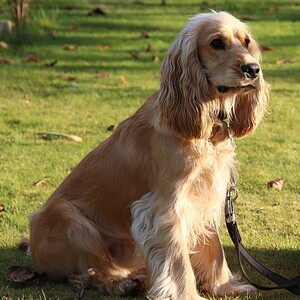
The long, feathered ears frame a grave, gentle expression. Wikipedia says the coat is darker than in other spaniels and has no undercoat. It has abundant feathering on the chest, under the body and on the backs of the legs.
| Feature | Field Spaniel |
|---|---|
| Size | Medium |
| Height at the withers | about 46 cm |
| Weight | 18–25 kg |
| Coat | Long, flat, silky |
| Ears | Long, feathered |
| Undercoat | None |
The accepted colours are black, black and tan, blue roan, blue roan and tan, liver, liver and tan, liver roan and liver roan and tan. In self-coloured dogs, white or roan on the chest is accepted.
Training and socialisation
The standard describes it as unusually docile, active, sensitive and independent. The AKC gives it the top score for trainability.
The AKC says it does best with clear communication and rewards, with very few corrections. Once it understands what is being asked, it is very reliable in training and excels in many dog sports. As it is so passionate about food, rewards are a strong motivation.
Tips for effective training
- Use rewards. The AKC says owners jokingly call it the “Food Spaniel”.
- Correct it as little as possible. It is a sensitive breed.
- Socialise it from an early age. It helps it become self-assured.
- Give it challenges. The AKC says it needs exercise for both mind and body.
Activity needs and lifestyle
The AKC says it is an active sporting breed that does best with regular exercise and mental activity. It copes in town as well as in the country, as long as it gets challenges for mind and body.
| Activity | How often | Why it matters |
|---|---|---|
| Brisk walks | daily | Regular exercise |
| Dog sports | weekly | It excels at many of them |
| Scent games | several times a week | Hunting instinct |
Tips for a balanced life
- Check the ears after walks.
- Keep food out of its reach.
- It suits families with children very well.
Care and health
Coat and skin care
The AKC says the single coat, with no undercoat, is one of the breed's most beautiful features, but it needs care: weekly brushing and combing to keep it glossy and reduce shedding. It is only lightly trimmed on the head and feet; unlike other spaniels, the body is not clipped.
Common health problems
The AKC says Field Spaniels are generally healthy, but a few problems can occur:
| Condition | Description | Common symptoms |
|---|---|---|
| Hip dysplasia | The hip joint forms incorrectly and, over time, arthritis develops | Limping, difficulty getting up or jumping, hip pain |
| Hypothyroidism | The thyroid gland produces too little hormone | Weight gain, tiredness, dull coat |
| Autoimmune haemolytic anaemia | The body destroys its own red blood cells | Weakness, pale gums, rapid breathing |
| Eye diseases | Inherited eye conditions | Poor vision, cloudy eyes |
Other care
- Check the ears regularly for signs of infection.
- Brush its teeth regularly.
- Trim the nails when they start to touch the floor.
Diet and nutrition
The AKC says Field Spaniels adore their meals and treats. Table scraps should be given very rarely or not at all, and cooked bones never.
Tips for a healthy diet
The table gives a starting estimate, calculated with the formula from the Merck Veterinary Manual. The first two calorie columns show the calories per day for a healthy adult dog. The last column shows what this means in dry food with 3,500–4,000 kcal per kilogram.
| Dog's weight | Calories per day (neutered) | Calories per day (not neutered) | Dry food per day (approximate) |
|---|---|---|---|
| 18 kg | 980 kcal | 1,100 kcal | 240–310 g |
| 21 kg | 1,100 kcal | 1,240 kcal | 280–350 g |
| 25 kg | 1,250 kcal | 1,410 kcal | 310–400 g |
- Training treats count towards the daily portion.
- Give it its food in two meals a day.
- A dog is at the right weight when you can feel its ribs under the coat without pressing hard.
Foods to avoid
Some human foods are dangerous for dogs: chocolate, coffee, grapes and raisins, onions, garlic, xylitol (a sweetener used in chewing gum), macadamia nuts and alcohol.
Reproduction and development
Physical and emotional maturity
In dogs, sexual maturity usually comes between 6 and 12 months. Most breeds become adults at around 13–15 months.
Mating and pregnancy
Pregnancy lasts about 63 days, counted from ovulation. Mating a female on her first heat is not recommended. The FCI standard requires that only healthy dogs of typical breed appearance are used for breeding.
Caring for the puppies
In dogs, a litter has 5–6 puppies on average, and the number rises with the size of the breed. Socialisation starts in the first weeks: gentle handling, everyday noises and new people.
Interesting facts
- “Food Spaniel”. The AKC says owners jokingly call it this, because it loves food so much.
- Nearly lost twice. In the early 1900s and in the 1950s.
- Created for the show ring. The first breeders wanted an all-black spaniel.
- A vulnerable breed. The Kennel Club considers it a vulnerable native British breed.
- A single coat. The AKC says it has a single coat, with no undercoat.
Frequently asked questions
How does the Field Spaniel differ from the Cocker?
It is larger and heavier than the English Cocker (18–25 kg), and its coat is usually black or liver.
How big does it get?
It measures about 46 cm at the withers and weighs 18–25 kg.
Is it easy to train?
Yes, the AKC gives it the top score for trainability, especially with rewards.
How long does it live?
The AKC gives 12–13 years.