AntInteresting facts and information
Ants are social insects in the family Formicidae. Their colonies usually include reproductive queens, female workers and males. Colony size and organisation vary greatly between species.
Ants can carry loads several times their own body weight, although their strength varies with species and the task. Different ants eat insects, seeds, nectar or fungi, and many help aerate soil and disperse seeds.
Ants are considered one of the most successful groups of animals due to their extraordinary adaptability, efficient communication and advanced survival strategies. However, some species can become agricultural pests or invasives, affecting native biodiversity.
Quick facts
| Common name | Ant |
| Scientific name | Formicidae (family Formicidae) |
| Typical lifespan | Workers: weeks to a few years; queens of some species: up to about 30 years |
| Maximum speed | Varies by species; the Saharan silver ant reaches about 0.85 m/s |
| Dimensions | Usually about 1-30 mm; some queens reach about 5 cm |
| Weight | Varies greatly with species and caste |
| Diet type | Omnivore (nectar, honeydew, insects, seeds, fungi) |
| Main predators | Birds, frogs, lizards, spiders, anteaters, pangolins, other ants |
| Conservation status | Varies by species; this family has no single conservation status |
| Distribution | Global, except for Antarctica and a few isolated islands |
| Habitat | Forests, grasslands, deserts, towns, underground, in trees |
Interesting facts
- Ants can build "living bridges" – Army ants such as Eciton burchellii link their bodies together to make temporary bridges over gaps.
- A supercolony about 6,000 km long – In southern Europe, Argentine ants (Linepithema humile) form a huge network of cooperating nests that stretches along the coast from Italy to Spain and Portugal.
- Some ants sacrifice themselves – Workers of certain Southeast Asian ants, such as Colobopsis saundersi, can burst their bodies to spray a sticky, toxic liquid on enemies.
- Some ants "farm" aphids – They protect aphids from predators and "milk" them for the sweet liquid they produce, called honeydew.
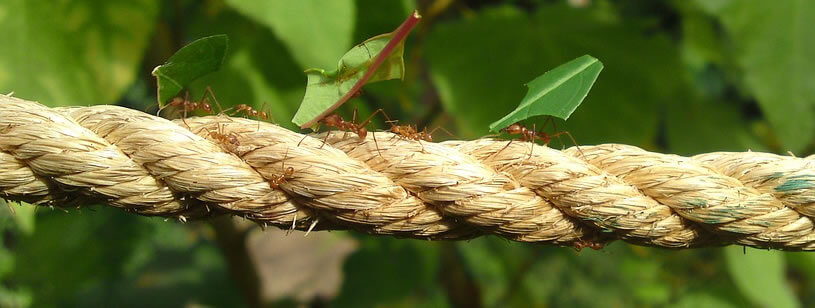
- Carrying food – Leafcutter ants transport pieces of vegetation to their nests, where they use the material to grow fungi.
- Living rafts – When their nests flood, fire ants link together to form floating rafts that can survive for days or even weeks.
- Ancient ants – Ant fossils are known from Cretaceous amber; the oldest-known specimen changes as new discoveries are assessed.
- Some ants raid other colonies – "Slave-making" ants such as Polyergus attack the nests of other ants and steal their pupae, which grow up to work for their captors.
- Ants were farmers long before humans – Leafcutter ants grow fungus gardens inside their nests and feed on the fungus.
Records and remarkable features
- Large ants – Dinoponera includes some of the largest living ants, with workers several centimetres long.
- Tiny ants – Some ant workers are less than a millimetre long.
- The longest-lived ant – A queen of the black garden ant (Lasius niger) lived almost 29 years in a laboratory.
- A painful sting – The bullet ant (Paraponera clavata) is known for its painful sting. This does not establish a ranking for aggression.
- Fastest ant – The Saharan silver ant (Cataglyphis bombycina) can run at about 0.85 m/s, more than 100 times its body length per second.
- Largest colony – The Argentine ant (Linepithema humile), whose European supercolony stretches for about 6,000 km.
Characteristics
Ants are eusocial insects with a body in three parts, elbowed antennae and strong jaws. They live in organised colonies in which each ant has a specific role that helps the whole group survive.
Main physical characteristics
| Feature | Details |
|---|---|
| Size | About 1 mm to 5 cm, depending on the species and caste |
| Weight | About 1-150 mg |
| Body | Head, thorax and abdomen, with a narrow "waist" |
| Antennae | Elbowed and very sensitive, used for smell, touch and communication |
| Jaws (mandibles) | Strong, used for carrying, fighting, digging and feeding |
| Legs | 6 jointed legs, adapted for fast running |
| Eyes | Compound eyes; eyesight varies greatly between species, and some ants are almost blind |
Special adaptations
- Great strength – Ants can carry objects many times their own weight, sometimes 50 times or more.
- Chemical communication – They use pheromones to signal danger, mark trails to food and recognise nestmates.
- Many ways of living – Some ants dig complex underground tunnels, others build nests in trees, and some use their own bodies to form bridges or rafts.
- Bites and stings – Some ants bite, while species such as fire ants and bullet ants can also sting.
Habits and behaviour
Ants are highly organised, and each ant has a clear role in the colony. This teamwork has made them some of the most successful animals on Earth.
Social organisation
Ant colonies are made up of three main castes:
| Caste | Role in the colony |
|---|---|
| Queen | Usually an egg-laying female; some species have several queens or reproductive workers |
| Workers | Females that build the nest, feed the young, find food and defend the colony |
| Males | Exist only to mate and usually live just a short time |
- Queens can live for decades – They are among the longest-lived insects known.
- Workers usually do not breed – They spend their lives working for the colony.
- Males are short-lived – They die soon after mating.
Specific behaviours
- Scouts find food and leave scent trails that guide other workers to it.
- Caring for injured nestmates – Wound care has been documented in some ant species; it is not a universal colony role.
- Raiders – Some species attack other colonies and steal their young.
Defence strategies
- Defence – Depending on the species, ants defend the colony with bites, stings or chemical secretions.
- Self-destruction – Some exploding ants burst their bodies to release toxic substances on enemies.
- Strength in numbers – Army ants attack in massive groups, overwhelming their enemies.
Habitat and geographic distribution
Ants are among the most widespread insects, living in almost every land region except Antarctica and a few remote islands. They are found in rainforests, deserts, grasslands, in the soil, in trees and in towns.
Habitat types
| Habitat | Example species |
|---|---|
| Rainforests | Army ants (Eciton burchellii), leafcutter ants (Atta cephalotes) |
| Meadows and woodland | Red ants (Myrmica rubra), red wood ants (Formica rufa) |
| Deserts | Saharan silver ant (Cataglyphis bombycina), harvester ants (Pogonomyrmex) |
| Towns and buildings | Pharaoh ant (Monomorium pharaonis), Argentine ant (Linepithema humile) |
Geographic distribution
- South and Central America – Tropical forests have the greatest variety of ants, including leafcutter ants, which live only in the Americas.
- Africa and Asia – Home to driver ants (Dorylus), whose huge columns march through the forest, and weaver ants, which sew leaves together to make nests.
- North America and Europe – Have many native species, such as wood ants, as well as invasive species such as the Argentine ant and the red imported fire ant.
- Australia – Home to bulldog ants (Myrmecia), large ants with powerful stings.
Impact of climate change and human activities
- Urban development and farming destroy natural ant habitats.
- Rising temperatures change where some species can live and help some invasive ants spread.
- Invasive species, such as the red imported fire ant and the yellow crazy ant, harm native wildlife.
Ants are a key part of ecosystems: they turn and aerate soil, recycle nutrients, spread seeds and are food for many other animals.
Diet and feeding
Many ants are omnivores that eat everything from nectar and seeds to insects and fungi. Their food depends on the species, habitat and season, and many ants have clever ways of collecting and storing food.
Types of food
| Food group | Ants that eat it |
|---|---|
| Nectar and honeydew | Black garden ant (Lasius niger), honeypot ants (Myrmecocystus), Argentine ants (Linepithema humile) |
| Insects and other arthropods | Army ants (Eciton burchellii), bullet ant (Paraponera clavata) |
| Seeds | Harvester ants (Pogonomyrmex, Messor) |
| Fungus grown in the nest | Leafcutter ants (Atta cephalotes, Acromyrmex) |
Feeding methods
- Working together – Workers follow scent trails to food sources and carry it back to the nest, sometimes teaming up to move large items.
- Fungus farming – Leafcutter ants use chewed leaves to grow fungus in their nests.
- Aphid farming – Some ants protect aphids and "milk" them for sugary honeydew.
- Living food stores – In honeypot ants, some workers store so much liquid food in their abdomens that they swell up like grapes and act as living storage jars.
- Fierce predators – Army ants hunt insects and other small animals in huge raids.
Ants' excellent communication and cooperation let them find and carry food remarkably efficiently.
Reproduction and life cycle
Ants have a unique way of reproducing: queens can live for decades, while thousands of workers spend their lives looking after the colony. Much of colony life is controlled by pheromones.
Life cycle stages
| Stage | Approximate duration | Details |
|---|---|---|
| Egg | 1-2 weeks | Laid by the queen; hatches into a larva. |
| Larva | 1-4 weeks | Fed by workers with food and secretions. |
| Pupa | 1-3 weeks | The larva changes into an adult, sometimes inside a cocoon. |
| Adult | Varies (weeks to decades) | Workers usually live from a few months to a few years; queens of some species live 20-30 years. |
Mating and reproduction
- Queens can lay huge numbers of eggs – After mating, a queen stores sperm and uses it to fertilise eggs for the rest of her life.
- The nuptial flight – At certain times of year, winged males and young queens leave their colonies to mate in the air.
- A new colony – The males die soon after mating, while each young queen sheds her wings, seals herself into a small chamber and lays her first eggs.
Survival strategies
- Giant colonies – Some colonies contain millions of ants, which makes them very hard to wipe out.
- Invasive ants – Species such as the fire ant and Argentine ant can spread quickly into new areas and push out native ants.
- Raiding other species – Slave-making ants, such as Polyergus, attack the colonies of other species and steal their pupae to raise as workers.
This way of life has allowed ants to become one of the most successful and resilient groups of insects on land.
Name and history
Ants have a long evolutionary history extending back to the Cretaceous. Fossils and genetic studies help researchers investigate their origins.
Origin of the name
- The word "ant" comes from Old English æmette (which also gave the old word "emmet"), probably meaning "the one that bites off". The Latin word for ant is formica and the Greek word is myrmex.
- The scientific name "Formicidae" comes from the Latin formica; the study of ants is called myrmecology, from the Greek myrmex.
Taxonomic classification
| Taxonomic category | Name |
|---|---|
| Kingdom | Animalia |
| Phylum | Arthropoda |
| Class | Insecta |
| Order | Hymenoptera |
| Family | Formicidae |
| Genera and species | More than 300 genera and over 14,000 described species |
Ants in history and culture
- Greek mythology – According to legend, Zeus turned the ants of the island of Aegina into people, the Myrmidons, who later fought for Achilles in the Trojan War.
- The Bible – The Book of Proverbs advises: "Go to the ant, thou sluggard; consider her ways, and be wise."
- Science – The Swiss naturalist Pierre Huber described ant behaviour in detail in 1810, Charles Darwin wrote about slave-making ants, and Bert Hölldobler and E. O. Wilson won a Pulitzer Prize for their book The Ants (1990).
Ants are iconic insects that inspire science, culture and mythology, and their social organisation is among the most complex in the animal world.
Cultural significance and mythology
In many cultures, ants are symbols of hard work, organisation and persistence. From Greek mythology to modern fables, they have inspired stories, proverbs and scientific studies.
Ants in mythology and folk belief
- Greek mythology – In the legend of the Myrmidons, Zeus turned ants into loyal, warlike people, who became Achilles' soldiers in the Iliad.
- A painful rite of passage – Among the Sateré-Mawé people of the Amazon, boys wear gloves filled with bullet ants as part of a test of courage.
- European fables – Fables describe ants as examples of hard work and planning ahead, in contrast to the carefree grasshopper.
Ant symbolism
- Work and discipline – Ants are often used as a symbol of persistence and efficiency.
- Collective strength – They stand for the importance of teamwork.
- Survival and strategy – Some cultures see them as examples of adaptability and natural intelligence.
Conservation status and threats
Ants are very hardy and have adapted to almost all land environments. However, some species are threatened by habitat destruction, climate change and invasive species.
Conservation status
| Species | Situation |
|---|---|
| Dinosaur ant (Nothomyrmecia macrops) | A rare, "primitive" Australian ant listed as Critically Endangered by the IUCN |
| Dracula ant (Adetomyrma venatrix) | Species-specific assessment needed |
| Red wood ants (Formica rufa group) | Listed as Near Threatened; protected in several European countries |
| Argentine ant (Linepithema humile) | Invasive; listed among the world's 100 worst invasive species |
| Red imported fire ant (Solenopsis invicta) | Invasive; listed among the world's 100 worst invasive species |
Main threats
- Habitat destruction – Deforestation and urban growth destroy the places where ants build their colonies.
- Invasive species – Argentine ants and fire ants compete with and push out native species.
- Pesticides and pollution – Farm chemicals harm many ants, especially those that live in the soil.
- Climate change – Extreme temperatures can change where some species live, and droughts reduce their food.
Conservation efforts
- Protecting rare species – Some countries protect important ants, such as red wood ants, and their nest mounds.
- Controlling invasive ants – Scientists develop ways to stop the spread of Argentine ants and fire ants.
- Biodiversity monitoring – Ants are indicators of ecosystem health, and studying them helps scientists understand the effects of climate change.
In popular culture
Ants have inspired many books, films, cartoons and video games as symbols of teamwork and survival.
Ants in literature
- "The Ant and the Grasshopper" (Aesop, 6th century BC) – A classic fable about hard work and responsibility, in which the ant prepares for winter while the grasshopper plays and later goes hungry.
- Empire of the Ants (Bernard Werber, 1991) – A French science-fiction novel about the secret, organised world of ants.
- Children's books – Ants often appear in educational stories about teamwork and nature.
Ants in film and television
- Them! (1954) – A classic science-fiction film about giant ants created by atomic tests.
- A Bug's Life (1998) – A Pixar film about an ant colony that stands up to a gang of greedy grasshoppers.
- Antz (1998) – An animated film about a worker ant who wants to break free from his colony's strict rules.
- Ant-Man (2015) – A Marvel superhero who can shrink to the size of an ant and talk to ants.
Ants in cartoons and video games
- Atom Ant (1965) – A classic cartoon about a superhero ant.
- SimAnt (1991, Maxis) – A simulation game in which players control an ant colony.
- Pokémon – Durant is an armoured ant Pokémon.
Ants as a cultural symbol
- Logos and emblems – Ants are used as symbols of hard work and resilience.
- Art – Ants appear in drawings and designs as symbols of collective strength and constant work.