Andalusian HoundCharacteristics, history, training and care
The Andalusian Hound (Podenco Andaluz) is a hunting dog from Andalusia, in southern Spain. It comes in three sizes and three coat types, making nine varieties. The standard of the Spanish Kennel Club (RSCE) describes it as intelligent, noble, sociable and always alert, very affectionate and loyal to its owner, but distrustful of strangers.
Quick facts
| Common name | Andalusian Hound (Podenco Andaluz) |
| Scientific name | Canis lupus familiaris |
| Country of origin | Spain (Andalusia) |
| Official recognition | RSCE (Spain) since 1992, official Spanish standard since 2001, VDH (Germany) since 2014; not recognised by the FCI |
| Lifespan | No published data for the breed; medium-sized dogs usually live 10–13 years |
| Size (males) | small 35–42 cm; medium 43–53 cm; large 54–64 cm |
| Size (females) | small 32–41 cm; medium 42–52 cm; large 53–61 cm |
| Coat type | Short, rough (“cerdeño”) or long and silky (“sedeño”), with no undercoat |
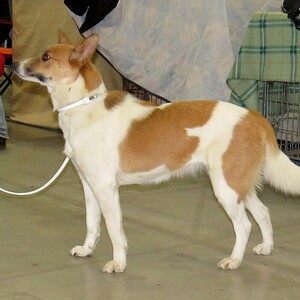
| Common colours | White, cinnamon or white with cinnamon |
| Energy level | High |
| Suited to an apartment? | Only with plenty of exercise |
| Temperament | Intelligent, noble, sociable, alert, loyal to its owner |
| Tendency to aggression | Low; distrustful and cold with strangers |
| Good with children | Good if raised with them |
| Good with other animals | Good with other dogs (hunts in packs); strong instinct towards rabbits and birds |
| Genetic predispositions | No breed-specific diseases are known |
- Primary category:Dog breeds
- Explore this animal's categories:
History and origin
Wikipedia says it is a traditional dog of Andalusia, but its history is poorly documented. It resembles other Iberian breeds, such as the Ibizan Hound, Podenco Canario and Portuguese Podengo. Genetically, its closest relative is the Galgo Español.
The Spanish Wikipedia says the first breed club was founded in 1990 by Manuel Lobo Moreno. The Faculty of Veterinary Medicine in Córdoba then carried out the studies for the breed description. The Spanish Kennel Club, RSCE, approved the standard in 1992, and the Spanish Ministry of Agriculture officially published it in May 2001.
In 2009 it was one of the two most numerous breeds in Spain, along with the Galgo. In 2026, the RSCE listed it among the 16 vulnerable Spanish breeds. Germany (VDH) recognised it in 2014.
How the breed developed
- 1990 – The national breed club is founded.
- 1992 – The RSCE approves the breed standard.
- May 2001 – The Spanish Ministry of Agriculture publishes the official standard.
- 2009 – One of the two most numerous breeds in Spain.
- 2014 – Recognised by the German kennel club VDH.
- 2026 – The RSCE lists it among the vulnerable Spanish breeds.
Breed rating
| Feature | Stars |
|---|---|
| Training and intelligence | ★★★★☆ |
| Easy to train | ★★★★☆ |
| Intelligence | ★★★★☆ |
| Independence | ★★★☆☆ |
| Stubbornness | ★★★☆☆ |
| Behaviour and temperament | ★★★☆☆ |
| Affectionate with family | ★★★★☆ |
| Friendly with children | ★★★☆☆ |
| Good with other dogs | ★★★★☆ |
| Good with cats and other animals | ★★☆☆☆ |
| Loyalty | ★★★★★ |
| Tendency to be aggressive | ★★☆☆☆ |
| Tendency to bark | ★★★☆☆ |
| Needs and care | ★★☆☆☆ |
| Shedding | ★★☆☆☆ |
| Needs frequent grooming | ★☆☆☆☆ |
| Activity and lifestyle | ★★★★☆ |
| Energy level | ★★★★★ |
| Daily exercise needs | ★★★★★ |
| Suited to apartment life | ★★☆☆☆ |
| Health and longevity | ★★★☆☆ |
| Life expectancy | ★★★★☆ |
| Predisposition to genetic diseases | ★★☆☆☆ |
| Working abilities and uses | ★★★★☆ |
| Good hunting dog | ★★★★★ |
| Good companion dog | ★★★☆☆ |
Indicative rating: 5 stars means the highest level. The breed has no FCI standard and no AKC profile; the rating is based on the RSCE standard and on Wikipedia.
Physical characteristics
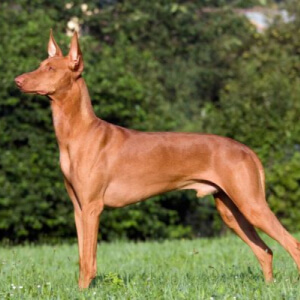
The RSCE standard describes it as a harmonious, compact, very robust dog that stands firmly on its legs. The head is shaped like a truncated pyramid, with triangular ears that rise when it is alert. The eyes are honey or hazel in colour. Wikipedia says its trot is as fast as its gallop.
General appearance
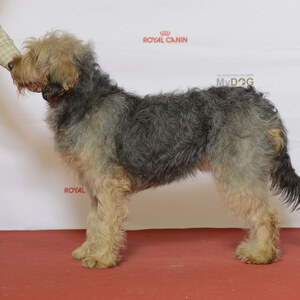
There are three coat types. The short coat is about 2 cm long and hard to the touch. The rough coat, called “cerdeño”, is about 5 cm long. The long, silky coat, called “sedeño”, is about 8 cm long. None of the types has an undercoat.
| Feature | Andalusian Hound |
|---|---|
| Small | males 35–42 cm, females 32–41 cm; 8 ± 3 kg |
| Medium | males 43–53 cm, females 42–52 cm; 16 ± 6 kg |
| Large | males 54–64 cm, females 53–61 cm; 27 ± 6 kg |
| Coat | Short, rough or long, with no undercoat |
| Colour | White and cinnamon |
| Ears | Triangular, erect when alert |
The standard accepts only white and cinnamon, separately or together. The white can be silvery, matt or ivory, and the cinnamon ranges from light to bright.
Training and socialisation
The RSCE standard says it is very affectionate, submissive and loyal to its owner, but breaks the bond when punished unfairly. So training must be gentle and fair, with rewards. The standard also says it has a great capacity to learn.
It is distrustful and cold with strangers. It needs socialising from an early age with new people, places and noises. Its hunting instinct is very strong, so the recall must be practised a lot.
Tips for effective training
- Never punish it unfairly. It loses trust in its owner.
- Use rewards. It learns easily.
- Practise the recall. It is quick to go after rabbits.
- Socialise it early. It is reserved with strangers.
Activity needs and lifestyle
The standard says that in the field it is tireless and tenacious when searching. It hunts alone, in pairs or in large packs called “rehalas”. The small and medium sizes flush rabbits out of the brambles, while the large dogs used to accompany sighthounds when hunting hares. A family dog needs running and scent games every day.
| Activity | How often | Why it matters |
|---|---|---|
| Long walks | daily | Fitness |
| Running in an enclosed area | several times a week | Burns off energy |
| Scent games | daily | Satisfies its hunting instinct |
Tips for a balanced life
- Suits active owners.
- A secure fence.
- A lead near areas with game.
Care and health
Coat and skin care
The coat has no undercoat and is easy to care for. The short-haired variety should be brushed once a week. The rough-haired and long-haired ones need brushing more often.
Common health problems
There are no published health studies on the breed and no known breed-specific diseases. Wikipedia says it is hardy and works well in the hot, dry summers of Andalusia. As with any active dog, it is worth watching for:
| Condition | Description | Common symptoms |
|---|---|---|
| Hip dysplasia | The hip joint forms incorrectly and, over time, arthritis develops | Limping, difficulty getting up or jumping, hip pain |
| Foot injuries | Thorns and brambles can cut the pads and skin while hunting | Limping, frequent licking of the feet |
Other care
- Check its feet and ears after outings.
- Protect it from ticks.
- Go for yearly check-ups.
Diet and nutrition
An active hunting dog needs good-quality food, in portions suited to its size and activity. A small dog's portion is very different from a large dog's.
Tips for a healthy diet
The table gives a starting estimate, calculated with the formula from the Merck Veterinary Manual. The first two calorie columns show the calories per day for a healthy adult dog. The last column shows what this means in dry food with 3,500–4,000 kcal per kilogram.
| Dog's weight | Calories per day (neutered) | Calories per day (not neutered) | Dry food per day (approximate) |
|---|---|---|---|
| 8 kg | 530 kcal | 600 kcal | 130–170 g |
| 16 kg | 900 kcal | 1,010 kcal | 220–290 g |
| 27 kg | 1,330 kcal | 1,490 kcal | 330–430 g |
- Split the food into two meals a day.
- Increase the portion only during the hunting season.
- A dog is at the right weight when you can feel its ribs under the coat without pressing hard.
Foods to avoid
Some human foods are dangerous for dogs: chocolate, coffee, grapes and raisins, onions, garlic, xylitol (a sweetener used in chewing gum), macadamia nuts and alcohol.
Reproduction and development
Physical and emotional maturity
In dogs, sexual maturity usually comes between 6 and 12 months. Most breeds become adults at around 13–15 months.
Mating and pregnancy
Pregnancy lasts about 63 days, counted from ovulation. Mating a female on her first heat is not recommended. Only healthy dogs of typical breed appearance should be used for breeding.
Caring for the puppies
In dogs, a litter has 5–6 puppies on average, and the number rises with the size of the breed. Socialisation starts in the first weeks: gentle handling, everyday noises and new people.
Interesting facts
- Nine varieties. Three sizes and three coat types.
- A fast trot. Its trot is as fast as its gallop.
- “Quitaor”. The large dog flushed out hares for the sighthounds.
- A relative of the Galgo. Genetically, its closest breed.
- Maneto. A short-legged variety, provisionally recognised by the RSCE.
Frequently asked questions
What does “podenco” mean?
It is the name given in Spain to hunting dogs used for rabbits; Wikipedia says they have excellent sight, hearing and smell.
How big does it get?
Between 32 and 64 cm at the withers, depending on size: small, medium or large.
What colours does it come in?
Only white, cinnamon or a combination of the two.
Is it a good family dog?
Yes, it is affectionate and loyal to its owner, as long as it gets plenty of exercise.