LeopardInteresting facts and information
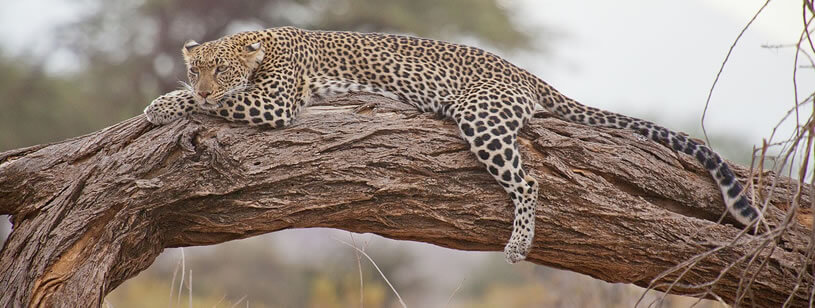
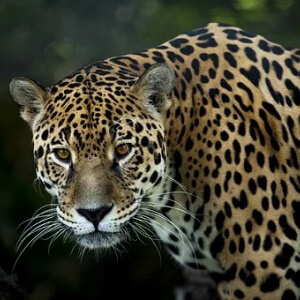
The leopard (Panthera pardus) is a large cat found across parts of Africa and Asia. It usually hunts alone and uses many kinds of habitat. Dark, melanistic leopards belong to the same species as spotted ones.
Leopards adapt easily to very different habitats, from African savannas to the tropical forests of Asia and the mountains of the Himalayas. Thanks to its camouflage and its habit of hunting at night, the leopard is very hard to spot in the wild.
Although it is a symbol of power and elegance, the leopard is threatened by habitat loss and poaching, and the International Union for Conservation of Nature (IUCN) lists it as Vulnerable.
Quick facts
| Common name | Leopard |
| Scientific name | Panthera pardus |
| Typical lifespan | 12 - 17 years in the wild, up to 23 years in captivity |
| Maximum speed | About 58 km/h over short distances |
| Dimensions | 90 - 190 cm long (head and body); 60 - 80 cm tall at the shoulder |
| Weight | Males: 30 - 90 kg; females: 20 - 60 kg |
| Diet type | Carnivore (solitary predator) |
| Main predators | Humans; lions, hyenas and tigers (mainly for cubs) |
| Conservation status | Vulnerable (IUCN); some subspecies are Critically Endangered |
| Distribution | Africa, Asia, the Middle East and the Russian Far East |
| Habitat | Savannas, forests, mountains, dry areas |
Interesting facts
- It can haul prey heavier than itself up a tree - The leopard drags its kills into trees to keep them away from hyenas and lions that might steal them.
- A master of camouflage - Its coat is covered in rosettes, which help it disappear among leaves and shadows.
- The most adaptable big cat - Leopards live in savannas, jungles, mountains and even deserts, and have the widest range of any big cat.
- A good swimmer - Although it depends on water less than the tiger does, the leopard swims well and sometimes catches fish.
- Strength rather than speed - Unlike the cheetah, the leopard relies on power and surprise rather than on long, fast chases.
Records and remarkable features
- The leopard has the largest natural range of any big cat, across much of Africa and Asia.
- It can carry prey heavier than its own body high into a tree.
- Black panthers are not a separate species: they are leopards (or jaguars) with dark, melanistic coats.
Characteristics
The leopard is one of the strongest and most versatile big cats, combining power, agility and excellent camouflage. It is built for stealthy hunting and surprise attacks, and it can bring down prey larger than itself and carry it into the trees, away from competitors.
Main physical features:
| Feature | Details |
|---|---|
| Length | 90 - 190 cm (head and body) |
| Height | 60 - 80 cm at the shoulder |
| Weight | Males: 30 - 90 kg; females: 20 - 60 kg |
| Colour | Golden to tawny, with black spots and a pale belly |
| Coat | Covered with black rosettes that give excellent camouflage |
| Retractable claws | Help with climbing and silent hunting |
| Top speed | About 58 km/h |
| Jumping | Up to about 6 m in length and 3 m in height |
Special adaptations:
- Exceptional strength - A leopard can lift prey heavier than itself and carry it up into a tree.
- Excellent camouflage - Its spotted coat makes it almost invisible among plants and shadows.
- Very sharp claws - Allow fast climbing and a firm grip on prey.
- Powerful bite - Strong enough to pierce bone and the thick skin of young buffalo.
- Good night vision - Leopards hunt mostly at night, helped by eyes adapted to the dark.
The leopard is a superb hunter thanks to its mix of strength, agility and cunning.
Habits and behaviour
The leopard is a solitary, secretive predator. It avoids fights with other predators and catches its prey through stealth and ambush.
Social behaviour:
- Solitary - Leopards do not live in groups; each one patrols its own territory.
- Large territories - Males can control areas of up to about 100 km², which they mark with urine and scratches on trees.
- Usually shy of people - Although they may attack if threatened, leopards generally avoid contact with humans.
Feeding and hunting methods:
- A night hunter - The leopard uses its excellent eyesight to hunt after dark.
- Fast surprise attacks - It creeps close to its prey and finishes with a short, deadly rush.
- Carrying prey into trees - Unlike the lion, the leopard often drags its kill into a tree, out of reach of hyenas and lions.
Defence and survival strategies:
- An excellent climber - It can climb trees quickly to escape lions or hyenas.
- Fast escape - When chased, the leopard sprints and leaps in unpredictable directions.
- Natural camouflage - Its spotted coat makes it hard to see in long grass or in the shade of trees.
Leopards are secretive and deadly predators, among the most successful big cats in the wild.
Habitat and geographic distribution
The leopard is the most widespread big cat, living in Africa, Asia and the Middle East. It adapts to many habitats, from savannas and jungles to mountains and deserts.
Habitat types:
| Habitat | Main regions |
|---|---|
| Savanna | South Africa, Kenya, Tanzania |
| Forests | India, Sri Lanka, Indonesia (Java), Southeast Asia, Central Africa |
| Mountains | Himalayas, Caucasus, East Africa |
| Semi-desert areas | Namibia, Iran, Arabian Peninsula |
Geographic distribution:
- Africa - Most leopards live in sub-Saharan Africa, including well-known parks such as the Serengeti and Kruger.
- Asia - Important populations live in India and Sri Lanka, with smaller ones in Southeast Asia and on Java.
- The Middle East and Russia - The Persian leopard lives in Iran and nearby countries, and the Amur leopard survives in the Russian Far East and north-east China.
- Europe (in the past) - Leopards once lived in Europe but disappeared thousands of years ago.
Impact of human activities on leopards:
- Habitat loss - Deforestation and farming reduce hunting grounds.
- Illegal hunting - Leopards are killed for their skins and bones, which are used in traditional medicine.
- Conflict with farmers - Leopards sometimes kill livestock and are then killed in revenge.
The leopard is the most adaptable big cat, but habitat loss and poaching threaten its future.
Diet and feeding
The leopard is an opportunistic predator that hunts a wide range of animals, from large mammals to birds and reptiles. Unlike the lion or the tiger, it does not depend on one type of prey, which helps it survive in very different habitats.
Types of food:
| Type of prey | Examples and context |
|---|---|
| Large herbivores | Antelopes, gazelles, wild pigs, deer |
| Medium-sized mammals | Monkeys, hares, porcupines |
| Birds | Guineafowl, waterbirds, peafowl |
| Reptiles | Snakes, monitor lizards, tortoises |
| Fish | Freshwater fish (occasionally) |
Hunting methods:
- Camouflage and patience - The leopard creeps close to its prey and attacks from a short distance.
- A deadly bite - It bites the prey's throat or the back of the head, killing it quickly.
- Hiding prey in trees - To avoid losing its kill to hyenas, lions and other predators, it stores the carcass in a tree.
Feeding adaptations:
- Strong jaws - A leopard's bite can crush bones and skulls.
- Great strength - It can lift prey heavier than itself and carry it high into a tree.
- A varied diet - Unlike the tiger, which prefers large prey, the leopard eats whatever it finds and can survive on small animals.
The leopard is an efficient, secretive hunter that can survive even in places where other big cats would fail.
Reproduction and life cycle
Leopards live alone, and males and females meet only to mate. The mother raises the cubs on her own, and many cubs die young because of predators and competition.
Life cycle stages:
| Stage | Approximate timing | What happens |
|---|---|---|
| Mating | All year round | Males and females meet briefly |
| Pregnancy | 90 - 105 days | The female gives birth to 1 - 4 cubs |
| Early care | First 2 - 3 months | Cubs are hidden and protected in dens, caves or thick vegetation |
| Learning to hunt | From 4 - 6 months | Cubs learn to hunt from their mother |
| Maturity | 2 - 3 years | Young males look for their own territory; females often settle nearby |
| Lifespan | 12 - 17 years in the wild, up to 23 years in captivity |
Reproductive behaviour:
- Females advertise when they are ready - They are receptive for about 5 to 7 days and attract males with calls and scent.
- Males compete for females - They usually avoid fights, but when they compete, the clashes can be violent.
- Cubs are vulnerable - Hyenas, lions and even male leopards may kill cubs.
- Mothers often move their cubs - To keep them safe from predators, the mother carries the cubs from one hiding place to another.
Because so many cubs die young, mothers are extremely protective, and the survival of leopards depends on these strategies.
Name and history
The leopard is one of the best-known big cats in history and appears in ancient literature, mythology and heraldry.
Origin of the name:
- "Leopard" - Comes from the Greek leopardos, which combines leōn ("lion") and pardos ("panther"), because people once thought it was a cross between the two.
- The scientific name Panthera pardus - Panthera is the genus of the big cats, and pardus is the old Latin name for the leopard.
- Names in other languages - léopard in French and nimr in Arabic.
Taxonomic classification:
| Taxonomic rank | Name |
|---|---|
| Kingdom | Animalia |
| Phylum | Chordata |
| Class | Mammalia |
| Order | Carnivora |
| Family | Felidae |
| Genus | Panthera |
| Species | Panthera pardus |
The leopard in history:
- Ancient Egypt - Some priests wore leopard skins during ceremonies.
- The Roman Empire - Leopards were brought to Rome for animal fights and shows in the arena, including the Colosseum.
- Africa - In many cultures, the leopard stands for power, courage and intelligence.
- The Middle Ages - In heraldry, the leopard was a symbol of bravery and appeared on knights' coats of arms.
The leopard has long been a symbol of skill and strength, but today it is a vulnerable species in decline.
Cultural significance and mythology
Throughout history and around the world, the leopard has been a symbol of power, cunning and grace. It has been honoured as a totem animal, used in heraldry and featured in many myths and legends.
The leopard in myths and beliefs:
- Ancient Egypt - The goddess Seshat, linked with writing and knowledge, was shown wearing a leopard skin, and some priests wore leopard skins in religious ceremonies.
- Africa - In many African cultures, the leopard is seen as a powerful animal, and chiefs and kings wore leopard skins as a sign of status.
- Greek and Roman mythology - Leopards and panthers were linked with Dionysus (Bacchus) and often appear with him in sculptures and mosaics.
- Asia - In China and India, the leopard was a symbol of courage and fierceness.
What the leopard symbolises:
- Strength and agility - The ability to overcome obstacles with speed and precision.
- Intelligence and cunning - In many cultures it is linked with strategy and caution.
- Power and leadership - A symbol of chiefs and warriors in Africa and Asia.
The leopard remains a symbol of grace and adaptability and appears on coats of arms, flags and works of art.
Conservation status and threats
Although it is the most adaptable of the big cats, the leopard has declined sharply, mainly because of poaching and habitat loss.
Conservation status
| Species / subspecies | Status (IUCN) |
|---|---|
| Leopard (Panthera pardus), species as a whole | Vulnerable |
| Amur leopard (Panthera pardus orientalis) | Critically Endangered |
| Arabian leopard (Panthera pardus nimr) | Critically Endangered |
| Persian leopard (Panthera pardus tulliana) | Endangered |
Main threats:
- Habitat loss - Deforestation and the growth of towns and farms reduce the leopard's hunting grounds.
- Poaching for skins - Leopards are killed illegally for their valuable fur.
- Revenge killings - Farmers kill leopards that attack their livestock.
- Less prey - Overhunting of wild herbivores leaves leopards with less to eat.
Conservation efforts:
- Reserves and national parks - Protected areas such as Kruger National Park (South Africa) and many national parks in India help keep leopard populations safe.
- Anti-poaching programmes - Organisations such as WWF work to stop the illegal trade in leopard skins and bones.
- Relocation - In some regions, problem leopards are moved to safer areas to reduce conflict with people.
Leopard numbers are thought to have fallen by more than 30% in recent decades, and some subspecies are now critically endangered.
In popular culture
The leopard has long been a symbol of strength and grace in art, literature, film and sport.
Leopards in literature:
- The Jungle Book (Rudyard Kipling, 1894) - Bagheera, the wise and protective "black panther", is a black leopard.
Leopards in film and television:
- Tarzan (Disney, 1999) - The villain Sabor is a fierce leopard that hunts in the jungle.
Leopards in video games:
- Far Cry 4 (Ubisoft, 2014) - Players can meet dangerous leopards in the wild.
The leopard as a cultural symbol:
- Heraldry and emblems - The leopard appears on royal coats of arms and seals as a symbol of bravery and agility.
- Fashion and design - Leopard print is widely used in fashion as a symbol of boldness and elegance.