Australian KelpieCharacteristics, history, training and care
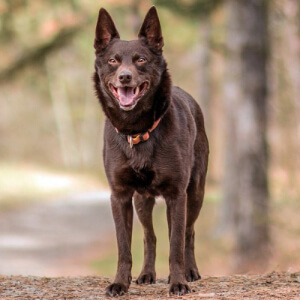
The Australian Kelpie is a medium-sized herding dog created in Australia. It gathers and drives sheep across huge open spaces, with few commands or none at all. The FCI standard describes it as extremely alert, eager and highly intelligent, mild-tempered and easily handled, with almost endless energy and great devotion to work.
Quick facts
| Common name | Australian Kelpie |
| Scientific name | Canis lupus familiaris |
| Country of origin | Australia |
| Official recognition | FCI, definitively since 3 September 1973 (group 1, herding dogs; standard no. 293) |
| Lifespan | 12 years on average, according to a 2024 UK study; the AKC gives 10–13 years |
| Size (males) | 46–51 cm at the withers; generally 14–20 kg |
| Size (females) | 43–48 cm at the withers; generally 14–20 kg |
| Coat type | Double, short and dense |
| Common colours | Black, black and tan, red, red and tan, fawn, chocolate, smoke blue |
| Energy level | Very high |
| Suited to an apartment? | Not suitable; it needs space and work |
| Temperament | Alert, intelligent, gentle, loyal, hard-working |
| Tendency to aggression | Low |
| Good with children | Good, but it may try to “herd” them |
| Good with other animals | Good |
| Genetic predispositions | Hip dysplasia, cerebellar abiotrophy, patellar luxation |
- Primary category:Dog breeds
- Explore this animal's categories:
History and origin
Its ancestors were the sheepdogs of Scotland and England, known generally as “collies”, which were brought to Australia in the 19th century. According to Wikipedia, the first dog called Kelpie was a black and tan bitch bought around 1872 by Jack Gleeson. The name comes from the kelpie, a water spirit from Celtic legend.
Her daughter, King's Kelpie, won an important herding trial in 1879, and her descendants became known as “Kelpie's pups”. Robert Kaleski published the first breed standard in 1904. The FCI recognised the breed definitively on 3 September 1973.
For a long time it was said that the breed has dingo blood, from Australia's wild dog. A 2019 genetic study by the University of Sydney was presented in the press as proof to the contrary. Its author, Claire Wade, explained, however, that the study compared only a few genes, so the question remains open.
How the breed developed
- Around 1872 – Jack Gleeson buys the first bitch called Kelpie.
- 1879 – King's Kelpie wins the trial at Forbes.
- 1904 – The first standard, written by Robert Kaleski.
- 3 September 1973 – Definitive FCI recognition.
- 2015 – Accepted at AKC herding trials.
Breed rating
| Feature | Stars |
|---|---|
| Training and intelligence | ★★★★☆ |
| Easy to train | ★★★★☆ |
| Intelligence | ★★★★★ |
| Independence | ★★★★☆ |
| Stubbornness | ★★★☆☆ |
| Behaviour and temperament | ★★★☆☆ |
| Affectionate with family | ★★★☆☆ |
| Friendly with children | ★★★☆☆ |
| Good with other dogs | ★★★☆☆ |
| Good with cats and other animals | ★★★☆☆ |
| Loyalty | ★★★★★ |
| Tendency to be aggressive | ★★☆☆☆ |
| Tendency to bark | ★☆☆☆☆ |
| Needs and care | ★★☆☆☆ |
| Shedding | ★★★☆☆ |
| Needs frequent grooming | ★☆☆☆☆ |
| Activity and lifestyle | ★★★★☆ |
| Energy level | ★★★★★ |
| Daily exercise needs | ★★★★★ |
| Suited to apartment life | ★☆☆☆☆ |
| Health and longevity | ★★★☆☆ |
| Life expectancy | ★★★★☆ |
| Predisposition to genetic diseases | ★★☆☆☆ |
| Working abilities and uses | ★★★★☆ |
| Good herding dog | ★★★★★ |
| Good companion dog | ★★★☆☆ |
Indicative rating: 5 stars means the highest level. The rating is based on the breed's AKC profile (energy 5 out of 5, trainability 4 out of 5, barking 1 out of 5) and on the FCI standard.
Physical characteristics
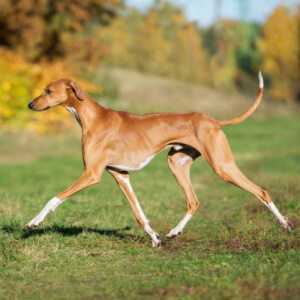
The FCI standard describes it as a lithe, active dog, capable of very quick movement, with no sign of heaviness or weakness. It has strong muscles and flexible joints. The head has a fox-like expression, softened by the almond-shaped eyes.
General appearance
The coat is double, with a short, dense undercoat and a harsh, straight outer coat that lies flat and keeps out the rain. The ears are erect and pointed. In Australia there are show Kelpies and working Kelpies, bred separately.
| Feature | Australian Kelpie |
|---|---|
| Size | Medium |
| Height at the withers | males: 46–51 cm; females: 43–48 cm (FCI) |
| Weight | generally 14–20 kg (Wikipedia) |
| Coat | Double, short and dense |
| Colour | Several shades, solid or with tan |
| Ears | Erect, pointed |
The FCI standard accepts black, black and tan, red, red and tan, fawn, chocolate and smoke blue. Working Kelpies can be almost any colour.
Training and socialisation
According to Wikipedia, it is intelligent and easy to train, and its AKC profile gives it 4 stars out of 5 for trainability. Working Kelpies are often called “workaholics”, because they have a very strong instinct to gather livestock.
If it does not get enough exercise and mental activity, it gets bored. It may then bark, dig or chew things. It needs a daily task, not just a walk.
Tips for effective training
- Give it a daily task. It was made for work.
- Use rewards. It learns very quickly.
- Stop it “herding” children. Its herding instinct pushes it to do so.
- Vary the exercises. It gets bored easily.
Activity needs and lifestyle
It has almost endless energy: its AKC profile gives it 5 stars out of 5 for energy. Every day it needs several hours of exercise and activities for the mind. It does very well at agility, and in Sweden it is also used for search and rescue.
| Activity | How often | Why it matters |
|---|---|---|
| Running or long walks | daily | Very high energy |
| Herding work or dog sports | several times a week | Herding instinct |
| Brain games | daily | Prevents boredom |
Tips for a balanced life
- Suits a farm or very active families.
- A large, well-fenced yard.
- Try agility or flyball.
Care and health
Coat and skin care
The short coat is easy to look after: brushing once a week is usually enough. Its AKC profile gives it 1 star out of 5 for grooming. In temperate climates it sheds more in spring, when the undercoat falls out.
Common health problems
According to Wikipedia, it is a hardy breed with few health problems. A 2024 study in the United Kingdom found a life expectancy of 12 years. Possible problems include:
| Condition | Description | Common symptoms |
|---|---|---|
| Hip dysplasia | The hip joint forms incorrectly and, over time, arthritis develops | Limping, difficulty getting up or jumping, hip pain |
| Cerebellar abiotrophy | Cells in the cerebellum, the part of the brain that coordinates movement, gradually die | Unsteady gait, high-stepping, head tremors |
| Patellar luxation | The kneecap slips out of place | Suddenly holds a hind leg up for a few steps, then uses it again |
Other care
- Ask for the parents' hip tests.
- Check its paws after work in the field.
- Go for yearly check-ups.
Diet and nutrition
A very active working dog needs good-quality food with enough protein. On days of hard work it eats more.
Tips for a healthy diet
The table gives a starting estimate, calculated with the formula from the Merck Veterinary Manual. The first two calorie columns show the calories per day for a healthy adult dog. The last column shows what this means in dry food with 3,500–4,000 kcal per kilogram.
| Dog's weight | Calories per day (neutered) | Calories per day (not neutered) | Dry food per day (approximate) |
|---|---|---|---|
| 14 kg | 810 kcal | 910 kcal | 200–260 g |
| 17 kg | 940 kcal | 1,050 kcal | 240–300 g |
| 20 kg | 1,060 kcal | 1,190 kcal | 260–340 g |
- Split the food into two meals a day.
- Adjust the portion to the effort of the day.
- A dog is at the right weight when you can feel its ribs under the coat without pressing hard.
Foods to avoid
Some human foods are dangerous for dogs: chocolate, coffee, grapes and raisins, onions, garlic, xylitol (a sweetener used in chewing gum), macadamia nuts and alcohol.
Reproduction and development
Physical and emotional maturity
In dogs, sexual maturity usually comes between 6 and 12 months. Most breeds become adults at around 13–15 months.
Mating and pregnancy
Pregnancy lasts about 63 days, counted from ovulation. Mating a female on her first heat is not recommended. The FCI standard requires that only healthy dogs of typical breed appearance are used for breeding.
Caring for the puppies
In dogs, a litter has 5–6 puppies on average, and the number rises with the size of the breed. Socialisation starts in the first weeks: gentle handling, everyday noises and new people.
Interesting facts
- Its name comes from a legend. The kelpie is a water spirit from Celtic folklore.
- It walks on the sheep's backs. Working Kelpies jump onto the backs of crowded sheep to get to the front.
- Maggie, aged 30. A Kelpie bitch from Victoria was considered the oldest dog in the world.
- Barb Kelpie. Black Kelpies bear the name of a horse that won the Melbourne Cup.
- It works on its own. It can gather the flock almost without commands.
In popular culture
Red Dog
Red Dog (c. 1971–1979) was a Kelpie cross who roamed Western Australia. His story became the film “Red Dog” (2011).
In cartoons
In the series “Bluey”, Rusty, one of Bluey's best friends, is a red Kelpie.
Frequently asked questions
Can it live in a block of flats?
Hardly; it needs several hours of exercise and work every day.
Does it have dingo blood?
No one knows for sure; a 2019 study compared only a few genes.
What colours does it come in?
Black, red, fawn, chocolate or smoke blue, solid or with tan.
Does it bark a lot?
Little, if it has enough to do; when bored, it may bark and dig.