MeerkatInteresting facts and information
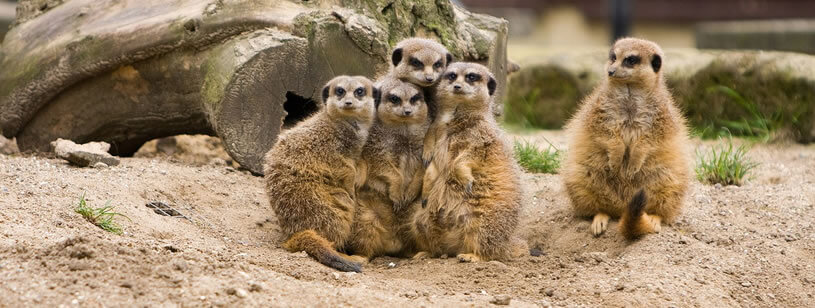
The meerkat (Suricata suricatta) is a small member of the mongoose family from southern Africa. Meerkats live in groups and use underground burrows. They feed mainly on invertebrates and other small animals.
Meerkats have a slender body, dark patches around the eyes and strong digging claws. Some members of the group keep watch while the others forage.
They use different calls in social interactions and to warn others of danger.
Quick facts
| Common name | Meerkat |
| Scientific name | Suricata suricatta |
| Typical lifespan | About 6-10 years in the wild, up to about 15 years in captivity |
| Maximum speed | About 30 km/h in short sprints |
| Size | 25-35 cm long (without the tail) |
| Weight | 600-900 g |
| Diet type | Carnivore (insects, scorpions, spiders, small vertebrates) |
| Main predators | Eagles, hawks, snakes, jackals and other carnivores |
| Conservation status | Least Concern (IUCN) |
| Geographical distribution | South Africa, Botswana, Namibia, south-western Angola |
| Habitat | Semi-desert, dry savanna and areas with low vegetation |
| Social behaviour | Live in groups called "mobs" or "gangs" |
| Special adaptations | Group vigilance, digging and resistance to some venom components; resistance is different from complete immunity to every scorpion sting. |
- Primary category:Mammals
- Explore this animal's categories:
Interesting facts
- They live in close-knit family groups - A group, called a mob or gang, usually has about 10-30 members, led by a dominant female and male.
- They have built-in sun protection - Dark patches around the eyes reduce glare, and their thin fur and dark belly help them control their body temperature.
- They are quick runners - Meerkats can sprint at about 30 km/h back to their burrows to escape birds of prey and other predators.
- Adults teach the young to hunt - Helpers bring pups live prey, such as scorpions with the sting removed, so they can practise handling it safely.
- Communication is essential - Meerkats use more than 30 different calls to warn of danger and to coordinate the group.
- They rarely need to drink - Meerkats get most of the water they need from their food, which helps them live in dry areas.
Records and remarkable features
- Meerkats are among the most cooperative mammals: almost every member of the group helps raise the dominant pair's pups.
- They give different alarm calls for danger from the air and danger on the ground.
Characteristics
Meerkats are small, agile mammals well adapted to life in dry areas, with a slender body, light-coloured fur and remarkable survival skills.
Appearance
- Long, slender body - Lets them move quickly and slip easily through their burrow tunnels.
- Light-coloured coat - Helps prevent overheating during the day.
- Large eyes with dark patches around them - Act like natural sunglasses, reducing glare in bright sunlight.
- Long, thin tail - Helps them balance when they stand upright to watch for danger.
- Long, curved claws - Ideal for fast digging, both for building burrows and for finding food.
Special adaptations
- A wide field of view - By standing upright and using their large eyes, meerkats can spot danger from far away.
- Advanced social organisation - They live in groups with clear roles, which helps protect everyone.
- Little need to drink - They get most of their water from food, which helps them survive in dry areas.
Habits and behaviour
Meerkats are extremely social animals that live in organised groups in which each individual has a role.
Social behaviour
- They live in groups, called "mobs" or "gangs", that usually have 10-30 members and sometimes up to about 50.
- Each group has a dominant pair, which produces most of the young and defends the territory fiercely.
- Other members help protect and raise the young and take turns at different jobs.
- They groom each other's fur, which strengthens the bonds within the group.
Survival techniques
- Sentries keep watch and warn the group with special calls when predators appear.
- Large burrow systems - They dig underground tunnels to hide from danger and extreme temperatures.
- Foraging together - The group searches for food together while one or more members keep guard.
- Shared care of the young - Females and males in the group help feed and protect the pups.
Habitat and geographic distribution
Meerkats live only in southern Africa, in dry and semi-dry areas, where they dig burrows to escape extreme temperatures.
| Region | Species present | Preferred habitat |
|---|---|---|
| Kalahari Desert (Botswana, Namibia, South Africa) | Suricata suricatta | Sandy semi-desert, dry savanna |
| South-western Angola | Suricata suricatta | Dry areas with low vegetation |
| Dry grasslands of South Africa | Suricata suricatta | Open grassland, dry ground |
Types of habitat
- Semi-desert - They prefer sandy or firm ground where they can dig burrows easily.
- Dry savannas and grasslands - Areas with little vegetation let them spot predators more quickly.
- Rocky ground - They sometimes shelter in cracks between rocks.
Human impact and threats
- Habitat change - Farming and overgrazing can change the land where meerkats live.
- Capture for the pet trade - In some places, meerkats are taken from the wild to be kept as pets.
- Climate change - Long droughts reduce the amount of food available.
- Natural predators - Meerkats are hunted by snakes, birds of prey and carnivorous mammals.
Diet and feeding
Meerkats are opportunistic carnivores that eat mainly insects and other invertebrates, as well as small vertebrates, and occasionally plants. They use their sense of smell and strong claws to find food in sandy soil.
What do meerkats eat?
| Type of food | How important |
|---|---|
| Insects (beetles and their larvae, crickets, termites, ants, locusts) | Their main food |
| Scorpions and spiders | Common prey, including venomous scorpions |
| Small rodents and birds | Occasionally |
| Bird eggs and small reptiles | Occasionally |
| Fruit and roots | Mainly when other food is scarce |
Feeding techniques
- Fast digging - Meerkats use their strong claws to dig insects and scorpions out of the soil.
- Foraging in groups - They search for food together, and the sentries keep watch for danger.
- Learning by practice - Adults give young meerkats prey that is easier to handle, and the young gradually learn to hunt.
Adapting to food supply
- They eat more insects in the rainy season, when insects are plentiful.
- In the dry season, they eat more roots, eggs and other food to make up for the shortage.
- When food is scarce, they travel farther from their burrows and face more danger.
Reproduction and life cycle
In a meerkat group, the dominant female produces most of the young. Other females that try to breed may be driven out of the group for a while.
| Feature | Details |
|---|---|
| Age at maturity | About 1-2 years |
| Breeding season | Can breed all year, with peaks in the warm, rainy months |
| Type of reproduction | Live birth (mammal) |
| Young per litter | 2-5 |
| Pregnancy | About 70-77 days |
| Nursing | 6-9 weeks |
| Lifespan | About 6-10 years in the wild, up to about 15 years in captivity |
Mating
- The dominant female protects her position by stopping other females from breeding.
- Males from other groups often visit to try to mate with subordinate females.
- Subordinate females that become pregnant may be evicted, and their young may be killed by the dominant female.
Raising the young
- Pups are born blind and almost hairless and spend their first weeks in the burrow.
- Other members of the group help feed and protect the pups, even though they are not their parents.
- At about 3 weeks old, the pups start coming out of the burrow, watched over by "babysitters".
- From about a month old, they start learning to forage, gradually discovering how to catch prey and avoid danger.
Name and history
Meerkats were described by European naturalists in the 18th century, but local people in southern Africa had known them for a very long time.
Origin of the name
- The English name "meerkat" comes from Dutch and Afrikaans; in Dutch, meerkat literally means "lake cat", although the animal has nothing to do with lakes.
- The scientific name Suricata suricatta comes from the old name "suricate" and was given to the species in the 18th century.
Meerkats in human history
- Local communities in southern Africa have long known meerkats and their habits.
- In Afrikaans, the meerkat is called stokstertmeerkat, meaning "stick-tailed meerkat".
- Since the 1990s, meerkats in the Kalahari have been studied in detail because of their complex social life.
Meerkats in folklore and superstition
Cultural significance and mythology
- A symbol of watchfulness - The upright sentry meerkat has become a symbol of alertness and looking out for others.
- A symbol of teamwork - Because the whole group helps raise the young and keep watch, meerkats are often used as an example of cooperation.
Conservation status and threats
Meerkats are not threatened globally, but in some areas they are affected by habitat change and capture for the pet trade.
| IUCN status | Species | Range |
|---|---|---|
| Least Concern (LC) | Suricata suricatta | South Africa, Namibia, Botswana, south-western Angola |
Main threats
- Habitat change - Farming and overgrazing alter the land where meerkats live.
- Capture for the pet trade - Meerkats are sometimes taken from the wild and sold as exotic pets.
- Climate change - Long droughts reduce the number of insects available as food.
- Natural predators - Birds of prey, snakes and jackals are the meerkats' main enemies.
Conservation efforts
- Protected areas - Meerkats live in parks and reserves such as the Kgalagadi Transfrontier Park in South Africa and Botswana.
- Long-term research - Studies in the Kalahari help scientists understand how meerkats cope with drought and climate change.
- Education - Campaigns discourage people from keeping meerkats as pets.
In popular culture
- The Lion King (Disney, 1994) - Timon, Simba's friend, is a funny, talkative meerkat.
- Meerkat Manor (2005-2008) - A popular television series that followed the lives of a family of wild meerkats in the Kalahari.
- Advertising - In the United Kingdom, a meerkat character called Aleksandr Orlov has starred in a long-running advertising campaign since 2009.