European stag beetleLucanus cervus — habitat, diet and reproduction
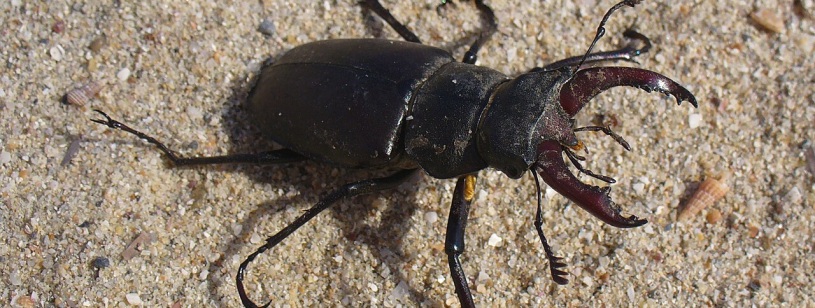
Male European stag beetle with branching mandibles and chestnut-brown wing cases. · George Chernilevsky / Wikimedia Commons / Public domain (https://commons.wikimedia.org/wiki/File:Lucanus_cervus_male_2008_G1.jpg). Cropped and resized. Source: https://commons.wikimedia.org/wiki/File:Lucanus_cervus_male_2008_G1.jpg
The European stag beetle (Lucanus cervus) is a large beetle whose males have antler-like jaws. These mandibles are used in contests with rivals. Most of its life is spent underground as a larva in rotting wood. The species also inhabits Romanian broadleaved forests.
Quick facts
| Common name | European stag beetle |
| Scientific name | Lucanus cervus |
| Lifespan | Typically 3–7 years, mainly as a larva; active adults survive weeks |
| Length | Males commonly 3.5–7.5 cm including jaws; females around 3–5 cm |
| Weight | Adults approximately 2–6 g |
| Diet | Larvae: decaying wood; adults: stored reserves and sweet liquids |
| Predators | Birds and mammals, including foxes |
| Conservation status | Near Threatened in the European assessment |
| Distribution | Europe and western Asia |
| Habitat | Broadleaved woodland, parks and gardens with dead wood |
| Family | Lucanidae |
| Reproduction | Egg, larva, pupa and adult; eggs laid near rotting wood |
Interesting facts
- The male’s antlers are jaws used to lift and push rivals.
- Fully grown larvae can reach around 10–11 cm, longer than many adults.
- Transformed adults can overwinter underground before emerging.
- Females can fly, though often seen walking while seeking egg-laying sites.
Records and extremes
One of Europe’s largest beetles, large males may reach 8–9 cm including mandibles. Size varies greatly.
Males have broad heads and elongated jaws; females have smaller jaws. Such differences between sexes are called sexual dimorphism.
Years of larval development contrast with a brief adult season above ground, focused on finding mates and laying eggs.
Characteristics
Dark heads and thoraxes contrast with often chestnut-brown wing cases. These hardened covers, called elytra, protect the flight wings. Antennae end in small fan-like plates.
Larvae are pale, curved grubs with orange-brown heads and short legs. Their soft bodies differ greatly from adults.
Females resemble lesser stag beetles, Dorcus parallelipipedus, which are more uniformly black and squarer in shape.
Behaviour
Males often fly on warm evenings while searching for females. Their loud buzzing and nearly upright posture are distinctive. Activity varies with region and weather.
Rivals grapple on trunks or branches, using jaws to grasp and unbalance one another. Females have smaller but stronger-pinching jaws when disturbed.
Habitat and distribution
Woodlands, hedges, orchards, parks and gardens can provide habitat. Decaying dead wood is essential; oaks and other broadleaved trees support larvae.
Romanian records include Cozia National Park. Underground roots and stumps offer food and shelter through several years of development.
Diet and feeding
Larvae consume rotting wood and contribute to its decomposition. This association with dead wood is termed saproxylic. Food quality and temperature influence development.
Adults mainly use reserves accumulated as larvae. Sap and soft fruit liquids can supplement them. Male jaws are chiefly suited to contests rather than cutting wood.
Reproduction and life cycle
Females lay eggs in soil near suitable wood. Larvae grow over several years in a site that must remain moist enough and undisturbed.
A mature larva constructs an underground chamber and becomes a pupa. Transformation produces the adult: a four-stage cycle called complete metamorphosis.
Adults can remain below ground through winter and emerge in warm weather. Removing a stump can interrupt years of development.
Name and history
Linnaeus described the species in 1758. Lucanus cervus refers to the resemblance between its jaws and a deer’s antlers. It belongs to Lucanidae.
The species is part of Coleoptera, the beetle order. Protective hardened wing cases are a characteristic feature.
Conservation and threats
The European assessment lists the species as Near Threatened. It is also a focus of Natura 2000 habitat conservation.
Stump removal and loss of old trees reduce breeding sites. Roads and habitat fragmentation add risks. Females often travel shorter distances than males.
Retaining dead wood, including partially buried logs, can support larvae. Leaving it for several years allows the full life cycle to finish.
Frequently asked questions
Are the antlers real horns?
They are modified jaws called mandibles.
How long does the adult live?
Usually weeks above ground; most years are spent as a larva.
Can females fly?
Yes, though they often walk while seeking egg-laying sites.
Do larvae attack healthy trees?
They develop in dead, decaying wood, usually underground.
Why retain an old stump?
It can feed and shelter larvae for several years.
Can they pinch?
Yes, particularly females when handled. Watching without capture avoids disturbance.