Black mambaDendroaspis polylepis — habitat, diet and reproduction
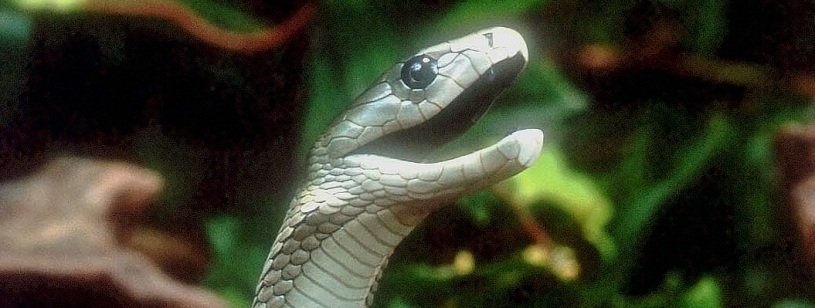
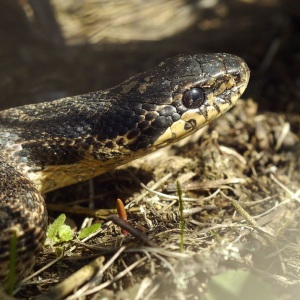
Black mamba, Dendroaspis polylepis, showing its dark mouth in a defensive posture. · Bill Love/Blue Chameleon Ventures / CC BY-SA 3.0 (https://creativecommons.org/licenses/by-sa/3.0). Cropped and resized.
The black mamba is a venomous snake from sub-Saharan Africa, known for its long body and agile movement. Its scales are usually grey, brown or olive rather than black. The name refers to the dark mouth lining, displayed when the animal feels threatened. Dendroaspis polylepis hunts small mammals rather than seeking people to attack.
Quick facts
| Common name | Black mamba |
| Scientific name | Dendroaspis polylepis |
| Diet | Carnivore: mainly small mammals, occasionally birds |
| Conservation status | Least Concern (LC) |
| Distribution | Sub-Saharan Africa |
| Habitat | Savannas, rocky areas and open woodland |
| Length | Adults commonly around 2–2.5 m |
| Family | Elapidae |
| Activity | Mainly diurnal |
| Reproduction | Egg laying |
| Venom | Highly dangerous; a bite requires immediate medical care |
- Primary category:Types of snakes
- Explore this animal's categories:
Interesting facts
- Its name refers to the dark lining inside the mouth.
- It climbs despite spending much time on the ground.
- Most activity takes place during daylight.
- Young snakes are independent after hatching.
Characteristics
The elongated body has smooth scales and a distinct head. The underside is paler than the back, while overall colour varies among individuals.
Adults commonly measure around two to two and a half metres. Size contributes to the striking appearance, but colour alone cannot safely identify a snake. A forked tongue gathers environmental chemicals for the vomeronasal organ, while vision helps detect movement.
Behaviour
Black mambas bask and search for food during daylight. They may return to familiar refuges such as hollows, rocky crevices or abandoned animal shelters.
With an open escape route they generally withdraw. When cornered, they may raise the front of the body and display the dark mouth. This defence should not be confused with deliberately pursuing people. Blocking a refuge, approaching closely or attempting capture increases the danger of an encounter.
Habitat and distribution
The species occupies suitable parts of sub-Saharan Africa, particularly eastern and southern regions, rather than occurring uniformly across the continent.
Wooded savannas, rocky slopes and open woodland provide prey and shelter. Although able to climb trees, the snake frequently travels on the ground. Safe retreats and basking places matter, and expanding human settlements can create more encounters at habitat edges.
Diet and feeding
Small mammals, including rodents, make up much of the diet, with birds taken occasionally. Visual and chemical cues help locate prey.
Venom is delivered through a bite and the prey is swallowed whole. The exact hunting sequence varies with circumstances. Through predation, mambas participate in the ecological relationships linking small mammals with their surroundings. Their danger to humans does not remove this ecological role.
Reproduction and life cycle
During the breeding season, males may compete by intertwining and raising their bodies. This behaviour is sometimes mistaken for mating.
Females place eggs in a sheltered location. Development occurs within the eggs, with incubation influenced by local conditions. Hatchlings find their own food and already have a functioning venom apparatus. A small snake should therefore never be treated as harmless or handled for identification.
Name and history
Dendroaspis polylepis belongs to Elapidae, alongside other mambas and many other venomous snakes. Green mambas are different species.
Its reputation has inspired stories of planned attacks and pursuit of people. Such stories do not describe ordinary behaviour centred on hunting, warming and avoiding danger. Understanding the animal depends on safe observation, not provoking a defensive display.
Conservation and threats
The global assessment is Least Concern, although habitat change and killing through fear can affect snakes locally. Maintaining distance and calmly withdrawing reduce encounter risks; trained professionals should deal with a snake inside a building.
A suspected bite requires immediate medical care. Keep the person as still as possible and arrange urgent transport. Cutting the wound, suction and improvised tourniquets are not appropriate substitutes for treatment.
Frequently asked questions
Is its body black?
Usually not. It is grey, brown or olive; the name refers to the mouth lining.
Does it live only in trees?
No. It can climb but spends much time on the ground.
Does it chase people to attack them?
That is not normal behaviour. It generally withdraws but can defend itself when cornered.
Are hatchlings venomous?
Yes. Their venom apparatus functions after hatching, so they must not be handled.