LeechHirudinea — habitat, diet and reproduction
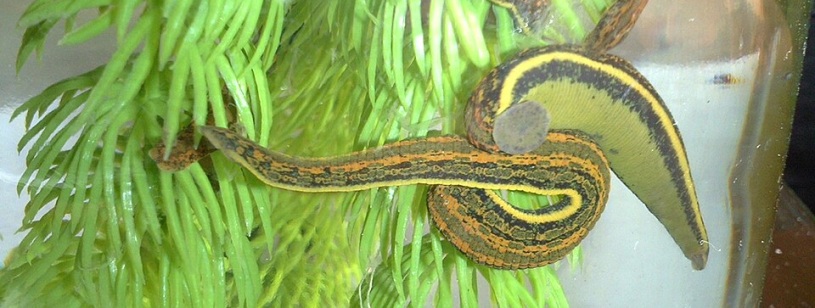
A Hirudo leech with an elongated body and longitudinal markings. · Legatr / Wikimedia Commons / CC BY-SA 4.0 (https://creativecommons.org/licenses/by-sa/4.0/). Cropped and resized. Source: https://commons.wikimedia.org/wiki/File:Pijavica_lek%C3%A1rska.jpg
A leech is a flexible segmented worm adapted to attachment and movement using suckers. Hirudinea includes species with different feeding habits. Some consume blood, while others capture small animals. They occur in freshwater, marine environments and moist terrestrial habitats.
Quick facts
| Common name | Leech |
| Scientific name | Hirudinea, a group of annelid worms |
| Lifespan | Variable; Hirudo medicinalis can live several years |
| Length | Variable; Hirudo medicinalis can reach about 20 cm |
| Appearance | Flexible elongated body, usually with two suckers |
| Diet | Blood, animal fluids or invertebrates, depending on species |
| Movement | Successive attachment; some species also swim |
| Conservation status | Species-specific; Hirudo medicinalis is Near Threatened |
| Distribution | Widely distributed, with different regional species |
| Habitat | Freshwater, marine or moist terrestrial environments |
| Zoological group | Annelida, Clitellata |
| Reproduction | Hermaphrodites with eggs protected in cocoons |
- Primary category:Invertebrates
- Explore this animal's categories:
Interesting facts
- Some leeches swallow small invertebrates whole.
- Body length changes greatly between contraction and extension.
- Suckers aid attachment and movement; the mouth lies at the front.
- Controlled breeding supplies medicinal leeches for specific surgical uses.
Records and extremes
Size varies considerably across the group. A contracted leech can appear much shorter than the same animal moving across a surface.
Hirudo medicinalis can reach about 20 cm and live for several years. Months may pass between substantial meals.
Waiting between meals is useful when hosts are scarce, but feeding schedules differ between species.
Characteristics
Leeches are annelids, related to earthworms. Their segmented bodies bear surface rings that do not each represent a separate internal segment.
Most have front and rear suckers. Mouth structures vary with diet, and colours range from browns and greens to contrasting patterns.
European medicinal leeches have longitudinal markings. Moist skin allows gas exchange with the surroundings.
Behaviour
Movement across surfaces involves repeated loops: one end attaches, the other moves closer and the body extends again. Some aquatic species swim by undulating.
Sensory systems detect light changes, vibrations and nearby stimuli. Medicinal leeches have several pairs of simple eyes, rather than detailed image-forming eyes.
Blood-feeding species respond to potential hosts, while predatory species search for small prey.
Habitat and distribution
Many species inhabit ponds, lakes and streams. Others live in the sea or in very wet forests where drying is less likely.
Medicinal leeches favour shallow, warm freshwater with suitable wet margins. Hosts include amphibians, fish, birds and mammals.
Even small ponds can provide valuable habitat. The animals present influence available food resources.
Diet and feeding
Blood feeders may have finely toothed jaws or a protrusible proboscis. Saliva in certain species contains substances that prevent blood from clotting.
Other leeches consume worms and small invertebrates, extracting fluids or swallowing prey. A single common name therefore covers several feeding strategies.
Understanding a leech’s role in an aquatic food web requires species identification.
Reproduction and life cycle
Leeches are hermaphrodites, with male and female reproductive organs in the same individual. Medicinal leeches exchange sperm and fertilisation is internal.
A glandular region called the clitellum secretes cocoon material. Hirudo medicinalis deposits cocoons in damp places above the waterline.
Young emerge as small versions of the adult body plan, without a distinct free-swimming larval stage. Growth depends on food and environmental conditions.
Name and history
Hirudinea names the zoological group. Linnaeus described Hirudo medicinalis in 1758; it is distinct from Hirudo verbana, another medically used species.
Leeches have a long medical history. Modern surgical teams may use specially bred animals to drain congested tissues after particular operations, under clinical supervision.
Conservation and threats
Conservation status varies by species. Hirudo medicinalis is globally Near Threatened, a category that does not describe all leeches.
Drainage, pond loss and altered shorelines reduce habitat. Historical collection contributed to declines, while loss of hosts can affect feeding opportunities.
Conservation projects monitor populations and restore wetlands. Some use environmental DNA and controlled breeding to support recovery.
Frequently asked questions
Do all leeches drink blood?
No. Some consume other invertebrates or their fluids.
Are they insects?
No. They are annelid worms belonging to Hirudinea.
Why can one look very short?
Its body contracts strongly and stretches during movement.
Can they live outside water?
Some species live on land in very moist habitats.
How do they move?
They attach successively using suckers; some also swim.
Are all medicinal leeches one species?
No. Hirudo medicinalis and Hirudo verbana are distinct species.