Humpback whaleInteresting facts and information
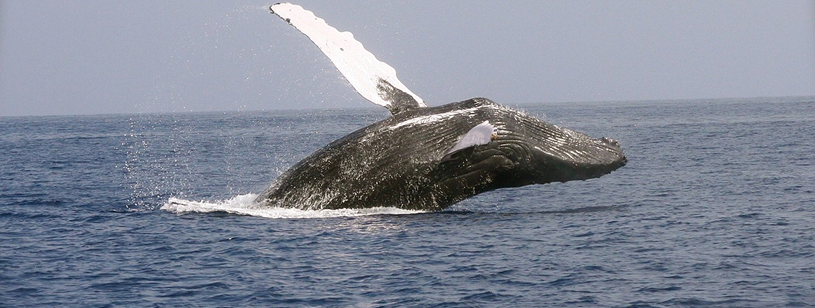
The humpback whale (Megaptera novaeangliae) is a large baleen whale known for its long pectoral fins, breaching and elaborate songs. Grooves along its throat allow expansion during feeding.
Many humpback populations migrate between feeding areas and warmer breeding grounds. Males produce complex songs, while individuals also use other sounds and social signals.
Some humpback populations have recovered substantially after commercial whaling, but recovery is uneven. Several populations still face serious threats.
Quick facts
| Common name | Humpback whale |
| Scientific name | Megaptera novaeangliae |
| Typical lifespan | Often 45-50 years; some may live much longer |
| Length | About 12-15 m (males), 13-16 m (females) |
| Weight | About 25-40 tonnes |
| Diet type | Filter feeder (krill and small fish) |
| Main predators | Killer whales (mainly attack calves) |
| Conservation status | Least Concern globally (IUCN); some populations remain endangered or threatened |
| Distribution | Oceans around the world, including polar and tropical waters |
| Living environment | Open ocean and coastal waters; cold feeding grounds and warm breeding grounds |
- Primary category:Mammals
- Explore this animal's categories:
Interesting facts
- Giant flippers - Its pectoral fins can be about 5 m long, almost a third of its body length, the longest flippers of any whale.
- Songs – Male humpbacks produce long, changing songs associated with breeding; their full function is still studied.
- Acrobats - Although they weigh about 30 tonnes or more, humpbacks often leap almost completely out of the water, a behaviour called breaching.
- Tail "fingerprints" - Each humpback can be identified by the unique black-and-white pattern and the jagged edge of the underside of its tail.
- Bubble nets - Groups of humpbacks blow rings of bubbles around shoals of fish, trapping them before lunging up through the middle with open mouths.
Records and remarkable features
- One of the longest migrations of any mammal - Some humpbacks travel more than 8,000 km each way between their feeding and breeding areas.
- The longest flippers - Their flippers, up to about 5-6 m long, give them great agility in the water.
- Songs that travel - Their songs can be heard many kilometres away, and new song patterns can spread from one population to another across an ocean.
- A song in space - Humpback whale song is included on the Golden Records carried by the Voyager spacecraft, launched in 1977.
Physical characteristics and adaptations
The humpback whale is one of the most recognisable large whales, with a stocky body, extremely long flippers and acrobatic behaviour.
Key physical adaptations
- Giant flippers - The longest of any whale, they help it turn sharply and manoeuvre.
- The "hump" - When it dives, the whale arches its back strongly, which gives it its name; it also has a small hump in front of its dorsal fin.
- Throat grooves - About 14-35 grooves under the throat let it expand to take in huge mouthfuls of water and prey.
- Knobbly head - Bumps called tubercles on the head and flippers each contain a sensory hair; the bumps on the flippers help water flow smoothly and inspired new designs for wind-turbine blades.
- A broad tail - With a jagged back edge and unique markings, used for swimming and for slapping the water.
Dimensions and gender differences
| Characteristic | Males | Females |
|---|---|---|
| Length | About 12-15 m | About 13-16 m |
| Weight | About 25-35 tonnes | About 30-40 tonnes |
| Flippers | About 4-5 m | About 4-6 m |
| Typical lifespan | Often 45-50 years; some may live much longer | |
As in most baleen whales, females are slightly larger than males.
Habits and behaviour
Humpback whales are among the most active whales, known for their spectacular leaps, complex songs and clever feeding methods.
Daily life
- Great travellers - Most humpbacks migrate between cold feeding waters near the poles in summer and warm tropical waters where they breed in winter.
- Changing groups - They live alone or in small, loose groups, but may cooperate when feeding.
- Curious - Humpbacks sometimes approach boats, making them popular with whale-watchers.
- Mothers and calves - A mother and her calf are often accompanied by a male "escort" hoping to mate with her.
Communication
- Complex songs - Males sing songs that last about 10-20 minutes and are repeated for hours; all males in a population sing the same song, which slowly changes over time.
- Slapping - Humpbacks slap the water with their flippers or tails, perhaps to communicate.
- Breaching - These leaps may be a form of communication, play or a way to remove parasites.
Defence methods
- Protecting calves - Mothers stay close to their calves and defend them against killer whales.
- Powerful blows - Humpbacks can strike attackers with their flippers and tails, which carry sharp barnacles.
- Helping others - Humpbacks have been seen chasing away killer whales that were attacking seals and other whales.
Habitat and geographic distribution
Humpback whales live in all the world's oceans and make some of the longest migrations of any mammal.
Distribution context
| Region | Population information |
|---|---|
| North Atlantic | Feeding off New England, Canada, Greenland, Iceland and Norway; breeding in the Caribbean |
| North Pacific | Feeding off Alaska and Russia; breeding off Hawaii, Mexico and Japan |
| Southern Hemisphere | Feeding around Antarctica; breeding off Australia, Africa, South America and Pacific islands; many populations recovering strongly |
| Arabian Sea | A small population of fewer than about 100 whales that does not migrate; Endangered |
Habitat types
- Cold, food-rich waters - Polar and subpolar seas are their main feeding grounds in summer.
- Warm, shallow waters - Tropical bays and reefs are used for mating and giving birth in winter.
- Coasts - Humpbacks often travel close to the coast, where they can be seen from land.
Environmental change
- Ocean warming - Can change where their prey is found and affect migration.
- Noise - Ship noise and sonar can interfere with whale communication.
- Ship strikes - Busy shipping lanes are dangerous for whales feeding near the surface.
Diet and feeding
The humpback whale is a filter feeder that eats huge amounts of small animals, using some remarkable hunting techniques.
What does the humpback whale eat?
| Food group | Examples and context |
|---|---|
| Krill | Antarctic krill (Euphausia superba), Thysanoessa species |
| Small fish | Herring, sand eels, capelin, mackerel, anchovies |
| Other small crustaceans | Copepods and similar tiny animals |
Feeding methods
- Filtering - The whale takes in a huge mouthful of water and prey, then pushes the water out through its baleen plates, which trap the food.
- Bubble nets - One or more whales swim in a spiral below a shoal, blowing bubbles that form a "net", then rise through the middle with mouths open.
- Lunge feeding - Whales lunge through dense shoals of fish or krill with their mouths wide open.
- Flipper and tail slapping - Some humpbacks slap the water to stun or concentrate prey.
In the feeding season, a humpback can eat more than a tonne of food a day, building up fat to live on during migration and the breeding season, when it eats very little.
Reproduction and life cycle
Humpback whales breed in warm tropical and subtropical waters, and calves stay with their mothers for about a year.
Breeding season
- Breeding takes place in winter in warm waters, such as around Hawaii, the Caribbean and the coasts of Australia.
- Males sing and compete for females.
- Groups of males may chase a female in "competitive groups", pushing, slapping and charging each other.
Gestation and birth
| Characteristic | Details |
|---|---|
| Gestation | About 11-12 months |
| Number of calves | 1 calf, usually every 2-3 years |
| Weight at birth | About 1-2 tonnes |
| Length at birth | About 4-5 m |
| Nursing | About 10-12 months |
| Sexual maturity | About 5-10 years |
Raising young
- The mother’s energy-rich milk supports the calf’s growth; composition varies during lactation.
- Mothers are very protective, and calves stay close beside them for the first months.
- Calves grow fast, building up the fat they need for their first migration to the feeding grounds.
Name and history
Origin of the name
- The name "humpback whale" comes from the way it arches its back before diving, and from the small hump in front of its dorsal fin.
- Megaptera means "big wings" in Greek, referring to its huge flippers.
- Novaeangliae means "of New England", the region of the USA from which it was scientifically described in 1781.
Taxonomic classification
| Classification | Name |
|---|---|
| Kingdom | Animalia |
| Phylum | Chordata |
| Class | Mammalia |
| Order | Artiodactyla (cetaceans) |
| Suborder | Mysticeti (baleen whales) |
| Family | Balaenopteridae |
| Genus | Megaptera |
| Species | Megaptera novaeangliae |
Evolution and fossils
- The humpback belongs to the rorqual family, together with the blue whale, the fin whale and the sei whale.
- Fossils of humpback relatives date back several million years.
- The ancestors of whales were land mammals related to hippos, which began to adapt to life in the sea about 50 million years ago.
Cultural significance and mythology
The humpback whale has an important place in the traditions of many coastal peoples and has become a worldwide symbol of ocean conservation.
The humpback whale in culture and symbolism
- Māori tradition - In Māori legend, the ancestor Paikea rode on the back of a whale to New Zealand.
- Hawaii - The humpback, called koholā in Hawaiian, is honoured in Hawaiian culture, and the waters around the islands are a national marine sanctuary for humpbacks.
- "Save the Whales" - The album Songs of the Humpback Whale (1970) made millions of people aware of whale song and helped start the campaign to end whaling.
Conservation status and threats
Recovery differs between humpback populations. Historical whaling, fishing-gear entanglement, vessel strikes and habitat changes all matter.
Conservation status
| Population | Status | Trend |
|---|---|---|
| Humpback whale (species) | Least Concern (IUCN) | Increasing overall |
| Southern Hemisphere populations | Many recovering strongly | Some close to pre-whaling numbers |
| Arabian Sea population | Endangered (IUCN) | Very small and isolated |
| Some North Pacific populations | Endangered or threatened under US law | Recovering slowly |
Several humpback populations have recovered since the end of intensive commercial whaling, while others remain depleted.
Main pressures
- Ship strikes - Humpbacks feeding near the surface can be hit by large ships.
- Noise - Military sonar and ship noise may disturb whales.
- Entanglement - Humpbacks often become tangled in fishing gear, which can injure or kill them.
- Climate change - Changes in ocean temperature affect their prey and migration routes.
- Disturbance - Boats that follow whales too closely can stress them.
Protection measures
- Ban on commercial whaling - Humpbacks have been protected by the International Whaling Commission since 1966.
- Safer shipping - Some shipping lanes have been moved and speed limits set to reduce collisions.
- Rescue teams - Trained teams cut entangled whales free from fishing gear.
- Responsible whale-watching - Rules on distance and speed help protect whales from disturbance.
In popular culture
The humpback whale is one of the most famous whales and appears in books, films and music.
Humpback whale in literature
- Moby-Dick (Herman Melville, 1851) - The novel's white whale is a sperm whale, but humpbacks are described among the whales the sailors meet.
- The Whale Rider (Witi Ihimaera, 1987) - A novel based on the Māori legend of Paikea, made into the film Whale Rider (2002).
Humpback whales on screen
- Star Trek IV: The Voyage Home (1986) - The crew travels back in time to bring two humpback whales, George and Gracie, to the future.
- Fantasia 2000 - A segment set to Respighi's Pines of Rome shows a family of flying humpback whales.