KangarooInteresting facts and information
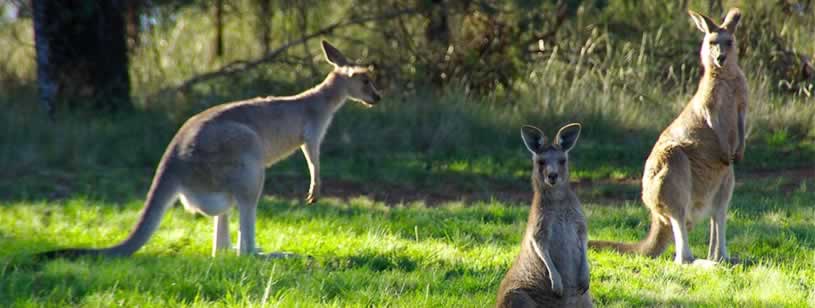
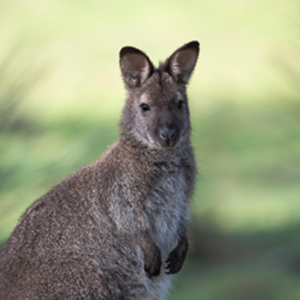
Kangaroos are Australian marsupials in the family Macropodidae, which also includes wallabies and tree-kangaroos. The red kangaroo is the largest living marsupial. Large kangaroos use their powerful hind legs to hop, while females carry developing young in a pouch.
Kangaroos mainly eat plants. Different members of the family live in grasslands, woodlands or forests, and their reproductive adaptations help them respond to changing conditions. They also have an important place in Australia’s public life and in the distinct traditions of Indigenous communities.
Quick facts
| Common name | Kangaroo |
| Scientific name | Macropodidae |
| Typical lifespan | About 6-8 years in the wild, up to about 20 years in captivity |
| Maximum speed | About 55-70 km/h in short bursts (red kangaroo) |
| Height | About 90 cm - 2 m (depending on the species) |
| Length | About 1 - 2.8 m (including tail) |
| Weight | About 18 - 90 kg, depending on the species |
| Diet type | Herbivore (grasses, leaves, shoots) |
| Main predators | Dingoes, wedge-tailed eagles (for young), humans |
| Conservation status | The large kangaroos are Least Concern; some relatives, such as several tree-kangaroos, are threatened (IUCN) |
| Main species | Red kangaroo (Osphranter rufus), eastern grey kangaroo (Macropus giganteus), western grey kangaroo (Macropus fuliginosus), antilopine kangaroo (Osphranter antilopinus) |
| Distribution | Australia (including Tasmania) and New Guinea |
| Habitat | Grasslands, savannas, dry areas and open woodland |
- Primary category:Mammals
- Explore this animal's categories:
Interesting facts
- Kangaroos rarely move backwards – Their legs and tail are built for hopping forwards, which makes moving backwards very awkward for them.
- Their tail acts as a fifth leg – When moving slowly, kangaroos lean on their powerful tail and front legs to support their weight.
- A mother can look after three young at different stages at once – A young joey out of the pouch that still drinks milk, a tiny joey attached to a teat in the pouch, and an embryo waiting in a resting state called "embryonic diapause" until conditions are right.
- Red kangaroos are the largest marsupials in the world – Large males can stand about 1.8-2 metres tall and weigh up to about 90 kg.
- They cover long distances by hopping – A large kangaroo can leap up to about 8-9 metres in a single bound and can keep up a speed of about 40 km/h for a long time.
- They can swim – When chased by a predator, kangaroos sometimes escape into water, where they can swim and defend themselves.
- They thump the ground as a warning – When a kangaroo senses danger, it thumps its hind feet on the ground to alert the rest of the group.
- Cooling down – Kangaroos can lick their forearms; evaporating saliva helps release body heat.
- Hopping saves energy – Thanks to the springy tendons in their legs, large kangaroos use surprisingly little extra energy when they hop faster.
Records and remarkable features
- The largest kangaroo – The red kangaroo (Osphranter rufus) can stand about 2 metres tall and weigh about 90 kg, making it the largest marsupial in the world.
- Top speed – Red kangaroos can briefly reach about 55-70 km/h.
- Kangaroos in trees – Tree-kangaroos (Dendrolagus), which live in the rainforests of New Guinea and northern Queensland, are much smaller than red kangaroos and climb trees.
- Long-lived kangaroos – In captivity, some kangaroos have lived for more than 20 years, while in the wild most live about 6-8 years.
Characteristics
Kangaroos are marsupials of the family Macropodidae, with long hind legs, a strong tail and, in females, a pouch on the belly in which they raise their young. Their adaptations allow them to live in many climates and to travel efficiently over long distances.
Main physical features:
- Long, powerful hind legs – Built for fast, energy-efficient hopping, so kangaroos can travel long distances without tiring.
- A muscular tail – Helps with balance when hopping and supports the body when moving slowly.
- A pouch – Females carry their young in a pouch for several months, giving them protection and milk until they can survive on their own.
- A wide field of view – Eyes on the sides of the head help them spot predators.
- Teeth for grazing – Strong front teeth and ridged cheek teeth let them cut and grind tough grasses; worn molars are replaced from the back of the jaw.
Special adaptations for survival:
- A flexible breeding system – Females can pause the development of an embryo, a process called "embryonic diapause", so that the next young is born when conditions are better.
- Coping with little water – Kangaroos of dry areas can go a long time without drinking, getting much of the water they need from plants.
- Efficient movement – At speed, hopping uses energy very efficiently, letting kangaroos cover long distances in deserts and grasslands.
Habits and behaviour
Kangaroos are social animals that live in groups called "mobs", made up of males, females and young. They are most active at dusk, at night and in the early morning, when it is cooler.
Social behaviour:
- Loose groups – Mobs usually have up to about 10 animals, but can be much larger where food is plentiful; kangaroos are not territorial, but the largest male usually gets most of the matings.
- Contests between males – Males compete for dominance by "boxing" with their front legs and kicking with their powerful hind legs.
- Sounds and thumps – Kangaroos make soft clucks, coughs and growls, and thump the ground to warn of danger.
How they move:
- Hopping – Large kangaroos move mainly by hopping and can reach about 55-70 km/h in short bursts.
- "Pentapedal" walking – When moving slowly, they lean on their tail and front legs while swinging their hind legs forward.
- Swimming – Kangaroos can swim, kicking their hind legs separately in the water.
Defence and survival:
- Speed – When in danger, kangaroos accelerate quickly and leap over obstacles.
- Fighting back – If cornered, they kick hard with their hind legs and can seriously injure attackers.
- Escaping into water – When chased into water, a kangaroo may hold a dog or dingo under the water with its front legs.
Habitat and geographic distribution
Kangaroos and their relatives are native to Australia and New Guinea and live in a wide range of environments, from rainforests to dry deserts. Eastern grey kangaroos also live in Tasmania.
Habitat types:
- Grasslands and open woodland – Kangaroos prefer open areas where they can spot predators from a distance.
- Dry and desert areas – Species such as the red kangaroo are adapted to the dry inland of Australia.
- Rainforests – Tree-kangaroos (Dendrolagus) live in the dense forests of New Guinea and northern Queensland.
- Cooler hills and mountains – Eastern grey kangaroos also live in cooler, hilly areas, including Tasmania.
Geographic distribution and estimated population:
| Region | Species present | Population information |
|---|---|---|
| Australia | Red kangaroo, eastern grey, western grey, antilopine kangaroo | Population estimates vary by year, species and survey area |
| Tasmania | Eastern grey kangaroos (called foresters), wallabies and pademelons | Common in many areas |
| Papua New Guinea | Tree-kangaroos (Dendrolagus) | Several species declining |
The impact of climate change on the habitat:
- Heat and drought – Climate change affects access to water and plants.
- Urban sprawl – New towns and roads reduce the natural habitat of kangaroos.
- Road collisions – Kangaroos are often hit by vehicles where roads cross their habitat.
Kangaroos are protected by law in Australia, but some common species are harvested under licence for meat and skins and to control their numbers.
Diet and feeding
Kangaroos are herbivores that feed mainly on grasses, leaves and shoots. Their diet depends on their habitat, and many species can survive long periods of drought.
Main food:
- Grass and green shoots – The main food of most kangaroos.
- Leaves of trees and shrubs – Tree-kangaroos eat leaves, fruit and flowers, and some kangaroos browse shrubs.
- Roots – In dry areas, kangaroos sometimes dig for moist roots and even for water.
- Seeds and fruit – Eaten occasionally when available.
Digestive adaptations:
- Fermentation in the stomach – Like cattle, kangaroos rely on microbes in their large stomach to break down tough plant material, and they sometimes bring food back up to chew it again.
- Saving water – Kangaroos of dry areas can go a long time without drinking, getting water from their food.
- Feeding in cooler hours – Most kangaroos feed at night or at dawn and dusk, avoiding the heat of the day.
Diet according to species:
| Species | Main food type |
|---|---|
| Red kangaroo (Osphranter rufus) | Grasses and other plants of dry inland Australia |
| Eastern grey kangaroo (Macropus giganteus) | Green grass, herbs, some leaves |
| Western grey kangaroo (Macropus fuliginosus) | Grasses, herbs, shrubs |
| Tree-kangaroos (Dendrolagus) | Leaves, fruit, flowers |
Reproduction and life cycle
Kangaroos have a remarkable way of reproducing: females can adjust the timing of births to the conditions around them.
Mating and pregnancy:
- Males compete for females – Contests involve kicking and "boxing" with the front legs.
- A very short pregnancy – Females give birth after only about 30-36 days.
- A tiny newborn – The young, called a "joey", is born at a very early stage, only about 2 cm long and weighing less than 1 gram.
- The journey to the pouch – Right after birth, the joey crawls on its own through its mother's fur into the pouch, where it attaches to a teat.
How the joey develops:
- It stays in the pouch for about 6-9 months, feeding only on its mother's milk.
- It gradually starts leaving the pouch to explore but keeps drinking milk until about 12-18 months old.
- At around 8-11 months, it leaves the pouch for good, although it stays close to its mother for some time.
Unique reproductive capacity:
- Embryonic diapause – When conditions are poor or the pouch is occupied, the female can pause the development of a fertilised embryo until conditions improve.
- Two kinds of milk – A female can produce two different kinds of milk at the same time, from different teats: one for the tiny joey in the pouch and one for the older joey that still suckles.
Lifespan:
- In the wild, kangaroos usually live about 6-8 years, because of predators, droughts and accidents.
- In captivity, they can live up to about 20 years, with no predators and a steady supply of food.
Name and history
Kangaroos were first described by European explorers in the late 18th century, but they have been central to Aboriginal and Torres Strait Islander cultures for tens of thousands of years.
Origin of the name:
- The word "kangaroo" comes from the Guugu Yimithirr language of north Queensland, where gangurru was the name of the eastern grey kangaroo.
- A popular but false story says the name came from a misunderstanding and meant "I don't understand"; in fact, gangurru was already the local name for the animal.
Taxonomic classification:
| Taxonomic rank | Name |
|---|---|
| Kingdom | Animalia |
| Phylum | Chordata |
| Class | Mammalia |
| Order | Diprotodontia |
| Family | Macropodidae |
| Main genera | Macropus, Osphranter, Dendrolagus |
| Main species | Osphranter rufus, Macropus giganteus, Macropus fuliginosus, Osphranter antilopinus |
Discovery and documentation:
- 1770 – Captain James Cook's expedition recorded kangaroos on the east coast of Australia.
- Late 18th century – The first live kangaroos were brought to Britain and exhibited.
- Early 20th century – The kangaroo became part of Australia's coat of arms (1908) and a national symbol.
The role of kangaroos in Aboriginal culture:
- Food and clothing – Aboriginal peoples have used kangaroo meat, skins, bones and sinew for tens of thousands of years.
- Rock art – Kangaroos are among the animals most often shown in Aboriginal rock art.
Kangaroos remain one of Australia's best-known symbols and appear on coins, the coat of arms and sporting emblems.
Cultural significance and mythology
Kangaroos have been important in the cultures of Indigenous Australians for tens of thousands of years and are also a national symbol of Australia.
Kangaroos in Aboriginal culture:
- Rock art – Images of kangaroos are found in Aboriginal rock art across Australia, some of it many thousands of years old.
- Dreaming stories – Kangaroos appear in many Aboriginal Dreaming stories, which differ between peoples and regions.
The kangaroo as a national symbol:
- Australia’s coat of arms – A kangaroo and an emu support the shield on the Commonwealth coat of arms.
- Coins – Kangaroos appear on Australian coins, including the $1 coin.
- Sports emblems – The kangaroo is a symbol of national sports teams; Australia's rugby league team is nicknamed "the Kangaroos".
Modern symbolism:
- Representing Australia – Kangaroos are used in marketing, branding and tourism, for example in the logo of the airline Qantas.
- A symbol of endurance – Because they live in harsh conditions, kangaroos are often seen as symbols of perseverance and of always moving forward.
Conservation status and threats
The large kangaroo species are common, but some smaller relatives, especially tree-kangaroos, are threatened by habitat loss and hunting.
Conservation status
- Red kangaroo (Osphranter rufus) – Least Concern; one of the most numerous kangaroos.
- Eastern grey kangaroo (Macropus giganteus) – Least Concern, but affected locally by urban growth.
- Tree-kangaroos (Dendrolagus) – Several species are Endangered or Critically Endangered because of deforestation and hunting.
Main threats:
- Habitat loss – Land clearing and urban growth reduce the space available to kangaroos and bring them into contact with people.
- Harvesting and control – In Australia, some common kangaroos are harvested for meat and skins under government quotas.
- Road collisions – Kangaroos are often hit by vehicles, especially in rural areas.
- Climate change – Severe droughts reduce food and water and can cause local population crashes.
Conservation efforts:
- Hunting rules – Kangaroo harvesting is controlled by permits and quotas set by the government.
- Reserves and national parks – Protecting natural habitat helps maintain kangaroo populations.
- Monitoring – Regular surveys track changes in kangaroo numbers.
In popular culture
Kangaroos appear in many films, books and cartoons and are recognised around the world as a symbol of Australia.
Kangaroos in film and animation:
- Kangaroo Jack (2003) – A comedy film in which a kangaroo hops off with a jacket full of money.
- Dot and the Kangaroo (1977) – An Australian animated film about a little girl who is helped by a kangaroo.
- Hippety Hopper (Looney Tunes) – A young kangaroo whom Sylvester the cat keeps mistaking for a giant mouse.
- Skippy the Bush Kangaroo (1968-1970) – An Australian TV series in which a clever kangaroo helps people solve problems.
Kangaroos in literature:
- Winnie-the-Pooh (A. A. Milne) – Kanga and her little son Roo are kangaroos living in the Hundred Acre Wood.
- Books about Australia – Kangaroos are a favourite subject of children's books and wildlife books.
Kangaroos in sports and mascots:
- "The Kangaroos" – Australia's national rugby league team uses the kangaroo as its symbol.
- The boxing kangaroo – A kangaroo wearing boxing gloves has been a popular Australian sporting mascot since the 1980s.
Kangaroos as commercial symbols:
- Australian companies – The kangaroo appears on products from food to airlines, including the logo of Qantas.
- Tourism and souvenirs – Kangaroos are central to Australian tourism and appear on T-shirts, magnets and other souvenirs.