Mongolian gerbilMeriones unguiculatus — habitat, diet and reproduction
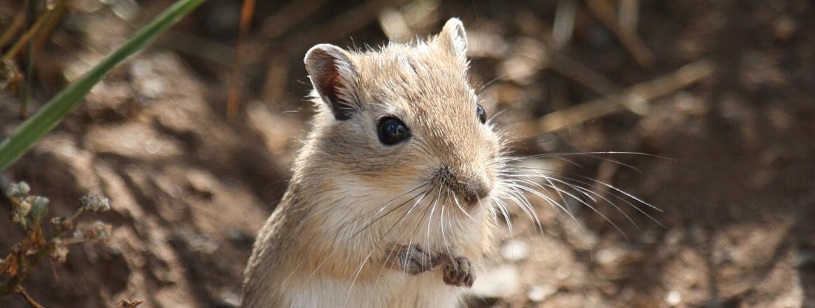
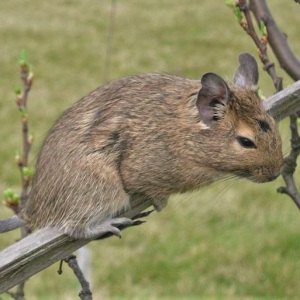
Mongolian gerbil (Meriones unguiculatus) at a burrow entrance. · Alastair Rae from London, United Kingdom / Public domain ().
The Mongolian gerbil is a small rodent with a long, furred tail and well-developed hind legs. In Asian steppes it digs burrows, stores food and lives with other gerbils. Pet individuals retain the same strong drive to dig and explore.
Quick facts
| Common name | Mongolian gerbil, Mongolian jird |
| Scientific name | Meriones unguiculatus |
| Lifespan | Usually up to 3–4 years in human care; sometimes longer |
| Length | Body about 12 cm; tail may reach about 12 cm |
| Weight | Approximately 50–130 g, varying by individual |
| Diet | Predominantly plant-based, with varied foods |
| Predators | Birds of prey, snakes and carnivorous mammals |
| Conservation status | Least Concern (LC) |
| Distribution | Mongolia, China and adjacent Russia |
| Habitat | Steppe, grassland and semi-arid areas with burrowable soil |
| Family | Muridae |
| Social organisation | Family groups |
- Primary category:Rodents
- Explore this animal's categories:
Interesting facts
- Gerbils may drum with their hind feet as an alarm signal.
- Burrows include resting areas and food stores.
- Sand bathing helps maintain the coat.
- The sensitive tail must never be used to lift a gerbil.
Characteristics
Wild-type fur is brown above and paler underneath, blending with soil and dry vegetation. Captive varieties include black, white and other colours.
A furred tail and developed hind legs distinguish the outline from a typical mouse. Gerbils often sit upright to inspect their surroundings. Forefeet handle food and help dig. Gnawing suitable objects is a natural rodent behaviour.
Behaviour
Groups share burrows and sleeping areas. Scent helps identify members and familiar surroundings. An unfamiliar newcomer may trigger aggression.
Activity alternates with rest during the day and night. Temperature and food influence time spent outside in the wild.
Deep, appropriate bedding allows pet gerbils to construct tunnels. Compatible gerbil companions are important. Introducing an unfamiliar adult to an established group requires a careful procedure advised by an experienced specialist.
Habitat and distribution
The natural range includes Mongolia, northern China and adjacent Russia. Gerbils occupy steppe and other dry landscapes with low vegetation and suitable soil.
Burrows offer protection from weather and predators. Some are dug near plants whose roots stabilise the soil. Stored food helps animals use seasonally available resources. These mammals are adapted to strongly seasonal Asian environments.
Diet and feeding
Natural foods include seeds, grasses and other plant material. Gerbils collect and carry food into stores. In captivity, hidden food needs checking, especially fresh items.
A complete gerbil diet can be supplemented with appropriate amounts of fresh food. Scattering some food through bedding encourages foraging. Fresh water must remain available even though the species is adapted to dry environments.
Reproduction and life cycle
Gestation lasts roughly three to four weeks. Litters commonly contain four to seven pups, with variation. Newborns depend on nest warmth and their mother’s milk.
As they grow, pups explore and begin eating solid food. Early breeding ability makes accurate sex identification important when establishing captive groups. Unplanned breeding can quickly produce more animals than one enclosure can accommodate.
Name and history
The species is also called the Mongolian jird. Its current scientific name is Meriones unguiculatus; Alphonse Milne-Edwards described it in 1867.
It became familiar through both companion-animal keeping and research. Burrowing behaviour persists after many generations in human care.
Conservation and threats
Mongolian gerbils are globally Least Concern. Their natural habitat supports a wider community of plants and predators.
Companion animals need secure accommodation. Releasing them can threaten their survival and affect local wildlife. Their requirements differ from those of other popular rodents, including guinea pigs.
Frequently asked questions
Can a gerbil be lifted by its tail?
Tail handling can cause severe injury. Support the body gently with both hands, close to a safe surface.
Does a desert-adapted gerbil still need water?
Yes. Clean drinking water must always be available, and the bottle should be checked daily.
Why does it hide food?
Food storage is natural. Hidden fresh leftovers should be removed before they spoil.
Are gerbils active only at night?
They can be active during daylight too, alternating exploration and rest. Timing varies with conditions and individuals.