TarantulaInteresting facts and information
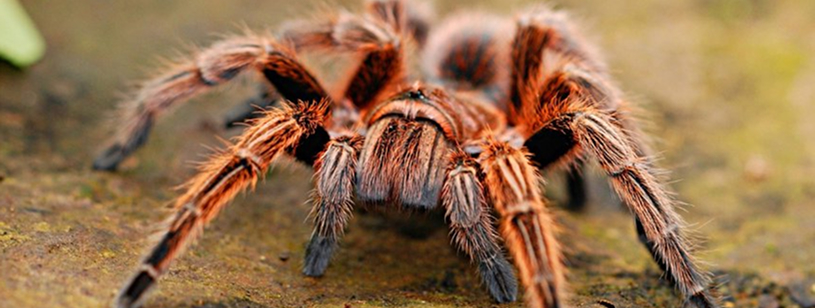
Tarantulas are spiders in the family Theraphosidae. Some live in burrows, while others spend much of their time in trees. They capture animal prey, and their defensive behaviour differs between species.
Tarantulas occur in many warmer regions of the world. Species differ in habitat, activity and lifespan, and females often live longer than males.
Quick facts
| Common name | Tarantula |
| Scientific name | Theraphosidae |
| Typical lifespan | Often 15 - 30 years (females), a few years (males) |
| Size | About 5 - 30 cm (leg span, depending on species) |
| Weight | From a few grams to about 170 g |
| Diet type | Carnivore (insects, spiders, small reptiles, amphibians, rodents) |
| Main predators | Tarantula hawk wasps (Pepsis spp.), birds, coatis and other small mammals |
| Conservation status | Assess separately by species and population; different taxa and regions have different needs |
| Habitat | Tropical forests, savannas, grasslands, deserts |
| Distribution (continents) | The Americas, Africa, Asia, Australia and southern Europe |
Interesting facts
- Regrowing legs - If a tarantula loses a leg, it can grow a new one over its next few moults.
- Burrowers and tree-dwellers - Many tarantulas live in burrows in the ground, while others live in trees and build silk tubes.
- No catching webs - Tarantulas do not build webs to catch prey; they ambush it, although they use silk to line burrows and as trip lines.
- Flicking hairs - Many American tarantulas can flick tiny barbed hairs from their abdomen at attackers, irritating their eyes and skin.
- A giant spider - The goliath birdeater (Theraphosa blondi) of South America is the heaviest spider in the world; despite its name, it eats birds only rarely.
Records and remarkable features
- Tarantulas are spiders in the family Theraphosidae. Some live in burrows, while others spend much of their time in trees. They capture animal prey, and their defensive behaviour differs between species.
- Long-lived spiders - Females of some tarantula species can live for 25-30 years, much longer than most other spiders.
Physical characteristics and adaptations
Tarantulas are large, hairy spiders, adapted to hunting at night and to many different habitats.
Distinguishing physical appearance
- Two body parts - Like all spiders, tarantulas have a front part (the cephalothorax), which carries the eyes, fangs and legs, and an abdomen.
- Eight hairy legs - Their legs are covered with sensitive hairs that detect vibrations and air currents.
- Hair for many jobs - Hairs help them sense their surroundings and, in some species, defend themselves.
- Large fangs - Their fangs point downwards and inject venom into prey.
- Many colours - Most are brown or black, but some are brightly coloured, such as the blue-and-yellow peacock tarantula (Poecilotheria metallica).
Adaptations for survival
- Venom - Tarantula venom paralyses or kills prey; digestive juices then turn the prey's insides into liquid.
- Urticating hairs - Many American tarantulas flick barbed hairs at enemies, which can cause itching and eye irritation.
- Regrowth - Lost legs grow back gradually with each moult.
- Senses - Their eyesight is poor, but they sense their surroundings through vibrations and air movements.
Habits and behaviour
Tarantulas are mostly solitary and nocturnal spiders that usually avoid trouble and wait for prey to come close.
Life mode and daily routine
- Active at night - By day, most tarantulas stay in their burrows or hiding places.
- Ambush hunters - They wait near the entrance of their burrow and rush out when they feel prey nearby.
- Little food - An adult tarantula can go for weeks or months without eating.
Social behaviour and interactions
- Solitary - Most tarantulas live alone and defend their burrows.
- Meeting to mate - Males and females meet only to mate, and a female sometimes eats the male afterwards.
- People - Tarantulas are not usually aggressive towards people; they prefer to flee, flick hairs or raise their legs in a threat display.
Defence techniques
- Flicking hairs - American tarantulas rub their back legs over the abdomen and throw clouds of irritating hairs.
- Threat display - They rear up on their back legs and show their fangs.
- Biting - The venom of most tarantulas is not dangerous to people, but the bite can be painful, like a bee sting; some Old World species have stronger venom.
Habitat and geographic distribution
Tarantulas live in warm regions on most continents, in tropical forests, savannas, grasslands and deserts.
Geographical distribution
| Region | Examples of where they live |
|---|---|
| North America | South-western USA (Texas, Arizona), Mexico |
| Central America | Guatemala, Costa Rica, Panama |
| South America | Brazil, Venezuela, Peru, Ecuador |
| Southern Europe | A few small species in Spain, Portugal and Sicily |
| Africa | Many species, from West Africa to Kenya and South Africa |
| Asia | India, Sri Lanka, Thailand, Indonesia |
| Australia | "Whistling spiders" in the north and centre |
Habitats
- Tropical forests - Many species live in rainforests, on the ground or in trees.
- Savannas and dry areas - Some species in Africa and South America live in drier habitats.
- Deserts and grasslands - Tarantulas in the USA and Mexico live in burrows in dry soil.
- Temperate zones - A few small species live in southern Europe and parts of Asia.
Habitat threats
- Deforestation - Habitat loss threatens many species, especially those with small ranges.
- Collection for the pet trade - Many tarantulas are caught to be sold as pets.
- Pesticides - Chemicals used in agriculture can harm tarantulas and their prey.
Diet and feeding
Tarantulas are predators that eat any animal they can overpower.
What do tarantulas eat?
| Type of prey | Examples |
|---|---|
| Insects | Cockroaches, crickets, grasshoppers, beetles |
| Other spiders | Smaller spiders, sometimes other tarantulas |
| Small reptiles | Lizards, small snakes |
| Small mammals | Mice and other small rodents (large species) |
| Amphibians | Frogs and toads |
| Birds (rarely) | Nestlings, mainly for the largest species |
Hunting mode
- Sensing vibrations - Tarantulas feel the vibrations of passing prey through the ground or their silk lines.
- A sudden attack - Although they usually move slowly, they can pounce very quickly.
- Venomous bite - Their bite injects venom that paralyses the victim.
- Outside digestion - Tarantulas pour digestive juices onto their prey and suck up the liquid.
Reproduction and life cycle
Tarantulas have careful courtship rituals and, compared with most spiders, very long lives.
Mating and laying of eggs
| Characteristic | Details |
|---|---|
| Sexual maturity | About 2-10 years (depending on species and sex) |
| Breeding season | Varies; in the USA, males wander in search of females in late summer and autumn |
| Number of eggs per sac | About 50-2,000, depending on species |
| Incubation period | About 1-3 months |
| Independence of young | A few weeks after hatching |
Reproductive behaviour
- Courtship - The male taps and drums at the entrance of the female's burrow to show he is not prey.
- Danger for the male - The male uses hooks on his front legs to hold the female's fangs while mating, then hurries away.
- Guarding the eggs - The female wraps her eggs in a silk sac and guards it, turning it regularly.
- Leaving the burrow - The spiderlings stay near their mother for a short time and then disperse.
Longevity
- Females of many species live 15-25 years or more; some live about 30 years.
- Males live much shorter lives and usually die within a year or two of becoming mature.
Name and history
Origin of the name "Tarantula"
- From the city of Taranto - The name comes from Taranto in southern Italy, where the bite of a large wolf spider (Lycosa tarantula), not a true tarantula, was blamed for a condition called "tarantism".
- A borrowed name - European settlers later gave the name to the large hairy spiders of the Americas.
Taxonomic Classification
| Kingdom | Animalia |
|---|---|
| Phylum | Arthropoda |
| Class | Arachnida |
| Order | Araneae |
| Family | Theraphosidae |
History and documentation
- Early taxonomy — The tarantula now known as Avicularia avicularia was described by Linnaeus in 1758. This is a specific taxonomic record, rather than a date for the first knowledge of all tarantulas.
- Pets - Because of their striking looks and calm behaviour, tarantulas are among the most popular spiders kept as pets.
- There are about 1,000 known species of tarantulas.
Cultural significance and mythology
Tarantulas have long fascinated and frightened people, and they appear in folk traditions, food and films.
- The tarantella - According to legend, people in southern Italy danced the lively tarantella to cure the bite of the "tarantula"; in fact the spider was a wolf spider.
- Food - In Cambodia, fried tarantulas are a well-known snack, especially in the town of Skuon.
- Tarantula migrations - In autumn, thousands of male tarantulas wander across roads in parts of the south-western USA in search of mates, attracting visitors.
Conservation status and threats
Most tarantulas are not assessed, but habitat destruction and collection for the pet trade threaten some species.
Main threats
- Deforestation - Habitat loss in South America, Africa and Asia threatens many species.
- The pet trade - Rare species are sometimes caught illegally and sold as pets.
- Pesticides - Chemicals used in agriculture can poison tarantulas and their prey.
- Climate change - Changes in rainfall and temperature can affect their habitats.
Conservation status
| Species | Status |
|---|---|
| Poecilotheria metallica (peacock tarantula) | Critically Endangered (IUCN) |
| Brachypelma smithi (Mexican red-knee tarantula) | International trade controlled under CITES |
| Aphonopelma johnnycashi (Johnny Cash tarantula) | Described in 2016; not assessed |
Conservation efforts
- Protecting habitats - Reserves protect the forests where rare tarantulas live.
- Trade rules - Many tarantula species are protected by CITES (Convention on International Trade in Endangered Species).
- Captive breeding - Breeding tarantulas in captivity reduces the need to take them from the wild.
In popular culture
Tarantulas in film
- "Tarantula!" (1955) - A classic science-fiction film about a giant tarantula.
- "Dr. No" (1962) - In the first James Bond film, a tarantula is placed in Bond's bed.
- "Home Alone" (1990) - Kevin's brother Buzz keeps a pet tarantula that escapes and causes chaos.
Tarantulas as symbols
- Fear and fascination - Tarantulas are often used in films and on Halloween as symbols of fear.
- Names - A tarantula found in California was named Aphonopelma johnnycashi after the singer Johnny Cash, because the males are mostly black.