Eurasian collared doveStreptopelia decaocto — habitat, diet and reproduction
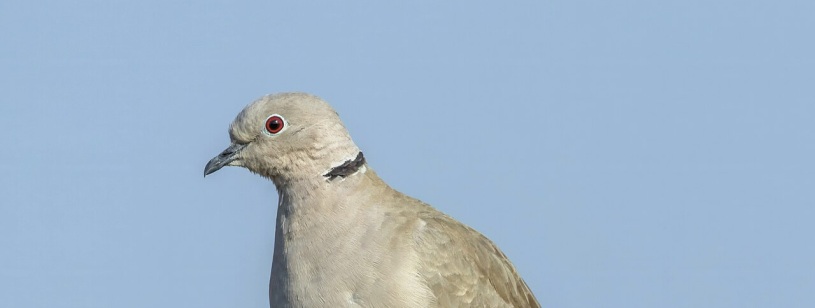
Eurasian collared dove with pale grey-beige plumage and a black half-collar. · Charles J. Sharp / Wikimedia Commons / CC BY-SA 4.0 (https://creativecommons.org/licenses/by-sa/4.0/). Cropped and resized. Source: https://commons.wikimedia.org/wiki/File:Eurasian_collared_dove_(Streptopelia_decaocto)_Rajasthan.jpg
The Eurasian collared dove (Streptopelia decaocto) is a pale grey-beige bird with a black half-collar. It gathers seeds in villages, towns and gardens. Its repeated coo can be heard throughout the year. In Romania it remains through winter.
Quick facts
| Common name | Eurasian collared dove |
| Scientific name | Streptopelia decaocto |
| Lifespan | BTO estimates around 3 years for birds reaching breeding age; British record exceeds 15 years |
| Length | 30–32 cm |
| Weight | Around 200 g in adults, with individual variation |
| Diet | Mainly seeds and cereal grain |
| Predators | Cats; crows and jackdaws can raid nests |
| Conservation status | Least Concern globally |
| Distribution | Europe, Asia and North Africa; introduced in North America |
| Habitat | Settlements, gardens, orchards and farmland |
| Family | Columbidae |
| Reproduction | Usually two eggs, with repeated breeding attempts in favourable conditions |
- Primary category:Birds
- Explore this animal's categories:
Interesting facts
- A fine white edge borders the black half-collar.
- The rhythmic coo has three parts.
- Mild weather and plentiful food can allow an extended nesting season.
- Twigs form a simple nest platform in vegetation or on structures.
Records and extremes
A British ringing record reached 15 years and 3 months, according to BTO. This exceptional survival greatly exceeds the typical lifespan.
European expansion was rapid. Britain’s first breeding record dates to 1955. Adaptability and repeated breeding helped the species establish in new regions.
Characteristics
The pale body can show a pinkish wash on the breast. Reddish eyes and legs contrast with the dark bill. White areas of the long tail appear in flight.
Males and females look similar. Uniform wings and a black neck band distinguish the species from the European turtle dove’s patterned wings and striped neck patches.
Behaviour
Collared doves forage by day and rest on branches, wires and roofs. Several birds may gather where food is abundant.
Males coo from elevated perches. Display flights can include a steep climb followed by a descent with the tail spread.
A harsher nasal call accompanies flight or landing. Romanian birds are resident, though young birds disperse to new areas.
Habitat and distribution
Asian in origin, the species expanded across Europe and North Africa. Human introductions also helped it reach North America, where it uses urban and agricultural habitats.
In Romania it is widespread, especially in lowlands. Gardens, parks, orchards and farmyards combine nesting supports with food. High mountain habitats are less suitable.
Diet and feeding
Seeds and cereal grains dominate the diet. Wheat, maize and millet are gathered from the ground, including spilled grain near farmland.
Small fruits and green plant material supplement the diet; invertebrates are occasional foods. Year-round resources favour life near human settlements.
Reproduction and life cycle
The male brings twigs and the female arranges the nest. Existing platforms may be reused.
Usually two white or cream eggs are laid. Both parents incubate, with BTO reporting about 16–17 days. Young remain in the nest for roughly another 17–19 days.
Breeding can extend from early in the year into autumn. Further broods depend on conditions, and fledged young remain dependent for a time.
Name and history
Imre Frivaldszky described the species in 1838. It belongs to Columbidae, the pigeon and dove family. The English name refers to its dark neck band.
Twentieth-century observations documented its European expansion. Dispersal into new regions differs from regular seasonal return migration.
Conservation and threats
The global classification is Least Concern. A large range and use of human-modified habitats support widespread populations, though regional trends differ.
Cats can catch inexperienced fledglings. Crows and jackdaws raid nests, as documented by long-term research in Poland.
Retaining trees and leaving active nests undisturbed support local birds. Watching from a distance avoids interrupting parental care.
Frequently asked questions
How does it differ from a turtle dove?
Look for uniform wings and a black half-collar. Turtle doves have patterned wings and striped neck patches.
Does it leave Romania in winter?
It is resident, although young birds may disperse.
Why does it keep cooing?
Calls play a role in territory defence and attracting a partner.
Can it nest on buildings?
Yes. Suitable structures may support its twig platform.
How many eggs are laid?
Usually two, with further breeding attempts possible in the same year.
Is it threatened with extinction?
It is globally Least Concern, although some local populations can decline.