CuttlefishInteresting facts and information
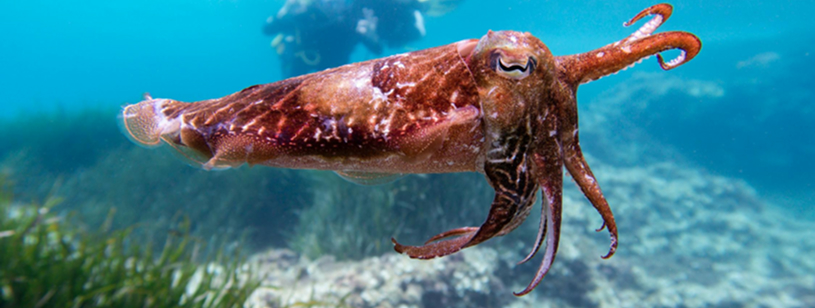
Cuttlefish are marine molluscs related to squid and octopuses. They have eight arms, two feeding tentacles and an internal shell called a cuttlebone. Changes in skin colour and pattern help with camouflage and communication.
The porous cuttlebone helps regulate buoyancy. Cuttlefish swim using their fins and can also move by expelling water through a siphon.
Cuttlefish capture prey with their feeding tentacles and handle it with their arms and beak. Lifespan differs between species.
Quick facts
| Common name | Cuttlefish |
| Scientific name | Sepiida |
| Typical lifespan | 1 - 2 years |
| Maximum speed | Varies with species or individual, distance and conditions |
| Size | Body usually about 15-25 cm; up to about 50 cm in the largest species |
| Weight | From a few grams to over 10 kg (depending on species) |
| Diet type | Carnivorous (crustaceans, fish, molluscs) |
| Main predators | Sharks, dolphins, seals, seabirds, large fish |
| Conservation status | Assess separately by species and population; different taxa and regions have different needs |
| Distribution | Eastern Atlantic, Mediterranean, Indian Ocean and western Pacific (not in the Americas) |
| Habitat | Temperate and tropical seas, coastal areas and coral reefs |
- Primary category:Molluscs
- Explore this animal's categories:
Interesting facts
- Instant camouflage - Cuttlefish can change the colour, pattern and even texture of their skin in a fraction of a second, using chromatophores and other special skin cells.
- Clever invertebrates - Cuttlefish can learn and remember; in one experiment, they waited for a preferred snack instead of eating a less tasty one straight away.
- Blue-green blood and three hearts - Their blood carries oxygen with a copper-based protein called haemocyanin, and they have three hearts.
- Jet propulsion - They usually swim with their side fins but can shoot away quickly by forcing water out through a siphon.
- Ink defence - When attacked, cuttlefish release a cloud of dark ink that confuses predators.
- A floating bone - The cuttlebone inside the body has many small chambers; by changing the amount of gas and liquid in them, the cuttlefish controls its buoyancy.
- Colour-blind masters of colour - Cuttlefish probably cannot see colours as we do, yet they match their background very well; they can detect polarised light.
Records and remarkable features
- Cuttlefish are marine molluscs related to squid and octopuses. They have eight arms, two feeding tentacles and an internal shell called a cuttlebone. Changes in skin colour and pattern help with camouflage and communication.
Characteristics
Cuttlefish are cephalopods with soft bodies, flexible arms and a large, complex brain. These features make them agile predators and masters of camouflage.
Main physical characteristics:
| Characteristic | Details |
|---|---|
| Length | Body (mantle) usually about 15-25 cm; up to about 50 cm in the giant Australian cuttlefish |
| Weight | From a few grams in small species to over 10 kg in the largest |
| Arms and tentacles | 8 arms and 2 long feeding tentacles that can be shot out to catch prey |
| Movement | Undulating fins along the body; jet propulsion through a siphon for fast escapes |
| Camouflage | Changes skin colour, pattern and texture very quickly |
| Eyes | Large eyes with a W-shaped pupil, able to detect polarised light |
| Cuttlebone | A porous internal shell used for buoyancy |
Special adaptations:
- Active skin - Cuttlefish can change colour and texture to match their surroundings, making them among the best camouflaged animals.
- Cuttlefish have well-developed eyes and can detect polarised light. Their colour vision differs from human colour vision.
- Feeding tentacles with suckers help seize prey.
- Ink - When in danger, cuttlefish release a cloud of ink that helps them escape.
- The porous cuttlebone helps regulate buoyancy through changes in its gas and liquid content.
Habits and behaviour
Cuttlefish usually live alone, but they have complex communication and hunting behaviour. They use colour patterns both to hide and to send signals to other cuttlefish.
Social behaviour:
- Mostly solitary - They usually meet only to mate, although some species gather in large numbers to breed.
- Communication by colour - Cuttlefish use changing patterns to show aggression, warn rivals or court partners.
- Rivalry - In the breeding season, males display to each other and may fight over females.
Feed and hunting:
- Carnivores - They feed on crustaceans, fish and other molluscs.
- Ambush hunters - They use camouflage to get close to prey and then shoot out their two feeding tentacles.
- A strong beak helps cuttlefish break down animal prey.
Survival techniques:
- Camouflage helps cuttlefish blend into their surroundings; the pattern and texture can change.
- Ink - They release ink to confuse predators and escape.
- Jet propulsion — cuttlefish expel water through a siphon to move quickly.
- Startle displays - Some species suddenly show dark eyespots or flashing patterns to scare predators.
Habitat and geographic distribution
Cuttlefish live in tropical and temperate seas of Europe, Africa, Asia and Australia; there are none in the Americas. Distribution differs between species.
Habitats:
| Habitat | Species predominant |
|---|---|
| Coral reefs and rocky areas | Giant Australian cuttlefish (Sepia apama); broadclub cuttlefish (Sepia latimanus) |
| Coastal waters and estuaries | Common cuttlefish (Sepia officinalis) |
| Tropical coastal waters | Flamboyant cuttlefish (Metasepia pfefferi) |
| Deeper waters (down to several hundred metres) | Some less well-known species |
Geographical distribution:
- The eastern Atlantic and the Mediterranean - Home of the common cuttlefish.
- The Indian Ocean and western Pacific support several cuttlefish species, including the giant Australian cuttlefish.
- Tropical cuttlefish use various coastal habitats and reefs. Their ranges differ from species to species.
Impact of climate change and human activities:
- Changes in water temperature can affect cuttlefish habitats and life cycles; effects differ between species.
- Fishing and accidental capture can affect cuttlefish populations.
- Ocean acidification - It can affect the cuttlebone, which is sensitive to water pH changes.
Cuttlefish species need separate population assessments; trends differ between species and regions.
Diet and feeding
Cuttlefish are carnivorous predators that eat crustaceans, small fish and other invertebrates. They use camouflage and fast tentacle strikes to catch prey by surprise.
Food types consumed:
| Food type | Examples |
|---|---|
| Crustaceans | Shrimps, small crabs, young lobsters |
| Small fish | Gobies and other small fish |
| Molluscs | Small molluscs, sometimes smaller cuttlefish |
| Worms and other invertebrates | Polychaete worms and other small animals |
Method of feeding:
- Ambush - Cuttlefish use camouflage to approach prey unnoticed.
- Fast tentacle strike - The two feeding tentacles shoot out very quickly and grab the prey with their suckers.
- A powerful beak - Their parrot-like beak can crack crab shells and tear fish flesh.
- Toxic saliva - Like other cephalopods, cuttlefish have saliva containing toxins that help subdue prey.
Cuttlefish grow fast and need to eat often to fuel their active lives.
Reproduction and life cycle
Cuttlefish live short lives, usually only 1-2 years. Courtship involves impressive colour displays and some surprising tactics.
Life cycle stages:
| Stage | Approximate duration | Characteristics |
|---|---|---|
| Breeding | Seasonal | Males show striking colour patterns to court females. |
| Egg laying | Soon after mating | Females attach their eggs to rocks, seaweed, coral or other objects. |
| Incubation | About 1-3 months, depending on temperature | The young develop fully inside the egg. |
| Juvenile | Several months | Young cuttlefish hunt and camouflage from the start. |
| Sexual maturity | Usually within about a year | Adults breed and soon die. |
Reproductive behaviour:
- Sneaky males - In the giant Australian cuttlefish, some small males disguise themselves as females to get past large males and mate.
- In many cuttlefish, the male transfers sperm packets using a specialised arm called a hectocotylus.
- Protected eggs - Common cuttlefish eggs are coloured black with ink and look like bunches of grapes.
- Adults die after breeding - Like many cephalopods, cuttlefish die soon after they reproduce.
Cuttlefish do not guard their eggs, but the young hatch as tiny versions of the adults, able to hunt and camouflage straight away.
Name and history
Cuttlefish have been known for thousands of years; the Greek philosopher Aristotle described them in detail.
Origin and etymology of the name:
- The genus name Sepia comes from the Greek word for cuttlefish; the brown pigment "sepia" is named after the animal.
- Despite the name "cuttlefish", they are molluscs, not fish.
- Sepiida is an order of cephalopods that includes cuttlefish.
Taxonomic classification:
| Taxonomic category | Name |
|---|---|
| Kingdom | Animalia |
| Phylum | Mollusca |
| Class | Cephalopoda |
| Order | Sepiida |
| Main Family | Sepiidae |
Sepia in history and human uses:
- Sepia pigment — cuttlefish ink has been used in writing and drawing.
- Sepia tones are brown shades associated with the pigment traditionally obtained from cuttlefish ink.
- Cuttlefish are eaten in several coastal food traditions. They are distinct from squid, even where both appear in seafood dishes.
- Cuttlebones are given to cage birds as a source of calcium and are used by jewellers to make moulds.
Cuttlefish are studied for their camouflage, behaviour and nervous systems.
Cultural significance and mythology
Cuttlefish have been part of Mediterranean life for thousands of years, as food, as a source of ink and as a subject of scientific curiosity.
- Ancient Greece - Aristotle wrote about cuttlefish behaviour and their use of ink in his "History of Animals".
- Art and writing - Sepia ink from cuttlefish was used for drawings and letters, and "sepia" became the name of a warm brown colour, also used for old photographs.
- Cuisine - In Italy, cuttlefish ink is used to make black risotto and black pasta.
Conservation status and threats
Threats and conservation status differ between cuttlefish species. Fishing pressure and changes to marine habitats can affect them.
Conservation status
| Species | Status (IUCN) |
|---|---|
| Common cuttlefish (Sepia officinalis) | Least Concern |
| Giant Australian cuttlefish (Sepia apama) | Near Threatened (2009 assessment) |
| Flamboyant cuttlefish (Metasepia pfefferi) | Data Deficient |
Main threats:
- Climate change - Warmer seas can affect breeding and the life cycle of cuttlefish.
- Ocean acidification - Changes in water pH may affect the cuttlebone and its role in buoyancy.
- Fishing - Cuttlefish are an important catch in many countries and are also caught by accident in trawls.
- Habitat destruction - Pollution and damage to coastal habitats reduce breeding and feeding sites.
Conservation efforts:
- Fishing rules - Some countries set catch limits and closed seasons.
- Protected areas - In South Australia, the breeding grounds of the giant Australian cuttlefish near Whyalla are protected from fishing.
- Monitoring - Researchers count cuttlefish at breeding sites to follow population changes.
Population trends vary between cuttlefish species and regions.
In popular culture
Documentaries and tourism
- "Kings of Camouflage" (2007) - A NOVA documentary about the intelligence and camouflage of cuttlefish.
- Whyalla, South Australia - Every winter, thousands of giant Australian cuttlefish gather to breed, attracting divers and snorkellers from around the world.
Cuttlefish as inspiration
- Science - Researchers study cuttlefish skin to develop new camouflage materials and flexible displays.
- Art - The word "sepia" keeps the cuttlefish's name alive in art and photography.