ElephantInteresting facts and information
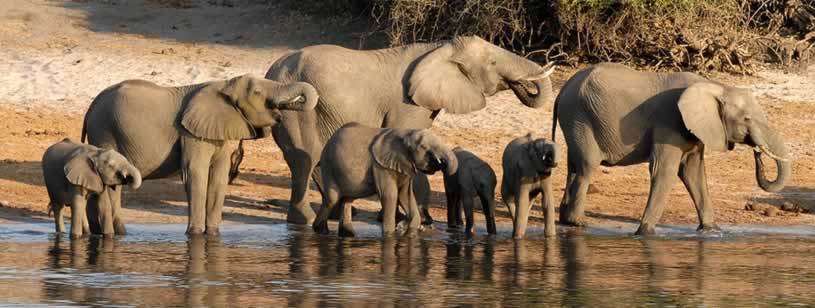
Elephants are large plant-eating mammals represented by three living species: the African savanna elephant (Loxodonta africana), the African forest elephant (Loxodonta cyclotis) and the Asian elephant (Elephas maximus). Their trunks, social lives and effects on vegetation are important features, but their ranges and conservation status must be described separately.
Elephants shape vegetation, spread seeds and create paths through their habitats. People have worked with elephants for centuries, using them for work and transport, and they are important in many cultural traditions.
Poaching, habitat loss and conflict with people threaten elephants. Pressures and population trends differ between species and regions.
Quick facts
| Common name | Elephant |
| Scientific name | Loxodonta africana; Loxodonta cyclotis; Elephas maximus |
| Typical lifespan | Up to about 60-70 years in the wild |
| Maximum speed | About 25 km/h over short distances |
| Height | 2.5 - 4 m (males), 2 - 3.5 m (females) |
| Weight | Females: 2,500 - 6,000 kg; males: 4,500 - 7,500 kg |
| Diet type | Herbivore (leaves, grass, bark, fruit) |
| Main predators | Humans (poaching, habitat destruction); lions occasionally kill calves |
| Conservation status | African forest elephant: Critically Endangered; African savanna elephant and Asian elephant: Endangered |
| Distribution | Africa, South Asia and Southeast Asia |
| Habitat | Savannas, rainforests, grasslands, hills and mountains |
Interesting facts
- Elephants can remember places and social information; no universal best-memory ranking among animals is established.
- The trunk is both strong and sensitive - It is made up of tens of thousands of muscle units, has no bones and can lift heavy loads or pick up a single peanut.
- Elephants show interest in the remains of other elephants and behaviour consistent with strong social bonds. This should not be equated automatically with human funeral rituals.
- The largest brain of any land animal - An elephant's brain weighs about 5 kg, roughly three to four times as much as a human brain.
- Some elephants have shown mirror self-recognition in experiments. Interpreting animal self-awareness requires care and should not be reduced to a single test.
- They communicate with very low sounds - Elephants make rumbles too low for humans to hear, which can travel for several kilometres through the air and the ground.
- They cool down with their ears - Elephants flap their large ears to lose heat, which is vital in hot climates.
- They can use tools - Elephants have been seen using branches to scratch themselves or to swat flies.
- They are extremely social - Females and their young live in family groups led by the oldest, most experienced female, called the matriarch.
- They are good at finding water - Elephants use their sense of smell and their memory of the landscape to find water, even in the dry season.
Records and remarkable features
- The African savanna elephant is the largest living land animal.
Characteristics
Elephants are the largest land mammals and have features that set them apart from all other animals. Their adaptations allow them to live in many environments, from tropical forests to dry savannas.
Main physical features:
- Huge size - Large African savanna elephant males can stand about 4 metres tall at the shoulder and weigh around 6,000-7,500 kg; females are smaller.
- A strong, sensitive trunk - Made of tens of thousands of muscle units, the trunk is used for feeding, drinking, communicating, defence and social contact.
- Ivory tusks (long incisor teeth) - In African elephants, both males and females usually have tusks, while in Asian elephants only some males grow large tusks.
- Thick but sensitive skin - Up to about 2.5 cm thick in places, but still sensitive to sun, insects and parasites.
- Giant ears for cooling - They help the elephant lose heat and are much larger in African elephants than in Asian elephants.
- A long tail with stiff hairs - Used to swat insects.
Special adaptations for survival:
- A large, complex brain - Elephants have one of the largest brains in the animal kingdom and show complex behaviour and excellent memory.
- Feet built for weight - A thick, elastic pad in each foot absorbs shocks and spreads the elephant's weight.
- An excellent sense of smell - Elephants can detect smells, including water and other elephants, from long distances.
- Strong social bonds - They live in family groups led by a matriarch, where cooperation is essential for survival.
Habits and behaviour
Elephants are highly social and intelligent mammals. Females and young live in family groups led by a matriarch, while adult males live alone or in small male groups.
Social behaviour:
- Family groups of females and calves - Each family is led by the oldest and most experienced female.
- Males leave home - At about 10-15 years old, males leave their mother's group and then live alone or with other males.
- Helping each other - Elephants care for orphans and protect injured members of the group.
- Play and affection - Young elephants play together, and adults touch each other with their trunks.
Breeding:
- Calves are born only every 4-5 years - A female is ready to mate for only a few days at a time, so males compete hard for her.
- Males come into "musth" - A period when they become very aggressive and their testosterone levels are high.
- Contests between males - Dominant males use their tusks, trunks and sheer size to assert themselves.
Defence and survival methods:
- Low-frequency calls - Elephants can send messages to each other over several kilometres.
- A protective circle - When predators threaten, adults surround the calves to protect them.
- Mud baths - Covering themselves with mud and dust protects their skin from the sun and insects.
Habitat and geographic distribution
Elephants are adaptable and live in many habitats, from savannas and tropical forests to hills and mountains.
Habitat types:
- African savannas - Savanna elephants live in open country, where they travel long distances in search of food and water.
- Tropical forests - African forest elephants are smaller and live in the dense forests of Central and West Africa; many Asian elephants also live in forests.
- Hills and mountains - In countries such as India and Sri Lanka, Asian elephants also live in forested hills.
- River valleys and wetlands - Some populations live near rivers, lakes and swamps, where they bathe often.
Geographic distribution and estimated population:
| Region | Species | Approximate population |
|---|---|---|
| Africa (savannas and forests) | African savanna elephant (Loxodonta africana) and African forest elephant (Loxodonta cyclotis) | About 400,000 in total |
| South and Southeast Asia (India, Sri Lanka, Thailand and others) | Asian elephant (Elephas maximus) | About 40,000 - 50,000 |
| Borneo | Bornean elephant (a population of the Asian elephant) | About 1,000 - 1,500 |
Impact of climate change and human activities:
- Deforestation and habitat loss - The spread of farms and cities reduces the space elephants need.
- Poaching for ivory - Elephants are killed for their tusks, which has caused dramatic declines, especially in Africa.
- Conflict with farmers - Elephants can destroy crops, which leads to clashes with local people.
- Climate change - Rising temperatures and droughts affect water and food supplies.
Elephants are essential to their ecosystems, and protecting them is a global priority.
Diet and feeding
The elephant is a huge herbivore that eats large amounts of vegetation every day. It eats leaves, branches, grass and fruit and plays an important role in shaping its ecosystem.
Main food:
- Grass and leaves - The basis of the diet, especially in the rainy season.
- Bark and branches - An important source of fibre and minerals, especially in the dry season.
- Fruit and seeds - Eaten especially by elephants living in forests.
- Water plants - Elephants also eat plants that grow in swamps and lakes.
Diet by habitat:
| Habitat | Main food |
|---|---|
| Savannas | Grass, bark, acacia leaves |
| Tropical forests | Fruit, leaves, water plants |
| Hills and mountains | Shrubs, bamboo, mountain grasses |
| Swamps | Water plants and roots |
Feeding methods:
- Using the trunk - The strong trunk can tear off branches or gently pick small fruit.
- Huge appetite - An adult elephant can eat about 100-200 kg of plants a day and drink up to about 200 litres of water.
- Spreading seeds - Many plants depend on elephants to spread their seeds, which helps forests regenerate.
Reproduction and life cycle
Elephants have the longest pregnancy of any mammal, and their calves need intensive care for several years. Because they breed so slowly, population losses are a major conservation problem.
Mating:
- Males come into "musth" - A period of high testosterone and aggressive behaviour.
- Contests between males - The strongest males compete for the chance to mate.
- Female choice - Females often prefer to mate with large, mature males in musth.
Pregnancy and birth:
- The longest pregnancy of any mammal - It lasts about 22 months.
- Usually a single calf - Twins are very rare.
- Weight at birth - A newborn calf weighs about 90-120 kg and can stand within a few hours.
How calves develop:
- Suckling for up to several years - Calves depend on their mother's milk for a long time, often 2-3 years or more.
- Group care - The whole family looks after the calves, including aunts and older sisters.
- Independence - Young males start to leave the family group from about 10 years old; females usually stay for life.
Lifespan:
- In the wild - Up to about 60-70 years.
- In captivity - Often shorter, and captive elephants can suffer from health and behavioural problems.
Name and history
The elephant is one of the most studied mammals, and its history is closely linked with that of people, both in daily life and in mythology.
Origin of the name:
- The word "elephant" comes from the Greek elephas, which meant both "elephant" and "ivory".
- The scientific names Loxodonta (African elephants) and Elephas (Asian elephant) come from Greek and Latin; Loxodonta refers to the slanted shape of the ridges on the teeth.
Taxonomic classification:
| Taxonomic rank | Name |
|---|---|
| Kingdom | Animalia |
| Phylum | Chordata |
| Class | Mammalia |
| Order | Proboscidea |
| Family | Elephantidae |
| Genus | Loxodonta (African elephants), Elephas (Asian elephant) |
| Species | L. africana, L. cyclotis, E. maximus |
Discovery and documentation:
- Ancient relatives - The earliest relatives of modern elephants lived about 60 million years ago.
- Prehistoric cousins - Mammoths and mastodons were close relatives of today's elephants.
- A long history with people - Elephants have been used for work, transport and war, for example in ancient India and by the Carthaginian general Hannibal.
The elephant in mythology and culture:
- Hinduism - The god Ganesha, who has an elephant's head, stands for wisdom and good fortune.
- China and Buddhism - Elephants are symbols of strength and long life.
- The ancient world - Elephants were used in war and in parades by several ancient powers, including Carthage, the Hellenistic kingdoms and Rome.
The elephant remains one of the most admired animals in the world, a symbol of strength, wisdom and family.
Cultural significance and mythology
The elephant has played a central role in the mythology, religion and culture of many civilisations. Honoured as a symbol of power, wisdom and good fortune, it appears in the legends and traditions of India, Africa, the rest of Asia and Europe.
The elephant in mythology and religion:
- Hinduism - Ganesha, the elephant-headed god, is the remover of obstacles and the patron of knowledge, wisdom and prosperity.
- Buddhism - White elephants are sacred and linked with the birth of the Buddha: his mother, Queen Maya, is said to have dreamed of a white elephant before he was born.
- African traditions - Elephants are symbols of strength, unity and wisdom, and in some traditions they are linked with ancestors.
- Carthage and Rome - The Carthaginian general Hannibal famously crossed the Alps with war elephants to attack Rome.
- China and feng shui - The elephant is linked with good luck, stability and protection.
What the elephant symbolises:
- Power and strength - Because of its enormous size.
- Wisdom and memory - It is seen as an intelligent, wise animal.
- Family and loyalty - The strong bonds within the herd stand for unity and mutual support.
Conservation status and threats
Elephant assessments are species-specific: African forest elephants are Critically Endangered, while African savanna and Asian elephants are Endangered.
Conservation status
- African savanna elephant (Loxodonta africana) – Endangered; numbers have fallen sharply because of poaching and habitat loss.
- African forest elephant (Loxodonta cyclotis) – Critically Endangered; poaching and habitat loss are major pressures.
- Asian elephant (Elephas maximus) – Endangered; its numbers have fallen by at least half over the last three generations.
Main threats:
- Poaching for ivory - The main cause of the decline, especially in Africa.
- Habitat loss - Deforestation and the spread of towns and farms greatly reduce the land available to elephants.
- Conflict with people - In some regions, elephants destroy crops and are killed by farmers.
- Climate change - Reduces the water and plant food available where elephants live.
Conservation efforts:
- Restrictions on the ivory trade - The Convention on International Trade in Endangered Species (CITES) has banned the international commercial trade in ivory.
- National parks and reserves - Protected areas such as Kruger National Park (South Africa) and Kaziranga National Park (India) help protect elephants.
- Anti-poaching patrols - Conservation organisations and rangers work to stop illegal hunting.
- Living alongside elephants - Projects help local communities reduce conflict, for example with beehive fences that keep elephants away from crops.
In popular culture
The elephant is one of the most popular animals in culture and appears in films, books, cartoons and sport.
Elephants in literature:
- Babar (Jean de Brunhoff, from 1931) - A series of books about an elephant who becomes king.
- "The Elephant's Child" (Rudyard Kipling, 1902) - A classic Just So Story about how the elephant got its trunk.
- Water for Elephants (Sara Gruen, 2006) - A novel about circus life, later made into a film.
Elephants in film and television:
- Dumbo (Disney, 1941; live-action remake 2019) - The story of a baby circus elephant with huge ears who can fly.
- The Jungle Book (1967, 2016) - Elephants, led by Colonel Hathi, are important characters in Mowgli's story.
- Water for Elephants (2011) - A film about circus life and the bond between people and an elephant.
Elephants in video games:
- Age of Empires - War elephants are powerful combat units.
- Far Cry 4 - Players can ride elephants.
Elephants in sport and emblems:
- Alabama Crimson Tide - The mascot of this American football team is an elephant called Big Al.
- The Republican Party - In the United States, the elephant is the symbol of the Republican Party.
Elephants in art:
- Statues and sculptures - Elephants appear often in Asian and African art.
- Tattoos and symbols - Elephants are popular designs, standing for wisdom and strength.