EarthwormsSegmented worms — soil, feeding, reproduction and behaviour
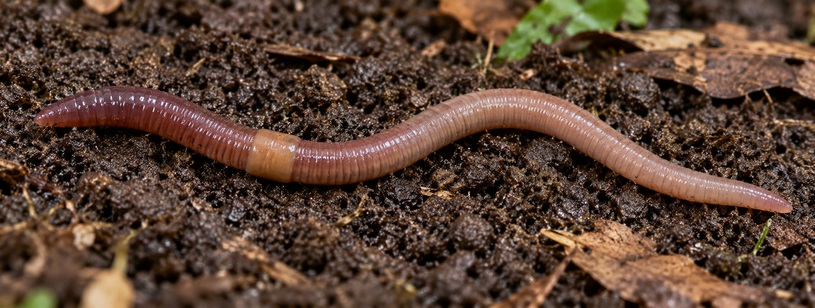
An adult representing Lumbricus terrestris, one example of a terrestrial earthworm.
Earthworms are segmented worms without legs. They breathe through moist skin and mainly feed on decomposing organic material. The name covers many terrestrial species rather than one animal with identical size and habits everywhere.
They help break down organic remains and change soil structure. Some live in surface litter, while others inhabit soil or deep burrows. Lumbricus terrestris, also recorded in Romania, is one example of a species that makes nearly vertical burrows.
Quick facts
| Common name | Earthworm |
| Scientific name | Crassiclitellata — a group containing familiar terrestrial earthworms |
| Typical lifespan | Varies with species and conditions; there is no single lifespan for all earthworms |
| Length | Highly variable; Lumbricus terrestris may measure about 12–30 cm, depending on the individual and how extended it is |
| Diet type | Mainly decomposing organic material and organic matter associated with soil |
| Conservation status | Assessed for individual species rather than the whole group |
| Geographical distribution | Many regions of Europe, Asia, Africa, the Americas and Australia; individual species have different ranges. |
| Habitat | Soil, leaf litter, decaying wood or compost, depending on species |
| Familiar example | Lumbricus terrestris, in the family Lumbricidae |
| Body | Elongated and segmented, without a bony skeleton |
| Legs and wings | Absent; tiny bristles help anchor the body during movement |
| Eyes | No eyes like ours, but they can detect light |
| Breathing | Gas exchange through moist skin |
| Clitellum | A thickened reproductive band, visible in mature worms |
| Activity | Related to moisture and temperature; some emerge mainly at night |
| Reproduction | Eggs protected in cocoons; usually involving sperm exchange between two worms |
| Sexes | Hermaphrodites: one individual has male and female reproductive organs |
| In Romania | Several species; Lumbricus terrestris is documented |
- Primary category:Invertebrates
- Explore this animal's categories:Animals of AfricaAnimals of AsiaAnimals of AustraliaAnimals of EuropeAnimals of North AmericaAnimals of RomaniaAnimals of Romania’s gardens and parksAnimals of Romania’s grasslands and plainsAnimals of South AmericaAnimals that regrow body partsBurrowing animalsEEgg-laying animalsForest animalsInvertebratesWild animals
Interesting facts
- No legs are needed to move. Muscles and tiny bristles work together as the worm advances.
- The thickened band is not the head. The clitellum sits some distance behind the head and is involved in reproduction.
- A small worm is not necessarily young. Adult size varies between species; a clitellum is a better indication of maturity.
- Composting worms have particular requirements. Species such as Eisenia fetida use rich accumulations of organic remains, unlike the deep burrows of some other earthworms.
- They can detect light without true eyes. Light-sensitive cells help them respond to conditions at the surface.
Records and extremes
How large can an earthworm grow?
Giant species are very different in size from familiar garden worms. In Australia, Megascolides australis, the giant Gippsland earthworm, can reach around 1.5 metres. Australian Museum also mentions reports of individuals up to 3 metres long.
| Species | Length and variation |
|---|---|
| Lumbricus terrestris | Around 12–30 cm, varying between individuals and with how extended the body is |
| Megascolides australis | A very large Australian species; around 1.5 m in the DCCEEW account, with larger exceptional measurements reported by the museum |
These are different species. A soft body changes length as it contracts and stretches, so measurements need context. Extreme sizes cannot be applied to ordinary earthworms in Romania.
Characteristics
How is the body built?
Numerous segments appear externally as rings. The mouth is at the front end and the anus at the rear. In adults, the clitellum forms a thicker band, usually nearer the head.
Earthworms have no bones, legs or wings. Internal fluid and muscles provide support and allow changes in shape. Tiny bristles, called setae, help grip surfaces.
How do they breathe and sense their surroundings?
Oxygen passes through moist skin, while carbon dioxide moves out. Drying of the skin threatens this gas exchange.
They respond to touch, vibrations and light. They do not have eyes formed like those of vertebrates, and they do not explore using antennae.
Why do species look different?
Earthworms can be reddish, brown, pink, grey or even greenish. Colour and length alone do not establish a reliable identification.
Specialists examine features such as clitellum position, the shape of structures and the arrangement of bristles. Many species require a good hand lens, a microscope and an appropriate identification guide.
Habits and behaviour
How do they move through soil?
Successive parts of the body lengthen and shorten. Bristles anchor particular segments so that the body can advance.
Some species use lasting burrows; others make networks of passages or live mainly in plant litter. Not every earthworm digs a deep vertical tunnel.
Why do worms appear after rain?
No single explanation fits every situation. A moist surface can allow movement towards food, new places or partners without the skin drying quickly.
Some earthworms can remain in oxygenated water for a period. Appearing after rain therefore does not necessarily mean they are all escaping drowning. Water low in oxygen and subsequent drying can nevertheless be dangerous.
What happens during cold or dry conditions?
Activity depends on species and local conditions. Some retreat deeper or become less active when soil is too dry or cold.
Land with no worms visible at the surface is not necessarily without them. They may be deeper in the soil or in other small habitats.
Habitat and geographical distribution
Where do earthworms live?
They occur across many regions of Europe, Asia, Africa, the Americas and Australia. Some have small ranges; others have been transported by people with soil, plants or organic materials.
Moisture, temperature, food and soil properties affect their presence. A species thriving in compost will not necessarily do well in every soil.
Three useful ways of understanding their habitats
| Lifestyle | Characteristics |
|---|---|
| Surface dwellers — epigeic species | Live in leaf litter and other organic accumulations; many do not build permanent burrows |
| Soil dwellers — traditionally called endogeic species | Feed within soil and make passages through its layers |
| Deep burrowers — anecic species | Connect the surface to deeper layers; Lumbricus terrestris is one example |
These categories are useful simplifications. Intermediate behaviours occur, and recent research shows that three labels do not perfectly describe every species.
Earthworms in Romania
Garden soils, grasslands, farmland and forests can support different species. Lumbricus terrestris is documented in Romania, but not every worm observed there belongs to this species.
A photograph of a juvenile is usually insufficient for exact identification. Location is a clue rather than proof on its own.
Diet and feeding
What do earthworms eat?
They are mainly detritivores: animals that use decomposing organic remains. Their food can include dead leaves, plant remains and organic matter mixed into soil, together with associated microorganisms.
Some pull leaves into burrows; others swallow soil rich in organic matter. Mineral particles are not a nutritious meal by themselves: food is associated with the organic material in the mixture.
What are the little heaps of soil?
They are often casts: material left after passing through a worm’s digestive tract. Some species deposit these mixtures of soil particles and processed remains at the surface.
Earthworm activity can mix soil layers and affect the movement of air and water. Effects depend on species and ecosystem; not every worm has an identical role.
Which animals eat earthworms?
Earthworms feed many other animals. The common blackbird, for example, can search for them on lawns, while the European mole can find them underground.
These feeding relationships help pass material from soil organic matter to other animals.
Reproduction and life cycle
What does hermaphrodite mean?
An adult has both male and female reproductive organs. In many species, reproduction still involves two individuals exchanging sperm. This does not mean every worm fertilises itself.
Some species can also reproduce by parthenogenesis: young develop from unfertilised eggs. This is not universal among earthworms.
The clitellum and cocoon
The clitellum produces the material that forms a cocoon around the eggs. Fertilisation and early development are associated with this protective enclosure.
Egg numbers and hatching time differ between species and with temperature or moisture. There is no single timetable for all earthworms.
From juvenile to adult
A juvenile resembles a small worm but lacks a well-developed clitellum. Adult features appear as it matures.
Lifespan varies. Some composting species can live for several years in suitable conditions, but that duration cannot be applied to every species in the wild.
Names and history
| Classification level | Name |
|---|---|
| Phylum | Annelida — segmented worms |
| Class | Clitellata |
| Families | Several, including Lumbricidae; not every earthworm belongs to the same family |
What kind of animals are earthworms?
Familiar terrestrial earthworms belong to Crassiclitellata, within the class Clitellata and phylum Annelida. Lumbricidae contains many familiar European species, but not all the world’s earthworms.
“Segmented worms” refers to their divided bodies. Not every long, legless animal is an earthworm: flatworms and nematodes are different groups.
Darwin’s earthworm research
Charles Darwin studied how earthworms work the soil and move organic remains. In 1881 he published a book devoted to the subject.
His observations drew attention to small processes repeated over time. This history does not replace modern investigation of particular species and ecosystems.
Cultural significance and mythology
The myth of cutting a worm in two
Cutting an earthworm is not a way to obtain two healthy animals. In some species, the part retaining the front end can replace rear segments if the injury is not too severe.
Ability depends on species and the position of the wound. In ordinary garden earthworms, the separated rear part does not normally become a second complete worm. Do not injure them to test the idea.
The gardener’s helpers
Earthworms are often described as gardeners’ helpers because of their effects on soil. This is an understandable comparison, but actual effects depend on species and place.
A cultivated garden and a forest that developed without particular earthworms do not necessarily respond in the same way to their introduction.
Conservation and threats
There is no single conservation status
Some species are widespread; others depend on restricted habitats. Drought, soil compaction, pollution and land-use change can affect populations in different ways.
The giant Gippsland earthworm is listed as Vulnerable under Australian EPBC legislation. This is a specific example, not the status of all earthworms.
When can earthworms cause problems?
Introduced species can change forests where they were absent. In some northern parts of North America, rapid consumption of the leaf layer changes conditions for native plants and animals.
Do not release bait or composting worms into other habitats. Moving soil and plants can also transport cocoons that are difficult to see.
Supporting life in soil
- Retain suitable vegetation and organic matter for the local habitat.
- Avoid unnecessary compaction and repeated disturbance.
- Do not move earthworms between ecosystems assuming they are always beneficial.
In popular culture
The Earthworm in James and the Giant Peach
In Roald Dahl’s James and the Giant Peach, a giant earthworm is among the characters James encounters. The book uses unusual animals in a fantastical adventure.
The character speaks and takes part in imaginary events. Those features belong to the story; real earthworms are understood through their anatomy, behaviour and role in soil.
Frequently asked questions
Is an earthworm an insect?
No. It is a segmented worm in the phylum Annelida, without the six legs of an adult insect.
What do earthworms eat?
Mainly decomposing organic remains and organic matter in soil, along with associated microorganisms. Diet varies between species.
How do earthworms breathe?
Gas exchange takes place through moist skin. Drying of the skin threatens their breathing.
Why do worms appear after rain?
A moist surface can allow movement without rapid drying. No single explanation applies to every situation.
Does a cut worm become two worms?
Not normally. Some species can replace segments depending on the injury, but cutting does not automatically produce two complete animals.
How do earthworms reproduce?
They are hermaphrodites; in many species two worms exchange sperm and then form cocoons for eggs. Some species also reproduce from unfertilised eggs.
Are earthworms beneficial everywhere?
No. They can benefit some cultivated soils, but introduced species can harm ecosystems that developed without those worms.
Which worm is illustrated?
An adult representing Lumbricus terrestris, with segments and a clitellum. The article covers terrestrial earthworms as a group, rather than only this species.
Did you know? About earthworms
- Earthworms breathe through moist skin.
- The clitellum is a thickened reproductive band in adults.
- Not every species digs deep burrows.
- Cutting a worm does not automatically produce two complete animals.