PufferfishTetraodontidae — habitat, diet and reproduction
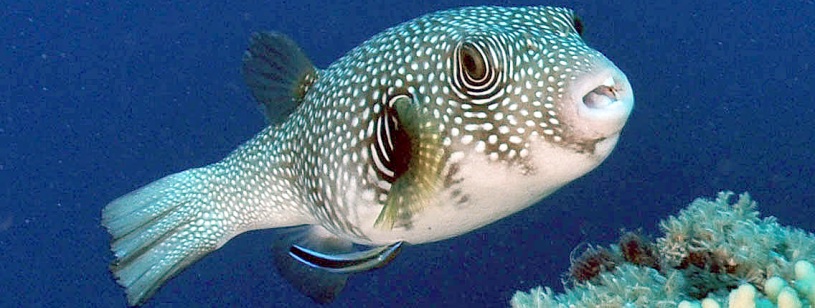
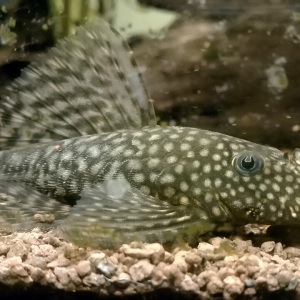
Arothron hispidus, a pufferfish with pale spots and rings around the pectoral-fin base. · Albert kok / CC BY-SA 3.0 (https://creativecommons.org/licenses/by-sa/3.0). Cropped and resized.
Pufferfish are known for rapidly enlarging their bodies when threatened. Here the name refers to Tetraodontidae, a family containing many marine and freshwater species. The photograph shows Arothron hispidus from the Indo-Pacific. Inflation is only one adaptation: fused teeth, varied diets and diverse reproductive behaviour are equally important parts of their lives.
Quick facts
| Common name | Pufferfish |
| Scientific name | Tetraodontidae — a family with many species |
| Diet | Varies by species; invertebrates, algae and other foods |
| Conservation status | Assessed separately for each species |
| Distribution | Mainly tropical and subtropical regions |
| Habitat | Marine, brackish or freshwater, depending on species |
| Length | Highly variable; Arothron hispidus can reach approximately 51 cm |
| Family | Tetraodontidae |
| Reproduction | Egg laying; behaviour varies by species |
| Defence | Inflation by swallowing water into an expandable stomach |
| Teeth | Four main dental plates, two in each jaw |
- Primary category:Fish
- Explore this animal's categories:
Interesting facts
- Underwater inflation uses swallowed water rather than a manufactured gas.
- Fused teeth form strong, beak-like plates.
- The family includes freshwater species.
- Only particular species build circular sand nests.
Characteristics
Pufferfishes vary in shape, but many have rounded bodies and relatively small mouths. Prominent eyes and manoeuvring fins help them explore close to the substrate.
In Arothron hispidus, pale body spots and rings around the pectoral-fin base are characteristic, rather than universal family markings. Teeth fuse into four main plates, two above and two below. The family name Tetraodontidae refers to this dentition, which helps process food.
Behaviour
When threatened, the fish can swallow water into an expandable stomach, increasing body volume and becoming harder for a predator to grasp or swallow.
Inflation is not play. Research on Canthigaster valentini found that preparing for and achieving this response takes effort, with physiological recovery afterwards. The fish continues breathing through its gills. Repeatedly provoking inflation for photographs disrupts a defence mechanism; normal swimming and feeding are better observed without interference.
Habitat and distribution
The family occurs mainly in tropical and subtropical regions. Many species are marine, while others inhabit brackish or freshwater environments.
Arothron hispidus uses Indo-Pacific habitats ranging from estuaries to coral reefs. Other species have very different requirements and ranges. The common name alone therefore does not specify suitable water conditions. Marine species cannot be treated like freshwater fishes, making precise identification important.
Diet and feeding
Diets vary by species. Many eat invertebrates, while some also consume algae and other reef foods. Dental plates help scrape or crush food.
Arothron hispidus eats foods including algae, sponges, molluscs, starfish and other invertebrates. That menu and its proportions should not be assigned to every pufferfish. Feeding illustrates the relationship between mouth structure and available resources: an apparently slow body can still explore surfaces carefully and exploit diverse foods.
Reproduction and life cycle
Pufferfishes lay eggs, but spawning sites and care differ between species. Some behaviours are especially specialised.
A male Torquigener albomaculosus constructs an elaborate circular sand structure around two metres across. Females spawn in the nest and the male guards the eggs until hatching. This example describes that species, not the photographed Arothron hispidus or the whole family. Species distinctions are essential when comparing adaptations.
Name and history
The common name describes the inflated body. Everyday usage sometimes includes relatives in Diodontidae, the porcupinefishes with conspicuous long spines.
Tetraodontidae and Diodontidae are separate families, and the photograph here shows a member of the former. In Japan, certain species are associated with fugu dishes. That cultural use does not mean an accidentally caught fish can be identified or prepared safely at home.
Conservation and threats
Conservation risk varies by species. Protecting reefs, estuaries and rivers supports different members of the family according to their habitat needs.
Many species can contain highly dangerous toxins, including tetrodotoxin. Concentrations and distribution among organs vary, so appearance and common names cannot establish food safety. Wild pufferfish should remain in the water and be observed without provocation. There is no need to inflate, capture or touch them to appreciate their adaptations.
Frequently asked questions
Does it inflate with air underwater?
In water, it inflates by swallowing water into its expandable stomach.
Do all pufferfish live in the sea?
No. The family also includes brackish and freshwater species.
Do all of them make sand circles?
No. Circular nests are known in particular species, such as Torquigener albomaculosus.
Should we make one inflate for a photo?
No. Inflation is a demanding defence response and should not be provoked.