European hareInteresting facts and information
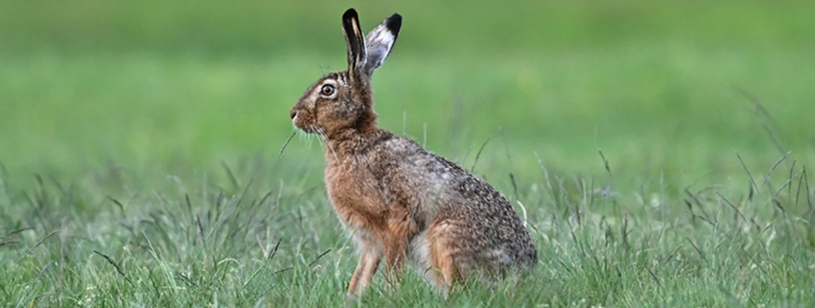
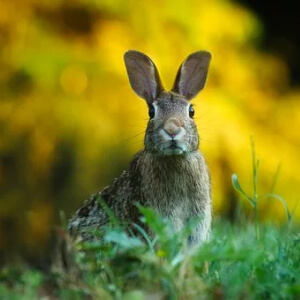
The European hare (Lepus europaeus) is a plant-eating mammal of open country. Unlike a rabbit that uses an underground warren, it usually rests in a shallow hollow on the ground called a form.
It is a mostly solitary animal, active mainly at dusk and at night. Unlike the European rabbit (Oryctolagus cuniculus), it does not dig tunnels, and its young are born furred and with their eyes open.
Hares rely on speed, sharp senses and camouflage to survive, and their digestive system is adapted to get the most out of tough plant food.
Quick facts
| Common name | European hare (brown hare) |
| Scientific name | Lepus europaeus |
| Typical lifespan | Usually a few years in the wild; up to about 12 years |
| Maximum speed | Up to about 70 km/h in short bursts |
| Length | About 48-70 cm |
| Length of tail | About 7-11 cm |
| Weight | About 3-6 kg |
| Diet type | Herbivore (grasses, herbs, crops, twigs, bark) |
| Main predators | Foxes, birds of prey, lynxes, wolves, wildcats, humans |
| Conservation status | Least Concern (IUCN); declining in parts of Western Europe |
| Distribution | Europe and western Asia; introduced to Britain, the Americas, Australia and New Zealand |
| Living environment | Grassland, farmland, steppes, forest edges |
Interesting facts
- A fast runner - The European hare can reach about 70 km/h in short bursts and can change direction suddenly to escape predators.
- Sharp senses - Its long ears and eyes set on the sides of the head help it spot danger early.
- Eating its own droppings - Like rabbits, hares eat special soft droppings to digest their food a second time and absorb more nutrients.
- Bigger females - Female hares are usually slightly larger than males.
- Many young - In a good year, a female can have three or four litters of leverets.
Records and remarkable features
- The European hare (Lepus europaeus) is a plant-eating mammal of open country. Unlike a rabbit that uses an underground warren, it usually rests in a shallow hollow on the ground called a form.
Physical characteristics and adaptations
The European hare (Lepus europaeus) is well adapted to life in open country, with features that give it speed, agility and camouflage.
Key physical adaptations
- A long, slim body - Built for fast running.
- Long, powerful hind legs - Allow long leaps and fast acceleration, essential for escaping predators.
- Long ears (about 9-11 cm) with black tips - Help it hear faint sounds and also help it lose heat.
- Brown fur - Yellowish-brown or greyish-brown with a white belly, it blends into fields and meadows.
- Eyes on the sides of the head - Give an almost all-round field of view.
- Teeth that keep growing - Its incisors grow all the time and are worn down by tough plants and bark.
- A short tail - Black on top and white underneath; it is clearly visible when the hare runs away.
Habits and behaviour
The European hare is a mostly solitary, alert animal that relies on speed and camouflage to survive.
Daily life
- It does not dig burrows; it rests in a "form", a shallow hollow in grass or soil.
- It is most active at dusk and at night, but in spring it is often seen by day.
- It relies on running rather than fighting, and does not defend a fixed territory.
Social interactions
- "Boxing" - In spring, hares stand on their hind legs and hit each other with their front paws; this is often a female fending off a male that is pursuing her too closely.
- Quiet communication - Hares are usually silent but may thump their feet or make grunts; a captured hare can scream loudly.
- Gatherings - Several hares may gather in the same field, especially in the breeding season.
Defence techniques
- Zigzag running - It suddenly changes direction to confuse predators.
- Keeping still - When danger is near, it presses itself flat in its form and stays still to avoid being seen.
- Long leaps - When escaping, it can cover several metres in a single bound.
Habitat and geographic distribution
The European hare is an adaptable species that lives in grassland, farmland, forest edges and steppes.
Regional distribution
| Region | Population information |
|---|---|
| Central and Western Europe | Widespread, but declining in many areas because of intensive agriculture |
| Eastern Europe and the Balkans | Large populations; widely hunted as game |
| Western Asia and the Middle East | Lives in drier steppes and farmland |
| Introduced populations | Brought by people to Britain, Ireland, South America, Australia, New Zealand and North America |
Habitat types
- Grassland and steppe - It prefers open land, where it can see predators coming.
- Farmland - It is often found in fields of cereals and other crops, especially where there are field edges and hedges.
- Forest edges - It uses the edges of woods and small woodlands for shelter.
- Mountains - In the Alps it can be found up to about 2,000 m or higher.
Climate and habitat change
- Intensive agriculture - Large fields, few hedges, pesticides and machinery reduce food and shelter and kill leverets.
- Weather - Cold, wet weather in spring can kill many young leverets.
- Predators - In some areas, foxes take many leverets, which slows the recovery of hare populations.
Diet and feeding
The European hare is a herbivore with a digestive system adapted to fibrous plants, including grasses, herbs, crops and bark.
What does the European hare eat?
| Food group | Examples and context |
|---|---|
| Grasses and herbs | Grasses, clover, dandelion and other wild plants |
| Crops | Winter wheat, other cereals, sugar beet, rapeseed |
| Tree bark | Willow, poplar, fruit trees (especially in winter) |
| Buds and twigs | Young shoots of shrubs and trees |
| Fruits and seeds | Fallen apples, berries, seeds |
Digestive adaptations
- Fermentation in the gut - Bacteria in a large caecum help break down plant fibre.
- Caecotrophy - It eats special soft droppings (caecotrophs) straight from the body, to absorb vitamins and nutrients made during fermentation.
- Little need to drink - It gets most of the water it needs from plants and dew.
Reproduction and life cycle
The European hare breeds quickly, which helps it keep its populations going despite many predators.
Breeding season
- It usually lasts from about January-February to September-October, depending on the climate.
- Males chase females, and several males may follow the same female.
- Females can mate with several males.
- A female can even become pregnant again shortly before giving birth to her current litter.
Gestation and birth
| Characteristic | Details |
|---|---|
| Gestation | About 41-42 days |
| Number of leverets per birth | 1-5 leverets (usually 2-4) |
| Weight at birth | About 100-130 g |
| Nursing period | About 4 weeks |
Raising young
- Leverets are born fully furred and with their eyes open, unlike rabbit kits, which are born blind and naked in a burrow.
- They are left alone during the day, and the mother returns only once a day, around dusk, to nurse them.
- After about 2-3 weeks they begin to eat plants, and at about a month old they are independent.
Survival
- Leverets are very vulnerable, and many die in their first months.
- Many wild hares live only a few years; the oldest known wild hares reached about 12 years.
Name and history
Origin of the name
- The English word "hare" comes from Old English hara.
- The scientific name Lepus europaeus means "European hare": lepus is the Latin word for hare.
- Young hares are called leverets, from an old French word related to lièvre, "hare".
Taxonomic classification
| Classification | Name |
|---|---|
| Kingdom | Animalia |
| Phylum | Chordata |
| Class | Mammalia |
| Order | Lagomorpha |
| Family | Leporidae |
| Genus | Lepus |
| Species | Lepus europaeus |
Evolution and fossils
- Hares and rabbits are lagomorphs, not rodents; their closest relatives are the pikas.
- Hares of the genus Lepus appeared a few million years ago and spread across much of the world.
- After the last ice age, the European hare spread across Europe as forests were cleared and farmland expanded.
Cultural significance and mythology
The hare has appeared in the myths, art and traditions of many peoples, often linked with the moon, spring and fertility.
The hare in myths and legends
- The Easter Hare - The German tradition of the Easter Hare (Osterhase), which brings eggs, was first recorded in the 17th century and later became the Easter Bunny.
- Ancient Britain - The Roman historian Cassius Dio wrote that Queen Boudica released a hare before a battle to foretell its outcome.
- The moon - In China, Japan and other parts of Asia, people see a hare or rabbit in the markings of the moon.
- The three hares - A circle of three hares sharing their ears appears in Buddhist cave art in China and in medieval churches in Europe.
- Folk tales - In Romanian and other European folk tales, the hare is often shown as a fearful but very fast animal.
The hare in symbolism
- Fertility and spring - Because it breeds quickly, the hare is a symbol of fertility and new life.
- Speed - The hare is a classic symbol of speed, as in Aesop's fable "The Tortoise and the Hare".
- "Mad as a March hare" - This English saying comes from the hares' lively chasing and boxing in spring.
Conservation status and threats
The European hare is not globally threatened, but its numbers have fallen in many parts of Europe since the 1960s, mainly because of changes in farming.
Conservation status
| Region | Assessment scope | Trends |
|---|---|---|
| Global | Least Concern (IUCN) | Declining in parts of its range |
| Eastern Europe and Central Asia | Common in many areas | Broadly stable |
| Some Western European countries | Listed as threatened on national red lists, for example in Germany and Switzerland | Declining because of intensive agriculture |
Main pressures
- Intensive agriculture - Large fields, fewer hedges and wild plants, and the use of pesticides reduce food and shelter.
- Farm machinery - Mowing and harvesting kill many leverets hiding in fields.
- Hunting - In some countries, hunting can add to declines if it is not well managed.
- Diseases - European brown hare syndrome (EBHS) and other diseases can kill many hares.
- Predators and roads - Foxes take many leverets, and many hares are killed on roads.
Protection measures
- Wildlife-friendly farming - Field margins, hedges and fallow strips give hares food and cover.
- Hunting regulation - In many European countries, hunting seasons and quotas protect hare populations.
- Safer mowing - Mowing fields from the centre outwards gives leverets a chance to escape.
- Monitoring - Regular counts help follow the trends in hare numbers.
In popular culture
Film and animation
- "A Wild Hare" (1940) - The Warner Bros. cartoon in which Bugs Bunny first appeared in his classic form; many Bugs Bunny titles play on the word "hare".
- "The Tortoise and the Hare" (Disney, 1935) - An Oscar-winning cartoon based on Aesop's fable.
Books and literature
- "Alice's Adventures in Wonderland" (Lewis Carroll, 1865) - The March Hare hosts the famous "mad tea party".
- "Guess How Much I Love You" (Sam McBratney, 1994) - A children's book about Little Nutbrown Hare and Big Nutbrown Hare.
- "Masquerade" (Kit Williams, 1979) - A picture book that hid clues to a real golden hare buried in England.
- "The Hare with Amber Eyes" (Edmund de Waal, 2010) - A family history named after a small Japanese carving of a hare.
Art
- "Young Hare" (1502) - A famous watercolour by the German artist Albrecht Dürer.
- The hare is a popular subject in wildlife painting and sculpture.
Mascots and symbols
- Easter traditions - The Easter Hare and Easter Bunny are among the most popular symbols of Easter.
- Speed - The hare is often used in logos and as a symbol of speed.