SwallowInteresting facts and information
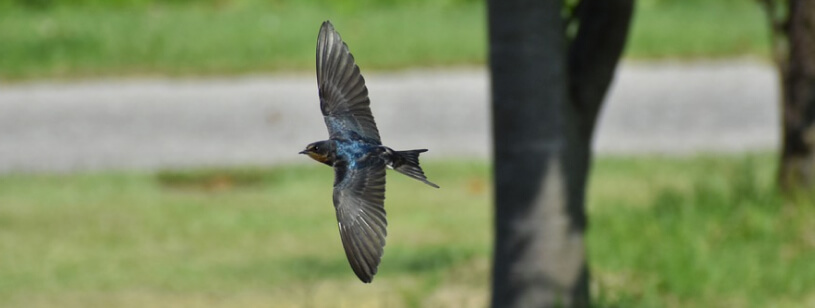
Swallows are birds in the family Hirundinidae, adapted to catching insects in flight. The barn swallow (Hirundo rustica) is one familiar species, with a forked tail and close associations with farms and other human buildings.
Many swallow populations migrate between breeding and wintering grounds. Changes to habitats and insect food supplies can affect their numbers, with trends differing between species and regions.
Quick facts
| Common name | Swallow |
| Scientific name | Hirundinidae; Hirundo rustica is the barn swallow |
| Typical lifespan | Usually 2-5 years in the wild; some live more than 10 years |
| Maximum speed | About 35-55 km/h in normal flight |
| Wingspan | About 32–35 cm for the barn swallow; varies across other swallow species |
| Length | About 15-20 cm (including tail streamers) |
| Weight | About 16-25 g |
| Diet type | Insectivore (flies, mosquitoes, flying ants and other flying insects) |
| Main predators | Hobbies and other falcons, hawks, owls, domestic cats, rats, snakes |
| Conservation status | Assess separately by species and population; different taxa and regions have different needs |
| Geographical distribution | Every continent except Antarctica |
| Habitat | Farms, villages, grasslands, wetlands |
| Social behaviour | Nests in pairs or small colonies; migrates in large flocks |
| Special adaptations | Agile flight, long-distance migration, nesting on buildings |
Interesting facts
- Long-distance travellers - Barn swallows from Europe fly about 10,000 km to spend the winter in southern Africa, and come back every spring.
- Mud nests - A pair builds its cup-shaped nest from hundreds of little beakfuls of mud mixed with saliva, lined with grass and feathers.
- Drinking on the wing - Swallows catch almost all their food in the air and even drink by skimming the surface of the water.
- Insect hunters - A family of swallows can catch thousands of flies, mosquitoes and other insects a day.
- Faithful to home - Swallows often return to the same building, and even the same nest, year after year.
- Long tails win - Female barn swallows prefer males with long, symmetrical tail streamers, a sign of good health.
- "One swallow does not make a summer" - This saying comes from the ancient Greek writer Aristotle, because the first swallows of spring do not mean that warm weather has arrived.
Records and remarkable features
- Swallows are birds in the family Hirundinidae, adapted to catching insects in flight. The barn swallow (Hirundo rustica) is one familiar species, with a forked tail and close associations with farms and other human buildings.
- The most widespread swallow - The barn swallow breeds across most of the Northern Hemisphere and winters across the Southern Hemisphere.
- National bird - The barn swallow is the national bird of Estonia and Austria.
- Huge roosts - Before and during migration, millions of swallows may gather to roost in reedbeds.
Characteristics
The swallow is a small, slender and very agile bird, one of the best adapted birds for fast, twisting flight.
Physical aspect
- Slim, streamlined body - Built for fast, agile flight.
- Long, pointed wings - Allow gliding and sudden changes of direction in the air.
- Deeply forked tail - In the barn swallow, the outer tail feathers form long "streamers" that help with steering.
- A tiny beak with a wide gape - Ideal for catching insects in flight.
- Small, weak legs - Good for perching, but not for walking.
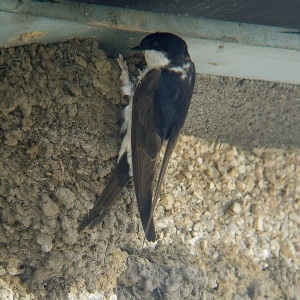
- Colours - The barn swallow has a glossy dark blue back, a reddish forehead and throat and a cream or pale orange belly.
Special adaptations
- Sharp eyesight - Lets them spot and follow small, fast-flying insects.
- Endurance - They can fly thousands of kilometres on migration, feeding on the way.
- Efficient flight - Swallows use gliding and rising air to save energy.
- Living with people - They nest in barns, stables, porches and under bridges.
Habits and behaviour
Swallows are social, migratory and very active birds that spend most of the day flying.
Social behaviour
- Pairs and colonies - Barn swallows nest in pairs, often several pairs in the same barn, and gather in large flocks before migration.
- Territory - Each pair defends a small area around its nest.
- Helpers - Sometimes young birds from an earlier brood help their parents feed the next brood.
Hunting and feeding techniques
- Feeding in flight - Swallows catch insects in the air, often flying low over fields and water.
- Open areas - They hunt over meadows, pastures, rivers and lakes, where insects are plentiful.
- Drinking in flight - They skim the water's surface and scoop up a sip without landing.
Defence and Survival Techniques
- Speed and agility - Swallows escape predators with fast flight and sudden turns.
- Alarm calls - When they see a predator, they give sharp alarm calls and may dive at cats and birds of prey.
- Safe nests - Nests inside buildings are hard for predators to reach.
Habitat and geographic distribution
Swallows and martins live on every continent except Antarctica.
| Region | Example species | Habitat Preferred |
|---|---|---|
| Europe | Barn swallow (Hirundo rustica rustica) | Farms, villages, meadows |
| North America | Barn swallow (Hirundo rustica erythrogaster), tree swallow, cliff swallow | Open country, farms, rivers |
| Asia | Barn swallow (Hirundo rustica gutturalis) | Farmland, villages, towns |
| Africa | Wintering barn swallows; many resident swallows, such as the wire-tailed swallow | Savannas, grasslands, rivers |
| Australia | Welcome swallow (Hirundo neoxena) | Open country, coasts, towns |
Types of Habitat
- Farms and villages - Barn swallows nest in barns, stables, sheds and under bridges.
- Grasslands and pastures - Rich in insects, especially near livestock.
- Wetlands - Rivers, lakes and marshes provide insects, mud for nests and reedbeds for roosting.
Human Impact and Threats
- Pesticides - Fewer insects mean less food for swallows.
- Fewer nest sites - Modern buildings and closed barns leave fewer places to build nests.
- Climate change - Droughts in Africa and changes in weather can make migration harder.
Diet and feeding
The swallow is an insectivore that catches its prey in flight, helping to control insect numbers.
What does the swallow eat?
| Type of food | Examples |
|---|---|
| Flies | House flies, horseflies, mosquitoes, midges |
| Other flying insects | Flying ants, aphids, small beetles, moths |
| Bees and wasps | Occasionally caught in flight |
| Spiders | Small spiders drifting through the air |
| Grit | Tiny bits of sand or shell, which may help digestion |
Feeding techniques
- Catching insects in the air - Swallows snap up insects with their wide-gaped beak while flying.
- Flying for hours - On warm days, swallows spend most of the day hunting.
- Following the weather - On fine days, insects fly higher and so do swallows; before rain, insects fly low, and swallows hunt close to the ground.
- Feeding chicks - Parents bring balls of insects to their chicks, many times an hour.
Adaptation to Food Availability
- In summer, there are plenty of insects for swallows and their chicks.
- When it gets colder and insects become scarce, they migrate to warmer regions.
- In bad weather, they often hunt low over water, where insects are still active.
Reproduction and life cycle
Barn swallows are mostly monogamous; pairs often stay together for the season and sometimes meet again the next year.
| Characteristic | Details |
|---|---|
| Age of sexual maturity | About 1 year |
| Breeding season | About April - August in Europe |
| Number of eggs per nest | Usually 4-5 (3-7) |
| Incubation period | About 14-16 days |
| Time in the nest | About 18-23 days; fed by parents for another week or so |
| Broods per year | Usually 2 (sometimes 3) |
| Life expectancy | Usually about 2-5 years; some live more than 10 years |
Breeding process
- Males sing and display their tail streamers to attract a female.
- Both partners build the nest from mud and grass, usually on a beam or ledge inside a building.
- The female incubates the eggs, and the male guards the nest.
- Both parents feed the chicks, which stay in the nest until they can fly, and keep feeding them for a while afterwards.
- Swallows defend their nest by diving and calling at predators.
Survival Strategies
- If a nest is destroyed, the pair can quickly build a new one.
- Young swallows soon learn to fly and catch insects.
- Sometimes older offspring help feed younger brothers and sisters, increasing their chances of survival.
Name and history
The swallow has been known since ancient times and has a special place in mythology, literature and symbolism.
Origin and etymology of the name
- The English word "swallow" comes from Old English swealwe, an old Germanic name for the bird.
- The scientific name Hirundo rustica comes from Latin: hirundo means "swallow" and rustica means "of the countryside", referring to its life on farms.
Swallow in the History of Humanity
- Ancient Egypt - In one myth, the goddess Isis turned into a swallow while searching for her husband Osiris.
- Ancient Greece - In Greek myth, Procne was turned into a swallow to escape her husband, King Tereus of Thrace; Aristotle wrote that "one swallow does not make a spring".
- The Middle Ages - Before migration was understood, many people believed that swallows spent the winter asleep in the mud at the bottom of ponds.
- Modern science - Ringing swallows has helped scientists understand bird migration.
Swallow in Folklore and Superstition
- Good luck - In many countries, a swallow nesting on a house is believed to bring good luck and protection.
- The bird of spring - The return of the swallows is a traditional sign that spring has arrived.
- Sailors' tattoos - Sailors traditionally got a swallow tattoo after sailing 5,000 nautical miles, and a second after 10,000.
Cultural significance and mythology
As a bird that returns every spring, the swallow is a symbol of hope, home, faithfulness and the coming of spring in many cultures.
- Returning home - Because swallows return to the same nest, they became a symbol of coming home safely, especially for sailors.
- San Juan Capistrano - In California, the return of cliff swallows to the old mission every March is celebrated with a festival.
- A bird of freedom - In folklore, the swallow is often called a bird of freedom, because it was said to die if kept in a cage.
Conservation status and threats
The barn swallow is not threatened, but its numbers have fallen in some regions, and some other swallow species are rare.
| IUCN Status | Species Affected | Affected Regions |
|---|---|---|
| Least Concern (LC) | Barn swallow (Hirundo rustica) | Global |
| Vulnerable (VU) | Blue swallow (Hirundo atrocaerulea) | Southern and eastern Africa |
| Endangered (EN) | White-tailed swallow (Hirundo megaensis) | Southern Ethiopia |
| Endangered (EN) | Bahama swallow (Tachycineta cyaneoviridis) | Bahamas |
Main threats
- Fewer insects - Pesticides and intensive farming reduce the swallows' food.
- Loss of nest sites - Modern buildings and the closing of barns leave fewer places to nest.
- Climate change - Droughts and storms on migration routes can kill many swallows.
- Habitat loss - Wetlands and pastures are being replaced by towns and intensive farmland.
- Predators - Domestic cats and birds of prey, such as the hobby, a small falcon, catch many swallows.
Conservation efforts
- Fewer pesticides - Some countries have reduced the use of chemicals that kill insects.
- Nest sites - People leave barn doors open, put up nest cups and keep muddy puddles for nest building.
- Monitoring - Researchers follow swallows with ringing and tiny tracking devices to study their migration.
- Education - Campaigns ask people not to remove swallow nests from their buildings.
In popular culture
- "The Happy Prince" (Oscar Wilde, 1888) - A swallow stays behind in winter to help a statue give its treasures to the poor.
- "Thumbelina" (Hans Christian Andersen, 1835) - A swallow rescued by Thumbelina carries her away to a warm land.
- Swallows and Amazons (Arthur Ransome, 1930) - A classic children's adventure book named after the children's sailing boat, the Swallow.
- Tattoos - The swallow is one of the most popular traditional tattoo designs.