White storkInteresting facts and information
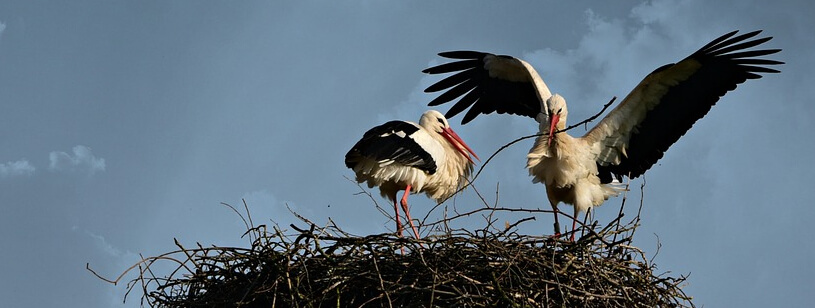
The white stork (Ciconia ciconia) is a large bird with mainly white plumage, black flight feathers, long legs and a long red bill. It is familiar around open country and settlements in parts of Europe, Africa and western Asia.
Many white storks make long seasonal migrations, while some populations now remain near reliable food supplies throughout the year. Large nests are built on trees, poles, roofs and other structures.
Habitat changes, dangerous power lines and other human activities affect storks. Population trends differ by region; a familiar appearance around people does not remove these threats.
Quick facts
| Common name | White stork |
| Scientific name | Ciconia ciconia |
| Typical lifespan | Often 8-10 years in the wild; some live more than 30 years |
| Height | About 100-115 cm |
| Length | About 100-115 cm |
| Weight | About 2.5-4.5 kg |
| Wingspan | About 155-215 cm |
| Diet type | Carnivorous (insects, amphibians, rodents, fish, worms) |
| Main predators | Adults have few; martens, crows and other birds may take eggs and chicks |
| Conservation status | Least Concern globally; local protection and population trends differ |
| Distribution | Breeds in Europe, North Africa and West Asia; winters mainly in Africa |
| Living environment | Wet meadows, grasslands, farmland and villages |
- Primary category:Birds
- Explore this animal's categories:Animals of AfricaAnimals of AsiaAnimals of EuropeAnimals of RomaniaAnimals of Romania’s grasslands and plainsAnimals of the Danube DeltaBirdsBirds of RomaniaBlack-and-white animalsCarnivoresEgg-laying animalsFeathered animalsFlying animalsInsect-eating animalsMigratory animalsMigratory birdsPredatory animals of RomaniaProtected animals of RomaniaVertebratesWWaterbirdsWetland animals
Interesting facts
- Folklore – The story that storks bring babies is a European folk tale, made famous by writers such as Hans Christian Andersen; it has nothing to do with real human reproduction.
- Clever route-planners - Storks avoid long sea crossings and high mountains, so most fly around the Mediterranean, through Gibraltar in the west or the Bosphorus in the east.
- Faithful to the nest - A stork usually returns to the same nest year after year, adding new material every season.
- Gliding on warm air - Storks soar on rising warm air currents (thermals), which lets them travel huge distances while saving energy.
- Social travellers - Although they nest alone or in loose colonies, storks migrate in large flocks, sometimes thousands of birds.
- Almost silent - Adult storks have almost no voice; instead, they loudly clatter their bills.
Records and remarkable features
- Long migrations - Storks from central Europe can fly more than 10,000 km to spend the winter in southern Africa.
- Large nests – Nests grow as material is added over the years; old nests can be about 2 m across and weigh hundreds of kilograms.
- The largest population - Poland has the largest white stork population in the world, with about 50,000 breeding pairs.
- Longevity – Ringing records show that some wild white storks have lived for more than 30 years.
- A famous arrow - In 1822, a stork with an African spear stuck through its neck was found in Germany, one of the first proofs that birds migrate to Africa.
Physical characteristics and adaptations
The white stork (Ciconia ciconia) is a large, elegant bird, well adapted to life in open, often wet countryside.
Key physical adaptations
- Long legs - Let it walk easily through wet meadows and shallow water.
- A long, pointed bill - Ideal for catching insects, frogs, rodents and other small animals.
- Mainly white plumage - With black flight feathers on the wings.
- Long, broad wings - Perfect for soaring and gliding during migration.
- The neck stretched out in flight - Unlike herons and egrets, which fold their necks, storks fly with the neck held straight out.
What does the white stork look like?
| Characteristic | Details |
|---|---|
| Colour | White, with black flight feathers on the wings |
| Length | About 100-115 cm |
| Weight | About 2.5-4.5 kg |
| Wingspan | About 155-215 cm |
| Legs and bill | Red in adults (blackish in young birds) |
| Neck | Long and held straight in flight |
Habits and behaviour
White storks spend most of their day looking for food and looking after their nest.
Daily life
- Active by day - Storks hunt in daylight and rest on their nests or in trees at night.
- High nests - They build nests on roofs, chimneys, poles and tall trees, often in villages.
- A migratory bird - Most European storks fly to Africa in late summer and return in spring.
- Soaring flight - They use thermals to gain height and then glide long distances.
- Pairs - Pairs usually stay together for the breeding season and often meet again at the same nest the next year, though not always for life.
Specific behaviors
- Bill clattering - Partners greet each other by throwing back their heads and rapidly clattering their bills.
- Nest building - Storks add sticks, grass, earth and even rubbish to their nest every year.
- Feeding the chicks - Parents regurgitate food onto the nest floor for the chicks.
Survival strategies
- Living near people - Storks thrive in farmland and villages as well as in wild wetlands.
- High nests - Nesting high up protects eggs and chicks from most ground predators.
- Flying in flocks - Travelling in large flocks helps them find thermals and good feeding places.
Habitat and geographic distribution
The white stork breeds in Europe, North Africa and western Asia, and spends the winter mainly in Africa south of the Sahara, with some birds wintering in South Asia.
Distribution context
| Region | Population information | Habitat examples |
|---|---|---|
| Central and Eastern Europe | The largest breeding populations, especially in Poland, Ukraine and Belarus | Fields, meadows, villages |
| Iberian Peninsula and France | Large and growing; many Spanish and Portuguese storks now stay all winter | Grasslands, rice fields, landfills |
| North and sub-Saharan Africa | Breeding in North Africa; huge numbers winter south of the Sahara | Savannas, grasslands, farmland |
| Middle East | Important migration route; hundreds of thousands pass through Israel | Farmland and wetlands |
| Central Asia | A smaller eastern population | River valleys, farmland |
Habitat types
- Open fields and grasslands - Places where it can easily catch insects, frogs and rodents.
- Farmland - It likes meadows, pastures and rice fields, which are rich in prey.
- Wetlands - Many storks feed in river valleys, deltas and around lakes, where there are plenty of frogs and fish.
- Villages and towns - Storks live happily near people and nest on roofs, chimneys and poles.
Environmental change
- Draining wetlands removes important feeding areas.
- Power lines cause many deaths by collision and electrocution.
- Milder winters and food from landfills mean that more storks now stay in Europe in winter, especially in Spain and Portugal.
- Intensive farming and pesticides reduce the insects and frogs that storks eat.
Diet and feeding
The white stork is an opportunistic carnivore that eats many kinds of small animals, depending on what is available. It feeds in wet meadows, grasslands and fields, catching prey with its long bill.
What does the white stork eat?
| Food group | Examples |
|---|---|
| Amphibians | Frogs, toads, newts |
| Reptiles | Lizards, small snakes |
| Insects | Grasshoppers, locusts, crickets, beetles |
| Small fish | Freshwater fish from ponds and rivers |
| Small mammals | Voles, mice, moles |
| Other prey | Earthworms, chicks and eggs of ground-nesting birds |
Feeding methods
- Walking and searching - It walks slowly through grass or shallow water, scanning the ground and striking quickly.
- Waiting - Sometimes it stands still and waits for prey to come close.
- Following farm machines - Storks often follow tractors and mowers to catch animals disturbed by them.
- Swallowing whole - It usually swallows its prey whole.
Impact of human activities on food
- Pesticides and intensive farming reduce the number of insects and frogs.
- Straightening rivers and draining marshes destroy traditional feeding areas.
- Rubbish dumps - Some storks, especially in Spain and Portugal, feed at landfills all year round.
Reproduction and life cycle
White storks usually pair for the breeding season, and many pairs meet again at the same nest each spring. Their nests are reused and enlarged year after year, sometimes becoming huge.
Breeding season
- Breeding begins in spring (March-April), after the birds return from migration.
- The male usually arrives at the nest first and greets the female with loud bill clattering.
- The pair repairs and enlarges the nest with sticks, grass and soft material.
- The female lays about 3-5 eggs, and both parents incubate them for about 33-34 days.
Raising young
| Stage | Duration | Characteristics |
|---|---|---|
| Hatching | After about 33-34 days | Chicks are covered with white down |
| Intensive feeding | First weeks | Both parents bring food and regurgitate it for the chicks |
| Learning to fly | About 8-9 weeks | Chicks exercise their wings and make their first flights |
| Independence | About 1-3 weeks after first flight | Young storks become independent and soon set off on migration |
Factors affecting reproductive success
- Food availability – Dry periods and low prey availability can reduce chick survival.
- Rain and cold - Long periods of cold rain can chill and kill young chicks.
- Predators and competition - Martens, crows and other birds may take eggs or small chicks, and storks sometimes fight over nests.
- People - Nests on buildings and poles are sometimes removed, but many people also put up nesting platforms for storks.
Name and history
Origin of the name
- The English word "stork" comes from Old English storc, a word shared with other Germanic languages; it may be related to "stark", meaning stiff, perhaps describing the bird's upright posture.
- Scientific name – Ciconia ciconia comes from the Latin word “ciconia”, meaning stork.
Taxonomic classification
| Classification | Name |
|---|---|
| Kingdom | Animalia |
| Phylum | Chordata |
| Class | Aves |
| Order | Ciconiiformes |
| Family | Ciconiidae |
| Genus | Ciconia |
| Species | Ciconia ciconia |
Evolution and fossils
- The stork family is old: fossil storks are known from about 30 million years ago.
- Fossils of the genus Ciconia are known from the Miocene, more than 5 million years ago.
- Today there are about 19 species of storks around the world.
Cultural significance and mythology
The white stork has long been a symbol of luck, new life, spring and family in Europe and beyond.
White stork in myths and symbolism
- Stories about babies – In European folklore, storks bring babies to families; the story became famous through Hans Christian Andersen's tale "The Storks" (1838).
- Bringers of luck - In many countries, a stork nest on a house is believed to bring good luck and protect it from fire.
- The first stork of spring - In Bulgaria, people tie their red-and-white martenitsa bracelets on a tree after seeing the first stork of spring.
- National bird - The white stork is the national bird of Lithuania and Belarus, and a symbol of Alsace in France.
Conservation status and threats
The white stork is listed as Least Concern by the IUCN. After declining in many parts of Western Europe in the 20th century, it has recovered strongly in recent decades.
Main pressures
- Wetland loss - Draining marshes and changing farmland reduce the stork's feeding areas.
- Electrocution and collisions - Power lines and poles kill many storks.
- Pesticides - Farm chemicals reduce the insects and frogs storks eat.
- Climate change - Changes in rainfall in Africa and Europe affect food and migration.
- Hunting on migration - Some storks are still shot along migration routes.
Protection efforts
| Measure | Organization / Action |
|---|---|
| Protection of wetlands | Projects to restore marshes and wet meadows in Europe |
| Nesting platforms | Conservation groups and electricity companies put up safe platforms and insulate dangerous poles |
| Migration tracking | Researchers follow storks with GPS tags; one Swiss stork, Max, was tracked for 13 years |
| Reintroduction | Programmes in Switzerland, Alsace and the Netherlands brought storks back after they almost disappeared |
Current population
- There are roughly 700,000 adult white storks in the world, and numbers have increased in many countries.
- The largest populations are in Poland, Spain, Ukraine and Belarus.
- Stork migration is one of the best-studied bird migrations, thanks to ringing and GPS tracking.
White stork in popular culture
The white stork is a symbol recognised around the world and appears in books, films, cartoons and emblems.
White stork as symbol
- Babies - The stork carrying a baby in a bundle is a common image on birth cards, in advertising and on children's products.
- Dumbo (1941) - In Disney's film, a stork delivers baby Dumbo to his mother.
- Storks (2016) - An animated film about storks that used to deliver babies and now deliver parcels.